
By Calista Stocker, Times of San Diego, a member of the San Diego Online News Association
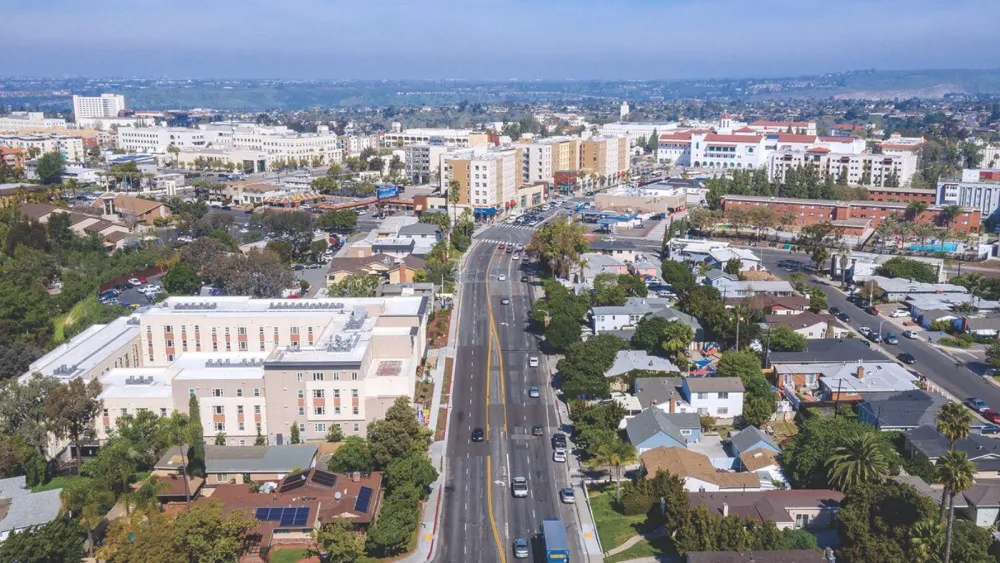
Photo: an aerial view of the College Area. Photo courtesy of the city.
November 25, 2025 (San Diego) – San Diego is set to update the College Area’s blueprint for future development, and San Diego State University’s enrollment forecasts are driving city planners’ push to allow lots of new housing in the area.
The city council could approve the new College Area Community Plan next month. If passed, it would make way for as much as a 322% increase in homes in the area over the next 30 years.
That would be enough to spike the population by 277%, from 19,690 to 74,170, if all of the envisioned development plays out — although planners stress that the area’s student population makes those numbers tricky to estimate.
Like many other neighborhoods as the city has pursued regulatory reforms to increase homebuilding, College Area residents have also raised concerns of density-induced inconveniences and inadequate public services over the plan update.
Some of the potential housing and population increase is leftover growth from the last approved blueprint in 1989 — and that unmet capacity is itself a reminder that the limits of the plan might never play out.
But a planning department representative said the rest of the increase is necessary due to the university’s enrollment expectations — especially among an increasingly non-commuter student body — and the area’s transit accessibility.
For the first time, SDSU’s fall enrollment at its San Diego campus exceeded 40,000 — a 4.5% increase from last year. While future enrollment targets have not yet been released, California State University currently requires all its campuses to reach 1% enrollment growth each year, with higher targets for SDSU.
“When we have enrollment being increased at the levels year-over-year at San Diego State, which the city doesn’t control, [the] city has to mitigate those housing impacts to the best of their ability, which is by creating density in these corridors,” said Planning Commission Chair Kelly Modén at an October meeting. “Or we’re just going to see more and more of these single-family homes taken over by students and disrupting people’s lives.”
In response, though, residents stress the College Area’s already-inadequate public facilities. It has just one park, one shared library with minimal parking, no recreation center and no fire station — despite last year’s Montezuma Fire and a large majority of the neighborhood sitting in a “Very High Fire Hazard Severity Zone.”
The city’s plan has identified opportunities to fulfill recreational needs — though even those would only satisfy 13% of what the area’s projected population would require, based on the city’s system for determining need. Additional public space could be built by private developers through another new city policy.
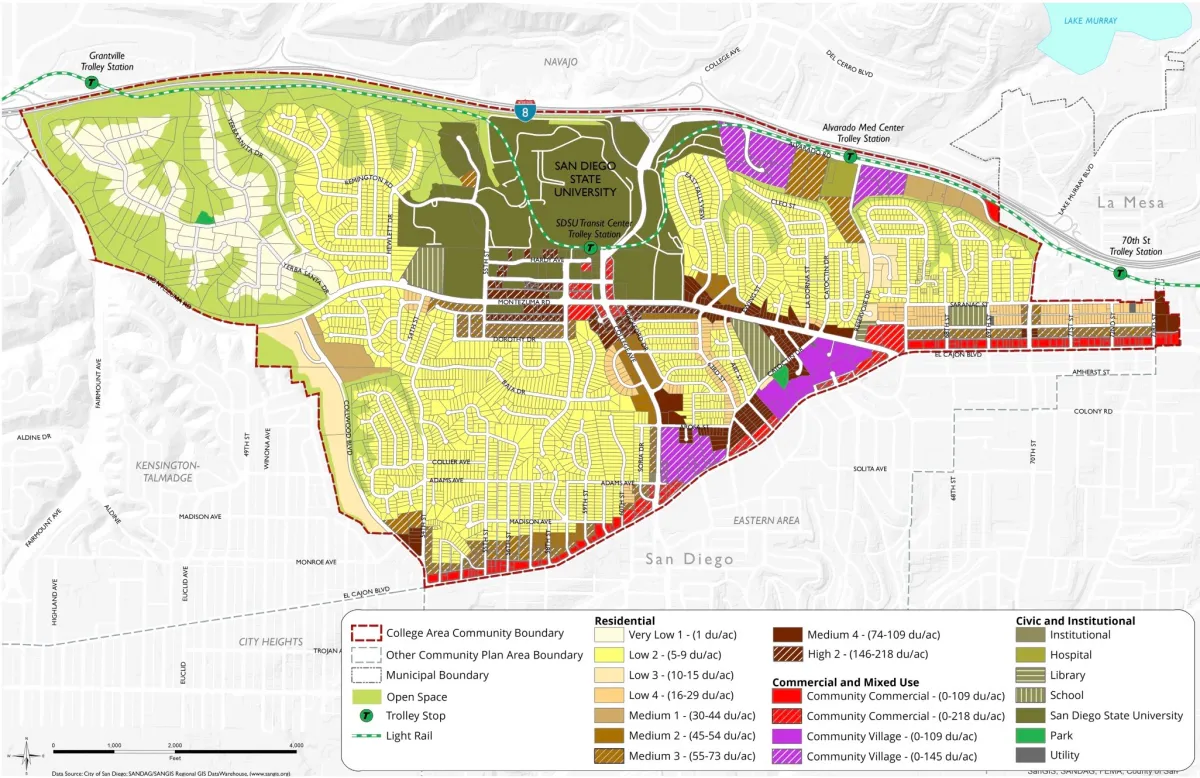 Photo, right: proposed land use map for College Area. (Photo courtesy of the City of San Diego)
“It’s really important to [Elo-Rivera] that recreation is provided in all his neighborhoods. And College Area is one of the communities that is lacking, sorely lacking, on park space,” said Jefferey Nguyen, College Area community representative and policy advisor to Councilmember Sean Elo-Rivera. “And with this plan, my hope is that it could be a rallying point for our office and the community together to push for that need.”
However, critics point to a lack of firm requirements for new infrastructure in the plan, and its reliance on developers to fix those issues while delivering the new housing density.
“What the plan has is a hope and a prayer for community services,” said Julie Hamilton, president of the College Area Community Council, or CACC.
While city planners developed the proposed growth outline, CACC wrote its own alternative. Their “7-Visions Report” instead pitched a 137% housing increase, a 112% population increase, mixed-use development at major corridors, creation of a “campus town” and preservation of single-family neighborhoods.
City planners included a discussion of the community’s proposal in their final plan.
“We take all that in to kind of create a fuller picture of how we want to develop the area,” Nguyen said. “It’s not a singular group, but it’s a combination and collaboration of all the different needs and wants in the community. And as far as I’m aware, they are part of those conversations.”
While the planning department met and collaborated with the CACC, community members and SDSU during development, not all felt heard.
“I think that they had a preconceived notion of the amount of density they wanted to get out of the plan, and they knew and accepted that it would be extremely expensive and difficult to get us the park space that we need, to get us the fire station that we need,” Hamilton said.
Hamilton said increasing development along major corridors like Montezuma Road and El Cajon Boulevard makes sense, but she opposes upzoning planned for Cresita Drive, north of Mohawk Street and on 63rd Street — which does not have contiguous sidewalks. That upzoning could also make way for even larger projects, because it would be qualify for the city’s new incentive program to promote denser and affordable housing near transit.
“One of the things that we asked for, is don’t put density in that location,” Hamilton said. “Put it on El Cajon [Blvd], put it on Montezuma [Road] and put it at the corners, but don’t put it right up next to the single-family homes, because the only thing they have is their backyard. They don’t have any parks.”
Hamilton also feels for the families in the area who have to drive to access recreational services and for the students who have minimal activities within walking distance.
The city’s plan would adopt zoning for mixed-use developments on major corridors, create a “Campus Town Center” concept and implement pedestrian-oriented “Complete Streets” to encourage community, walkability and economic opportunity.
Nguyen said El Cajon Boulevard and the eastern College Area are burgeoning business districts, and new development there will encourage walking to those shops and restaurants. He said that would get cars off the road, while buffered bike lanes and sidewalks would increase road safety for everyone.
“There’s this … practice of short-distance driving,” Nguyen said. “… With mixed-use development, we can incentivize and also make the area more walkable just by the mere fact that it’s mixed-use. The areas become more walkable. We take more cars off the streets.”
While Hamilton does not agree that traffic will be mitigated by these measures, she is excited for the chance to dispel the misconception that the single-family residents dislike the students.
“How many other communities do you go to where you see this many people walking around the streets … For me, that’s the fabulous part of this community — that plus all the kids like my Corgi,” Hamilton said. “I think that there is a very, very tiny percentage of people that resent the students. And there is a very small percentage of people that have to daily deal with the parties happening in their neighborhood that can make it dangerous.”