
 By Karen Pearlman
April 16, 2026 (La Mesa) — La Mesa is the latest city in San Diego County seeking to codify strict regulations on electric bicycles, specifically looking to protect riders under 12.
On Tuesday, the La Mesa City Council unanimously voted to establish a new e-bike safety pilot program as part of Assembly Bill 2234, which passed in 2024 and looks to put the brakes on reckless riding.
AB 2234, the San Diego Electric Bicycle Safety Pilot Program, allows local authorities in the county to pass ordinances prohibiting children under 12 from operating Class 1 or 2 electric bicycles.
The program went into effect in 2025 and runs until January 1, 2029, with a focus on enhancing safety through local regulations.
Other cities in the county cracking down on e-bike enforcement include Santee, Poway, San Marcos, Carlsbad, Coronado and Chula Vista.
The La Mesa ordinance follows months of growing public concern over high-speed near misses involving juvenile riders and creates a legal framework that targets the age of the operator rather than just the speed of the bike.
The local push began in earnest following the passage of AB 2234, which authorized cities specifically within the county to experiment with local regulations that exceed standard California Vehicle Code provisions.
While the state has been slow to regulate the growing e-bike industry, AB 2234 opened a window of local authority that expires on Jan. 1, 2029.
La Mesa City Councilmember Genevieve Suzuki, who initiated the local item in late January, argued that the city could no longer wait for a “one-size-fits-all” solution from the state capital.
La Mesa’s plans
The pilot program introduces strict age-based tiers for e-bike operation within La Mesa city limits:
- Class 1 and 2 E-Bikes: Children under the age of 12 are strictly prohibited from operating these bikes, which can reach speeds of 20 miles per hour;
- Class 3 E-Bikes: More powerful, the bikes are prohibited for anyone under the age of 16.
Additionally, all riders must comply with existing state helmet laws.
To support the transition, the city is coordinating with local schools, nonprofits and the San Diego County Bicycle Coalition to develop educational materials.
For the first 60 days of the program, La Mesa Police will issue only warnings to violators. Once that grace period expires, violations will be processed as infractions carrying a $25 fine — the maximum allowed under current state law.
However, La Mesa officials said that fine can be entirely waived if the violator completes a city-approved e-bike safety training program within 120 days of the citation.
The ordinance also includes provisions for the removal and seizure of e-bikes in cases of extreme reckless operation or repeated violations.
Suzuki continues to be vocal about safety issues around e-bikes. “We cannot go over 10 to 15 miles per hour around our townhouse community,” she said. “Twenty mph as a 12-year-old? I have a 10 year old who’s almost 11 he has no business going anywhere near anything faster than 5 mph, and so I while I understand we want to give our kids the the opportunity to have a good time this is a safety issue.”
A closer look at e-bikes
The U.S. e-bikes market is divided into Class 1, Class 2 and Class 3. The Class 1 segment dominated the market, accounting for around 61 percent in 2025 and is expected to grow at a Compound Annual Growth Rate of more than 6 percent from 2026 to 2035.
The U.S. e-bike market was valued at approximately $2 billion in 2025 and is projected to reach $4.3 billion by 2035. California is the largest e-bike market in the United States.
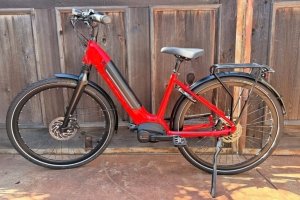
While an e-bike typically looks like a standard bicycle with a thicker frame, legal distinctions are based on how the motor provides power:
Class 1 bikes, often called “pedal-assist,” allows a motor to kick in while the rider is pedaling and stops assisting once the bike hits 20 miles per hour.
Class 2 bikes feature a throttle. A rider can move at 20 mph without moving their legs at all. Because of this “moped-style” functionality, they have become immensely popular among middle-school students.
Class 3 bikes are pedal-assist only like Class 1, but the motor continues to help the rider reach a top speed of 28 mph. Because of this significantly higher speed, they are legally treated more like motor vehicles, requiring riders to be at least 16 years old and wear a specific type of helmet