
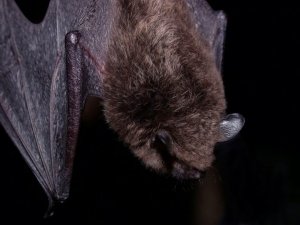
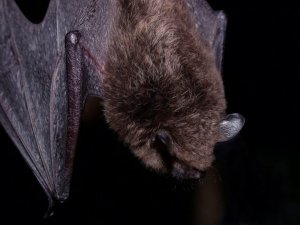
 Officials seeking potential contacts, photo courtesy County of San Diego
East County News Service
March 28, 2026 (Escondido) — San Diego County public health officials are seeking anyone who may have come into direct physical contact with two wild bats found in separate Escondido locations last weekend.
Both animals have since tested positive for rabies, marking the fourth and fifth confirmed cases of rabid bats in the county this year.
The first infected bat was discovered at about 4 p.m. on Saturday, March 21, in a grassy area near the White Oak Villas condo complex. The animal was retrieved by the San Diego Humane Society for testing.
The second bat was located the following morning, just after 10 a.m., found clinging to a rock wall outside the Okavango Restaurant at the San Diego Zoo Safari Park.
Park officials were quick to clarify that the bat was a wild animal and not part of any park exhibit.
Visitors who observed the bat from a distance but did not touch it are not considered at risk.
The County Public Health Laboratory confirmed the rabies diagnosis for both bats earlier this week, county official said.
“Human rabies is almost always fatal without prompt post‑exposure vaccination and treatment,” said Dr. Sayone Thihalilopavan, County Public Health Officer. “Rabies can be transmitted through a bite or when an infected bat’s saliva enters a cut, scrape, or the eyes, nose, or mouth.”
County officials said that if you or someone you know was in the vicinity of White Oak Villas or the Safari Park and had direct contact with a bat, call County Public Health Services immediately at (619) 692-8499..
More on bats
While these recent cases highlight a public health risk, officials emphasize that bats are a vital part of our environment.
Understanding the local bat population and the reality of rabies can help residents stay safe while coexisting with these nocturnal mammals.
San Diego County is a biodiversity hotspot for bats, serving as home to 22 to 23 different species. The most frequently seen species include the Mexican free-tailed bat, the Big Brown bat, and the Yuma myotis. A single bat can consume up to 1,000 mosquito-sized insects in just one hour, providing an invaluable natural service in controlling pests that carry other diseases like West Nile Virus.
Rabies remains rare in humans within the United States, but bats are currently the primary source of the virus domestically. In California, bats account for more than 62 percent of all rabid animals detected annually.
The state’s most recent human case occurred in 2024, involving a Fresno County resident exposed in Merced County.
According to the Centers for Disease Control and Prevention, bats are responsible for roughly 7 in 10 rabies deaths among humans in the U.S. This is often because bat bites can be so small they go unnoticed, or people attempt to handle “sick” bats without realizing the danger.
It is a common misconception that all bats have rabies. In reality, less than 1% of the general bat population is infected.
Beyond public health, bats are critical to the economy.
A study published in Science estimates that bats save the U.S. agricultural industry between $3.7 billion and $53 billion annually by reducing the need for chemical pesticides. In addition to eating crop-destroying beetles and moths, some local species act as essential pollinators for native desert plants.
Safety reminders offered by the CDC include never touching a bat as healthy bats do not typically allow humans to get close to them. A bat found on the ground or active during the day is likely ill or injured.
If contact occurs, immediately wash the area with soap and water and call a healthcare provider.
Ensure your dogs and cats are up to date on their rabies vaccinations, as they are often the “middlemen” in wildlife-to-human transmission.
For more information regarding local rabies testing and statistics, please visit the County of San Diego’s Rabies Dashboard.