
East County Eater: Fresheria, a new La Mesa eatery, offers delicious healthy foods

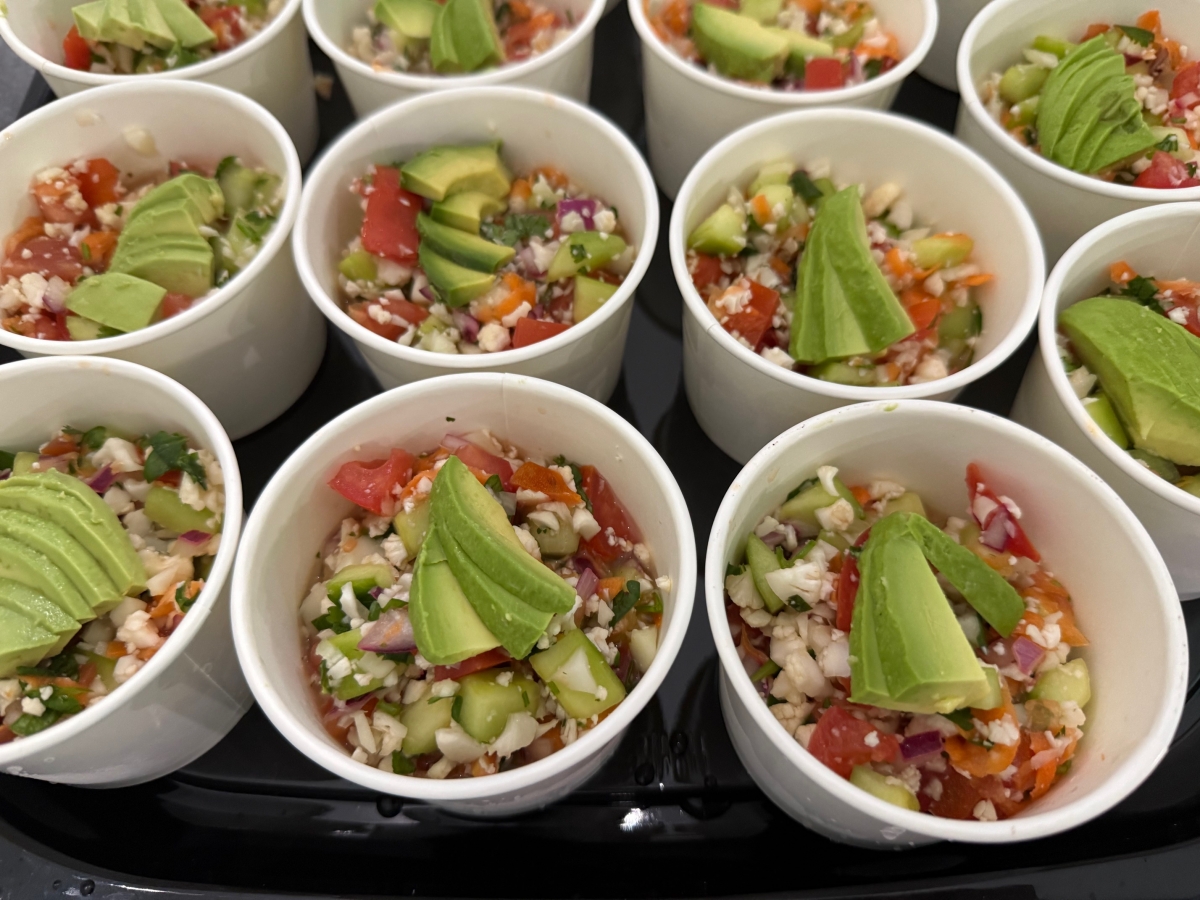
By Miriam Raftery Photo: cauliflower ceviche November 16, 2026 (La Mesa) – If you’re looking to eat healthy and savor a wide array of delicious options, you’ll want to stop by and savor the many tasty offerings at Fresheria, located at 5575 Baltimore Drive, La Mesa. They’re open seven days a week from 7 a.m. to 9 p.m. serving up delectable breakfast, lunch and dinner dishes with the aptly chosen motto, “balanced tasty food.” At an open house Nov. 6 hosted by the La Mesa Chamber of Commerce, owner Salomon Espinoza, his wife and staff served up samples of several dishes. The cauliflower ceviche was amazing-you’d never guess it’s a vegetarian dish. It was packed with flavorful ingredients including lemon juice, cilantro, avocado,carrots, cucumber, tomato, onions and cauliflower., Next came tortas in freshly made Birote rolls (right). “The secret is the bread,” Espinoza said. Tortas included a spicy pork in chipotle sauce and another with chicken. We also tasted a delightful watermelon beverage at the open house, where the Chamber held a ribbon cutting ceremony to welcome Fresheria to La Mesa. My husband and I returned a few days later to take home two additional dishes, both wonderful. The apple salad was filled with generous portions of apples, oranges, strawberries, avocado, tomato, pecans and chicken in a spring salad mix topped with balsamic dressing. We also enjoyed a wonderful fruit salad that included apples, bananas, cantelope, mango, pineapple, strawberry and watermelon with choice of toppings; we opted for Greek yogurt, fresh coconut, raisins and honey. Mmmm! The restaurant has a broad menu that includes breakfast options (omelets, oatmeal, avocado almond toast , breakfast bowls, pancakes and more), as well as sandwiches, salads, tortas, wraps, sinchronizadas, fruit dishes, tostadas, soups, energy bowls, smoothies, agua frescas, and many other tempting choices. Fresheria is a local chain, with the La Mesa location as the flagship store. The restaurant is offering 10% discounts to police, firefighters and paramedics in uniform to thank them for their service. Visit their website here: https://www.lafresheria.com/ View menu: https://lafresheria.appfront.app/order/branchName=Fresheria%20La%20Mesa&search=/
Less water, more problems – California, six states miss key Colorado River deadline

By Rachel Becker, CalMatters Photo: Drought-stricken Lake Mead on the Colorado River in August 2022. (File photo by Christopher Clark/U.S. Bureau of Reclamation) This story was originally published by CalMatters. Sign up for their newsletters. November 16, 2025 (San Diego) – After two fraught years of negotiations amid dire projections for the Colorado River’s reservoirs, California and six other states that rely on the river’s water have yet again failed to reach a deal — despite a federal deadline. “While more work needs to be done, collective progress has been made that warrants continued efforts to define and approve details for a finalized agreement,” the states said. The written statement released Tuesday included no details about how they plan to manage the river after the current rulebook expires at the end of next year. Officials at the U.S. Bureau of Reclamation, the federal stewards for the river under the Department of the Interior, have threatened to impose their own plan in the absence of a deal. “Two years. And the lack of progress, in light of how perilous the conditions are on the Colorado — it’s unacceptable,” said Mark Gold, former director of Water Scarcity Solutions at the Natural Resources Defense Council and a board member of the Southern California water import giant, the Metropolitan Water District. The federal government frequently sets deadlines on the Colorado River, but it almost never enforces them. Negotiations now continue in advance of another deadline, in February, for a seven-state deal. Scott Cameron, acting head of the Bureau of Reclamation, said in June that the goal is to “parachute” the states’ agreement into the ongoing federal planning process, in time to finalize a plan by May or June next year. Yet the states remain deadlocked even as the agreements that currently govern the river near expiration. Elizabeth Koebele, a political science professor at the University of Nevada, Reno, suspects that relationships between the states have become too fractured, and water too scarce, for deadlines to effectively motivate them. “We have less water, and it’s caused more rippling problems,” Koebele told CalMatters. “You’re cutting a smaller pie, for more people.” Federal pressure or state collaboration? A major conflict has been over how much each basin must cut back their use of the overtapped river to close the ever-growing gap between dwindling supply and ravenous demand. California, Arizona and Nevada in the lower basin offered in March 2024 to cut their use by up to 1.5 million acre-feet of water per year, depending on reservoir conditions. They urged Colorado, Wyoming, Utah and New Mexico upstream to share any belt-tightening beyond that, but the upstream states balked — saying that their water users must already conserve water when dry conditions shrink the river’s flows. Becky Mitchell, Colorado’s Upper Colorado River Commissioner, said that the states “remain committed to collaboration grounded in the best available science and respect for all Colorado River water users. We are taking a meaningful step toward long-term sustainability and demonstrating a shared determination to find supply-driven solutions.” But Arizona Governor Katie Hobbs has pressed the Trump administration to be more forceful in state negotiations. In a letter Tuesday to Trump’s Interior Secretary Doug Burgum, Hobbs and Arizona legislative leaders called the upstream states’ negotiating position “extreme.” “We find it alarming that the Upper Basin States have repeatedly refused to implement any volume of binding, verifiable water supply reductions,” the letter said. Experts say there’s no time to waste; even the time it takes to develop a new plan for the river may be too long for its dwindling reservoirs. The Colorado River basin is suffering a climate change-fueled megadrought, and the basin’s major reservoirs, Lake Powell and Lake Mead, are each less than one-third full. California’s Colorado River use is on track this year to hit its lowest since 1949. Still, projections show another dry winter may yet send Lake Powell plunging below the levels needed to generate power by December 2026. The problem is that even when it rains or snows, runoff is disappearing into thirsty soils before it reaches the river. The paltry runoff keeps driving up estimates of the conservation required to stabilize the basin and its reservoirs. Jack Schmidt, director of the Center for Colorado River Studies at Utah State University, and others have urged more urgent conservation in order to protect operations at the dams and ensure that water can be released from Lake Mead and Lake Powell. “We continue to drag our heels on not implementing additional cuts right now. That’s our fear: if it doesn’t snow this winter, we’ll really compromise the system,” Schmidt said. “We might get bailed out by a more decent winter, but that’s betting on a whole lot of hope.”
“Bolder Than Most” rapist back in state hospital for alleged parole violation

East County News Service Photo: Alvin Ray Quarles. (File photo courtesy of California Department of Corrections) November 15, 2025 (Borrego Springs) — Alvin Ray Quarles, a sexually violent sex offender who had been temporarily placed in a Borrego Springs home, has been arrested on an alleged parole violation. In Superior Court on Friday, Quarles, 63, pleaded not guilty to the parole violation, which was not disclosed. Quarles waived his right to have a hearing to contest the charge, however, and asked to be transferred back to Coalinga State Hospital, where he previously underwent treatment. He is slated to next appear in court on January 23 regarding the alleged violation. Quarles pleaded guilty in 1989 to four counts of forcible rape for a series of sex assaults at knifepoint that began in 1985. In some cases, he broke into homes or motel rooms in San Diego communities and forced the victim’s husband or boyfriend to watch; authorities dubbed him the “bolder than most” rapist. He also pleaded guilty to robbery and burglary counts. After serving 25 years in prison, Quarles was civilly committed to the Department of State Hospitals for treatment as a sexually violent predator. He later petitioned for conditional release into a residence with monitoring. Amid outcry from communities and elected officials, several earlier attempts by the state to place Quarles in monitored homes in Jacumba and Campo fell through. Last year, a judge ordered him released as a transient; he was placed in the Borrego Springs site as a temporary measure while the state continued to seek a long-term residence. Senator Brian Jones, who represents much of East County, has been leading efforts to reform the state’s system of placing sexually violent predators in order to protect communities. Following news of Quarles’ recommitment to a state hospital for a parole violation, Jones, the Senator Minority Leader, had this to say. “This keeps happening and will continue until the majority party comes to its senses about the need for sweeping, comprehensive reform to the way our state handles these sexually violent predators. This violent rapist was released to roam free in our community and has failed to demonstrate the basic restraint needed to remain in compliance with his release. “ Jones adds, “Communities like ours cannot continue to be used as dumping grounds for criminals. Our communities deserve better. We will keep advocating to reform California’s broken sexually violent predator release program and continue to fight for the people of California to be protected.”