
SDSU LACROSSE FALLS AT ARIZONA STATE

Printer-friendly versionDeanna Balsama led SDSU with four goals Source: goaztecs.com Photo courtesy goaztecs.com February 25, 2022 (Tempe) – The Aztec lacrosse team (1-3) fell at Arizona State (1-2) 16-6 on Friday. SDSU fell behind 11-2 in the first half and was unable to overcome the big deficit despite improved play in the second half where they tied the Sun Devils in shots. Deanna Balsama once again led the Aztecs in scoring, finishing with four goals. SDSU’s other two goals came from Bailey Brown and Emma Betts, her first goal of the year. ASU’s Kaylon Bucker scored two goals in the first 100 seconds of the game. Balsama started the scoring for the Aztecs when she found the back of the net with 11:19 left in the first quarter, but then ASU scored five unanswered goals and nine of the next 10. The Sun Devils outscored SDSU just 5-4 in the second half The Sun Devils out shot SDSU 21-11 in the first half and 32-22 for the game. The Aztecs were 20-for-27 in clears while ASU was 22-for-23. Maggie Marion had a team-high four ground balls for SDSU, and Cailin Young won three draw controls. Goalkeeper Sam Horan had eight saves. Arizona State had 10 players score and were led by Emily Pinzone’s three scores. STAT OF THE GAME The Aztecs tied the Sun Devils in shots in the second half. THE NOTE Deanna Balsama has led the Aztecs in scoring in every game. UP NEXT The Aztecs play at Oregon Sunday at 12 p.m. Box Printer-friendly version
WORKING FAMILIES ORDINANCE ADOPTED BY SUPERVISORS IN CLOSELY DIVIDED VOTE

Printer-friendly versionBy Miriam Raftery Photo: CC via Bing February 25, 2022 (San Diego) – By a 3-2 vote, San Diego County Supervisors approved a Working Families Ordinance on Feb. 8. The measure requires payment of prevailing wages and use of a skilled, trained workforce on construction projects over $1 million on county lands. It also brings sick leave requirements in line with state standards. A second reading is set for March 1st. if approved then, it will go into effect 30 days later on new contracts or projects up for renewal. The measure as first introduced by Supervisors Terra Lawson-Remer and Chair Nathan Fletcher in July 2021. Nora Vargas joined with them to pass the measure, which was opposed by Supervisors Joel Anderson and Jim Desmond. Fletcher and Lawson-Remer issued a statement after the vote. “Today, the County took action to ensure that public lands yield public benefits. With the passage of the Working Families Ordinance, we voted to guarantee adequate workplace protections in alignment with state policy and regional needs. Today’s action will reduce working poverty and promote economic sustainability for families throughout our region.” Supervisor Anderson issued this statement on his opposition to the measure. “The land near Gillespie airport is surrounded by some of the poorest areas in my district and San Diego County. These people have endured loss of work due to COVID, supply chain difficulties, and now the county’s proposed ordinance. After reading all three economic impact studies, I cannot support this ordinance. I am not willing to sacrifice long-term careers for the sake of short-term jobs.” Anderson’s staff provided a link to a video of Anderson further explaining his vote: https://youtu.be/-dyGk7qoPi8 The staff report indicates staff engaged stakeholders for feedback, reach out to over 882 businesses and community members. The report acknowledges that some are small businesses in disadvantaged communities, adding that “The burden of increased costs due to implementing a wage floor and increased benefit costs, may cause some businesses to close or relocated off County-owned property. This could result in the unintended consequence of employees being laid off, which could potentially have a disproportionate impact on low income and/or black, indigenous people of color (BIPOC). However, if the businesses were able to pay the age floor and associated benefits, this could increase the standard of living for those same low income or BIPOC employees…” Supervisors opted against adopting a wage floor, for now, until more stakeholder input is gathered specifically on that issue, according to Fletcher and Lawson-Remer. Staff reports can be found for the measure, agenda item 17, at https://www.sandiegocounty.gov/content/sdc/cob/bosa/bos-calendar-meetings.html?date=02/08/2022&meetingtype=BOARD%20OF%20SUPERVISORS Printer-friendly version
SANTEE COUNCIL DENIES PERMIT FOR NEW GAS STATION/MINI MART ON PROPERTY TIED TO KALASHO FAMILY

Printer-friendly versionBy Mike Allen File photos: Lina Charry and Ben Kalasho February 25, 2022 (Santee) — Santee apparently has enough gas stations, or at least enough on a stretch of Mission Gorge Road near the confluence of State Routes 125 and 52. At its Feb. 23 meeting, a reduced City Council shot down a proposal to build yet another station under the Arco brand, a car wash and mini-mart on an oddly shaped, less-than-an-acre parcel at 9015 Mission Gorge Road. With two members absent, the vote was 2-1 with Vice Mayor Ronn Hall voting against a motion to deny the project. Mayor John Minto was attending a meeting at the League of California Cities and Councilwoman Laura Koval was working at her day job at the Padre Dam Municipal Water District, said City Clerk Annette Ortiz. The project included granting the applicant, Royal Share LLC, a bunch of variances or exceptions from city requirements covering reduced parking, reduced setbacks (minimum distances from street and other buildings), and traffic flows. Santee’s development staff said the variances were justified because of the parcel’s unusual size and shape. The triangle-shaped parcel is 0.77 acres, where Royal Share already operates a car wash. The parcel abuts an existing gas station/mini mart called Qwik Korner, whose legal name is Lemon Grove Ultra Mart. Owned by the Charry family, the business has a history of litigation against the owner of the triangle parcel, identified by his attorney as Joe Kalasho. If that name rings a bell, do a Google search for Ben Kalasho, the owner’s son, a former El Cajon City Councilman who has a long history of litigation in San Diego courts both as a plaintiff and defendant. The most sensational of his extensive legal conflicts involved some former winners of a beauty contest he and his wife ran several years ago. In 2017 several winners of the Miss Middle East Beauty Pageant alleged they were denied their cash prizes, and that Kalasho and his wife defamed them using social media after pressing their claims. In 2020, Ben Kalasho resigned from the El Cajon Council after he and his wife settled with three of the plaintiffs for $300,000, but not Lina Charry, an attorney who pursued her defamation claim. In their testimony at Wednesday’s public hearing, Charry and her brother, Sam, said their family business has sued Ben Kalasho over the car wash customers “blasting through” their gas station, and “demolishing our property.” If the city of Santee allowed the proposed new gas station, it would hurt not only Quik Korner, but other similar businesses nearby, the Charrys and several other people said at the hearing. Within a mile of the Kalasho business at 9015 Mission Gorge Rd., there are five other gas stations including one across the street at the 7-Eleven, and at least four other convenience stores. Sam Charry also stated his family had an agreement with Arco to build a similar designed complex on their land, but once the pandemic hit, it all was pushed to the side. McNelis said he was an ardent supporter of small businesses and increased competition, especially for gasoline, but there were so many variances needed for this project it gave him heartburn. “Sorry, I don’t see the need for it, and it doesn’t conform to our requirements for parking, doesn’t conform to our requirements for landscaping, which we’re trying to get done so Mission Gorge looks better. I’m not in favor,” he said. Councilman Dustin Trotter seconded the motion. Hall said the project has generated far too many disputes, adding, “It’s a lawsuit waiting to happen.” Despite those remarks, Hall voted against McNelis’ motion to deny the permit. In other actions, the three Councilmembers present approved a design change for an expansion at the Lantern Crest assisted living complex on Magnolia Avenue that increases an earlier permit approval by a net of 12 units. The reduced Council also approved spending about $300,000 for a series of playground features at the public park at the Weston complex across the street from West Hills High School, and spending $621,000 for the street resurfacing of parts of Cuyamaca Street and Woodside Avenue in a contract awarded to SRM Contracting & Paving. A staff estimate for the work came in at $940,000. Printer-friendly version
COVID-19 HAS TURNED DEADLIER FOR BLACK CALIFORNIANS, WHO HAVE THE STATE’S LOWEST VACCINATION RATE
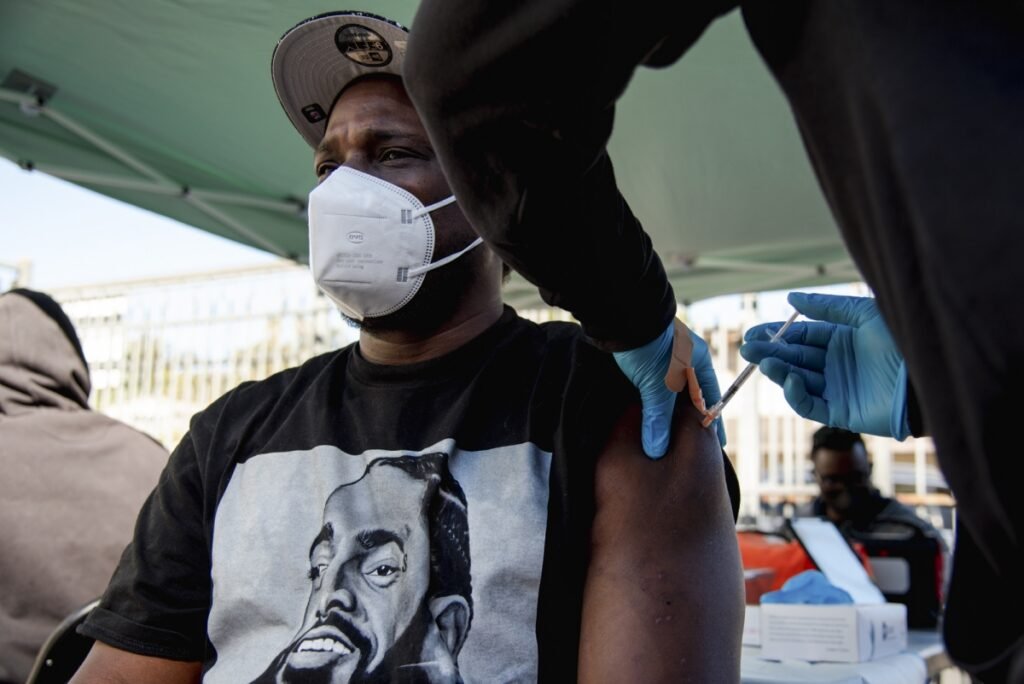
Printer-friendly versionBy Kristen Hwang, CalMatters CalMatters is a public interest journalism venture committed to explaining how California’s state Capitol works and why it matters Photo: George Dowell, 40, receives the COVID-19 vaccine at Umoja Health pop-up clinic in Oakland last week. He waited a year to watch for any side-effects or problems in his vaccinated friends. Photo by Marissa Leshnov for CalMatters February 25, 2022 (San Diego) – Deondray Moore sat in a plastic folding chair, rolled up his sleeve and got his first COVID-19 shot in the parking lot of Center of Hope Community Church in Oakland a week ago. He was the last in his family to get vaccinated after putting it off for more than a year, and only acquiesced because he wants to be in the delivery room when his son is born this summer. “My mom has been trying to get me vaccinated forever, since the (vaccines) came out,” Moore said. “My partner got it quick, and her kids got it as fast as they could. She wasn’t playing around. She was like ‘Don’t miss out on the baby.’” The 35-year-old Oakland native, an African American, knows multiple people who have contracted COVID-19 and died. Moore wears a mask and doesn’t go out much. But he’s suspicious of the vaccine and the way it was developed. “I just don’t trust the government,” he said. African Americans, who have a litany of historical reasons to mistrust public health officials and doctors, have the lowest vaccination rate in the state, at 55%. COVID-19 has become deadlier for Black Californians since the widespread availability of vaccinations, and vaccine hesitancy could be among the reasons why. Other races, which have higher vaccination rates, have seen death rates rise, but not as dramatically. A CalMatters analysis shows since last summer, the rate of Black Californians dying from COVID-19 has increased tenfold — from one death per 100,000 people last July to 10.4 deaths this week. That surpasses Latinos and all races except Pacific Islanders, who are dying at the rate of 14.7 per 100,000, according to state data. And while statewide deaths from COVID have declined in the past week, they have continued to rise for African Americans. So far, 5,544 Black people have died from the virus in California. Dr. Kim Rhoads, an associate professor of epidemiology at University of California, San Francisco, said she isn’t surprised by the growing death rate among African Americans. “Disparities aren’t new. They aren’t new to COVID,” said Rhoads, who helped organize the community clinic where Moore got his shot. For some Black residents, the disparity grew worse after vaccines became widely available last summer, according to a study from UC Santa Cruz and UC San Francisco researchers. Middle-aged Blacks make up a growing, disproportionate share of the Californians who died, while the proportion shrank for Latinos and others: In March 2021, Black people aged 40-64, who make up roughly 5% of all middle-aged Californians, accounted for 6% of COVID-19 deaths in that age group. But a few months later, their numbers skyrocketed, accounting for 21% by last July, according to the study. In contrast, middle-aged Latinos accounted for 66% of all COVID-19 deaths at the beginning of March 2021, but then last July shrank to 30%, mirroring their proportion of all middle-aged Californians. Lead researcher Alicia Riley said preliminary data through November shows continuing disparities. So why did the vaccines apparently help Latinos but not Black Californians? It’s possible that those who are most at risk of dying from the disease aren’t getting vaccinated. Younger African Americans also may not have been included in early vaccination campaigns or may have felt they weren’t at risk of severe illness or death. “What’s puzzling to me is that they have a really different story in terms of who’s dying,” said Riley, a UCSC assistant professor of global and community health. “Are the people who were at risk of dying in the Latino community actually being reached with vaccination, whereas somehow that’s not happening for Black Californians as effectively?” Experts say myriad other factors could also be driving the trend, including poverty, lack of insurance, distrust of the health care system and higher rates of health complications like diabetes or heart disease. The increased share of deaths for Black Californians is a powerful sign of “who was left behind when everyone else was kind of moving on out of the pandemic,” Riley said. The study did not find significant differences for other age groups, although state data suggests Black children fare worse than other races, too. Black children in California are the second most likely to die from the virus among Californians younger than 18, with 1.2 deaths per 100,000 Black children. Pacific Islanders are twice as likely to die from COVID as Black children, while all other races have less than one COVID-19 death per 100,000 children. The drivers for African American deaths are likely deeper than vaccination disparities. Photo, left: Dr. Kim Rhoads has helped set up the Umoja Health pop-up clinic in Oakland to vaccinate Black residents. Photo by Marissa Leshnov for CalMatters Rhoads, who studies death disparities in Black cancer patients, said pre-existing health complications also aren’t entirely to blame. Structural factors like poor quality health care also likely contribute to higher death rates, she said. For instance, medical devices like the pulse oximeter, which is used to determine whether a patient needs supplemental oxygen, don’t work well on dark skin. “If we just say comorbidities, then we’re blaming the victim number one and we’re washing our hands of any responsibility,” Rhoads said. Vaccine campaigns successful for some Substantial gains have been made among Latinos, according to Riley’s study. After bearing the brunt in the early stages, Latinos’ death rate dropped from nearly 25 deaths per 100,000 people in January 2021 to 1 death per 100,000 in July. Over the last