
SLAMMED: LA MESA RESIDENTS AND COUNCILMEMBERS VOICE ANGER, FRUSTRATION OVER SKETCHY REPORT ON OFFICER’S USE OF FORCE AT HELIX HIGH
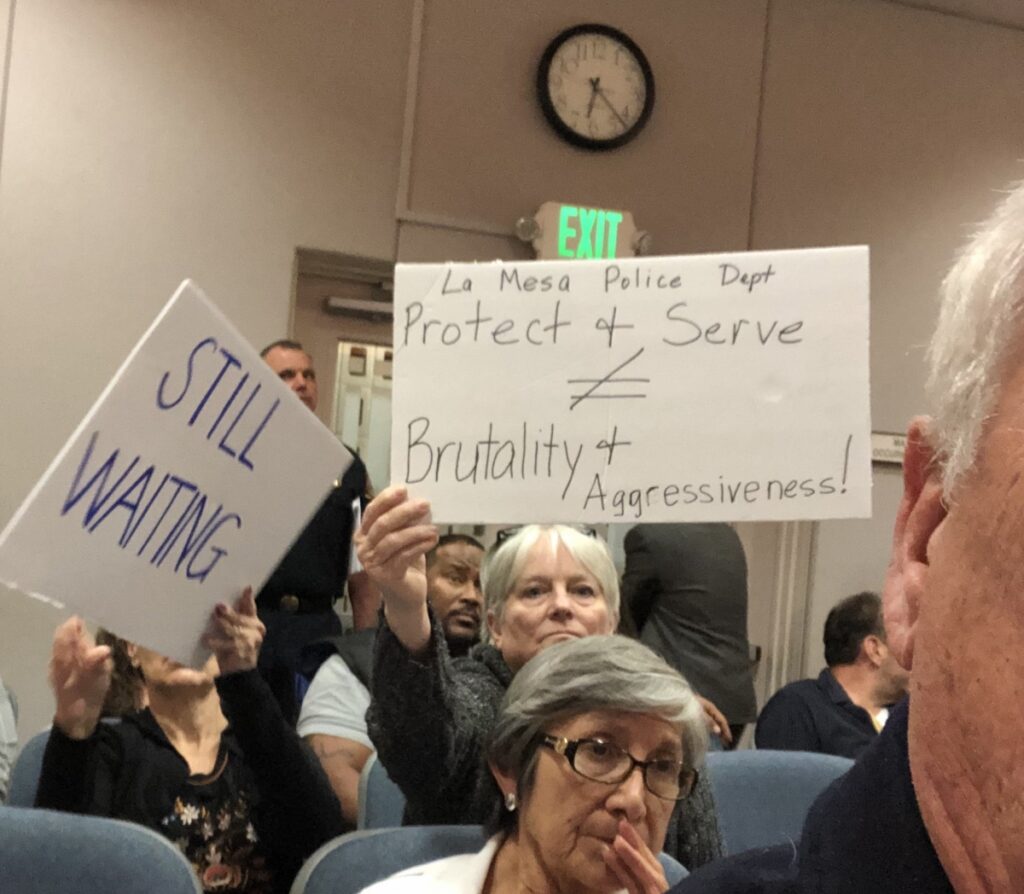
By Miriam Raftery January 9, 2019 (La Mesa) – La Mesa’s Mayor, Councilmembers and members of the public voiced frustration and at times, anger at the outcome of an independent investigation commissioned by the city into use of force by La Mesa police school resource officer Scott Wulfing, who was shown on video knocking a handcuffed female student to the ground at Helix High School in January of last year. Attorney Scott Tiedemann gave the presentation on the report prepared by Barry Aninag of B.A. Investigations, a former Irvine police commander. Aninag reportedly interviewed some 20 witnesses—but the public and council will not be permitted to read the report or statements from any of those interviews, due to confidentiality laws protecting investigations into police misconduct. Those witnesses did not include the student, Brianna Bell, who was knocked down, and who has filed a lawsuit against the city. Nor did the report include any details on what transpired on campus before the take-down show on the video. The report also had zero information on whether any investigation was conducted by the school or the school district, or results of any such inquiries. The report did examine four allegations — and found no wrongdoing on the part of the officer. Tiedemann (photo, lefft) told Council that the report concluded that the officer’s initial and subsequent actions against the student did not violate the La Mesa Police Department’s use of force policy. The report also found that an allegation of racial motivation (the officer is white and the student is African-American). An allegation that the officer lost his temper was also deemed to be unfounded. Mayor Mark Arapostathis, a teacher, (photo, right) pressed Tiedemann on why the student was not interviewed. Tiedmann stated that repeated calls, letters and emails to the student’s mother and attorney were not returned. The Mayor also pushed back on claims on confidentiality of the report given during a public meeting. “Confidential to whom?” he asked, appearing flummoxed when Tiedmann replied that the report will be provided only to the La Mesa Police Chief. Councilwoman Kristine Alessio asked if LMPD’s use of force policy is similar to that of other police departments in the state;Tiedmann stated that it is similar. Councilman Bill Baber asked how the report will tie into the federal lawsuit. The City Attorney replied that the information could be presented in court or become public if the plaintiff is able to obtain the report through a subpoena. Newly elected Councilwoman Akilah Weber, M.D., asked, “Is there information on why the officer felt this was necessary?” Tiedmann fired back that he was prohibited from disclosing this information. Weber then said she would like to hear from LMPD regarding the racism issue. “Is there any cultural sensitivity training?” she asked. Mayor Arapostathis wanted to know, “Was it necessary to call the police department instead of handling this at the school?” adding, “Is the school conducting its own investigation?” Members of the public took to the podium. Yusef Miller (photo, left) with the Council on Islamic Relations and East County Justice Coalition railed, “This is not justice for the community. There needs to be justice for La Mesa.” He called it an “empty report with zero satisfaction” adding, “We’ve come all this way, we sit all this time to hear nothing about this incident…no questions can be answered.” He voiced his view that the officer should be jailed or fine, then rattled off names of African-Americans killed or injured by police across San Diego County, adding, “All this abuse in law enforcement and we come and hear a report of absolutely nothing.” Next up, La Mesa resident Jack Shu told the Council, “There has been a failure of process.” He pointed out that if you ask law enforcement to do an investigation, “you don’t get answers…We should know what happened,” adding that there should be alternatives to force. Shu proposed that the city establish a citizens advisory commission for police “so we don’t have this happen again” with a potentially even more harmful outcome. Aeiramique Meeka, a community activist who has been a spokesperson for the family in the past, praised LMPD Chief Walt Vasquet for being receptive in meetings to suggestions for more trainings. But she told Council, “I’ sorry you wasted y our money on the report,” she said of the study that cost taxpayers $22,089. Then she called for actions to set things right. “Just because something is legal doesn’t make it right,” she said, citing the past legality of slavery as an example. She criticized the Police Bill of Rights for shrouding the investigation in secrecy and faulted Council for not contacting the school about any additional investigation a year after the incident occurred. “I was shaking back there,” she said after the presentation, “because we’ve all seen the video…We see it and you know it was wrong, when a young lady is slammed to the ground twice while she’s in handcuffs, when a grown man slams a young lady to the ground. There is never an excuse for that.” Tasha Williamson told Council she believed the student was significantly injured and that the investigation should be made public. “Today what I heard is that it is acceptable to brutalize a black girl…until you get it right, there will be public unrest,” she warned. “Racism still exists in La Mesa and the city of San Diego…This has to stop.” She said activists plan to “shut down” the city of Sna Diego “and if this should happen again here, it will be different.” The next speaker, a white woman, said she agreed that a Citizens Advisory Council is needed “or better yet, an oversight council” to benefit the entire community. She suggested this could save money and encourage mediation instead of litigation. After public testimony punctuated by signs held by audience members displaying their concerns, the Council shared their views. The Mayor voiced frustration. “We were thinking that this was going to shine a light…We
READER’S EDITORIAL: SUPERVISOR JACOBS’ HYPOCRISY

By Martha Sullivan, San Diego January 9, 2019 (San Diego) — SD County Supervisor Dianne Jacobs voted No yesterday on providing emergency shelter to refugees seeking political asylum. She said we should take care of our own homeless residents first. What a HYPOCRITE — she has consistently refused to do anything meaningful to shelter and care for 9k homeless San Diego County residents, which led to the nation’s worst HepA epidemic in 20 years in 2017. With a $2 billion reserve, The County can do BOTH. It’s about priorities. The opinions in this editorial reflect the views of the author and do not necessarily reflect the views of East County Magazine. To submit an editorial for consideration, contact editor@eastcountymagazine.org.
DEPUTIES SHOOT, KILL ARMED MAN IN LEMON GROVE TACO SHOP

Update January 9, 2019 — The deceased suspect has been identified as Adolfo Gonzalez, 28, of San Diego. The deputies involved in this shooting are Carlos Cenizo, Sean Daly and Casey Dow. All are assigned to the Lemon Grove Sheriff’s Substation. Cenizo has been a deputy since 2014; Daly and Dow have been deputies since 2015. East County News Service January 6, 2019 (Lemon Grove) – Three Sheriff’s deputies opened fire on an armed man inside the Del Taco restaurant at 7060 Broadway in Lemon Grove last night. According to Lieutenant Rich Williams with the Sheriff’s Homicide Unit, a 9-1-1 caller shortly after 8:30 p.m. reported that the suspect had pointed a handgun at the caller and his family in the Del Taco shop. Deputies arrived minutes later and when they tried to talk to the suspect, The man produced a handgun and as a result, a deputy-involved shooting occurred,” Lt. Williams said. “It appears all three of the deputies who contacted the armed suspect fired their handguns in response to the threat.” After the shooting, deputies rendered first aid and called for paramedics. Paramedics took over lifesaving measures and transported the suspect to a local hospital, where despite further lifesaving efforts, he was pronounced dead, Lt. Williams says. No deputies were injured in the altercation. The identities of the suspect and the deputies have not yet been released. The Medical Examiner’s office will conduct an autopsy and notify he deceased’s family. The Sheriff’s Homicide Unit is investigating the shootings. Anyone with information about this incident is asked to call the Sheriff’s Homicide Unit at (858) 285-6330/after hours at (858) 565-5200. You can also remain anonymous by calling Crime Stoppers at (888) 580-8477.
SAN DIEGO BORDER PATROL AGENT SUING FOR WAGES UNPAID SINCE SHUTDOWN BEGAN

By Ken Stone Reprinted with permission from Times of San Diego, a member of the San Diego Online News Association Photo: A Border Patrol agent walks along newly installed concertina wire at Border Field State Park. Photo by Chris Stone January 9, 2019 (San Diego) – Albert Vieira, working as a border officer in San Diego, hasn’t been paid since the partial government shutdown began Dec. 22. Now he’s the named plaintiff in a major lawsuit against the federal government. Lawyers for him and thousands of others are suing the feds for unpaid minimum wage and overtime — plus matching damages. Vieira, represented by the National Treasury Employees Union, is an “excepted employee” being forced to work without pay. The collective action is on behalf of 150,000 employees at 33 federal agencies and departments. Filed Monday in the Washington-based U.S. Court of Federal Claims, the 15-page complaint alleges the administration is violating the Fair Labor Standards Act by requiring federal employees to work without pay. “It is unconscionable that many employees are having to work – and in some cases overtime – with no pay whatsoever,” NTEU President Tony Reardon said in a statement. “These civil servants took an oath to the Constitution and they do not deserve to be treated this way.” According to the complaint, Vieira is normally assigned to Oakland. But on Nov. 25, he was deployed by Customs and Border Protection to San Ysidro and Otay Mesa in a duty set to last until Jan. 13. “The FLSA guarantees, for employees falling within its coverage, the on-time payment of any minimum wage and overtime wages earned,” the suit says. “If those wages are earned, but not paid out, on the employee’s corresponding regularly scheduled payday, the FLSA has been violated.” Vieira has worked six days a week during the “instant shutdown,” and the suit says he is scheduled to be paid wages earned between Dec. 23, 2018, and Jan. 5, 2019, on either Jan. 14 (via electronic deposit) or by Jan. 17 (by paper check). Vieira’s attorneys — led by NTEU general counsel Gregory O’Duden — say that the federal government has previously been held to be liable for liquidated damages stemming from its failure to timely pay FLSA wages to FLSA nonexempt employees during a government shutdown. The lawsuit says Vieira’s overtime pay, as well as matching liquidated damages, may be paid from the Judgment Fund, a permanent appropriation for the payment of judgments and compromises. “It is not subject to the annual appropriations process and it is not implicated by the current shutdown,” his lawyers said. Other agencies represented by the NTEU affected by the lapse in appropriations include the IRS, Commodity Futures Trading Commission, Environmental Protection Agency, Federal Communications Commission, Food and Drug Administration, Federal Election Commission, National Park Service, Patent and Trademark Office, Securities and Exchange Commission and the U.S. Department of Agriculture.
JACUMBA HIKERS AND OMEGAMANIACS HIKE TO BOW WILLOW AND ROCKHOUSE CANYONS LOOP JANUARY 12

East County News Service January 8, 2019 (Jacumba Hot Springs) — Jacumba Hikers are invited to join Omegamaniacs for their next hike Saturday, January 12 – Bow Willow and Rockhouse Canyons Loop. This is a moderate 8 mile (5 hour) hike located northwest of Ocotillo off S-2. Hikers will travel through canyons in the Carrizo Gorge Wilderness with the halfway point an old cattleman’s line shack. Good boots, short or long pants, plenty of water, hat, sunscreen and sunglasses are all most appropriate. The weather is currently expected to be in the low 60’s, perfect for hiking. It is about a 1:15 drive to the trailhead. Meet at the Great Escape – 1147 N Imperial Hwy, Ocotillo, CA 92259 at 9 a.m. The group may be stopping somewhere for refreshments on the way back to San Diego. This is definitely an all day adventure. RSVP Required: Contact Bruce Silva bwaynesilva@gmail.com
SAN DIEGO TROLLEYS: PRESENTATION AND BOOK SIGNING JAN. 19 IN SANTEE

East County News Service January 8, 2019 (Santee) — The Santee Historical Society announces San Diego Trolleys, a presentation and book signing by Douglas W. Mengers on Saturday, January 19 from 11 a.m. to 12:30 p.m. at the Santee Historical Society and Museum, 9200 Magnolia Avenue in Santee. Starting with the first horse-drawn trolleys introduced by the San Diego Streetcar Company in 1886, San Diego’s history includes the growth and decline of several transportation systems. After electricity arrived, San Diego was the site of early experimentation for electric trolleys on the West Coast. Speaker Douglas W. Mengers is a San Diego–based historian and archaeologist specializing in historical archaeology, the history of infrastructure and population growth of Southern California, and the history of the San Diego trolley suburbs. He is a Senior Archaeologist/Historian with environmental consulting firm PanGIS, Inc. and also serves on the Board of Directors of the San Diego County Archaeological Society. “Images of Rail: San Diego Trolleys” will be available for purchase at the event. You can register for your free ticket at https://www.eventbrite.com/e/san-diego-trolleys-presentation-and-book-signing-tickets-54369763426. The museum will be open before and after the event from 10 a.m. to 2 p.m.
SUPERVISORS VOTE TO HELP FIND TEMPORARY SHELTER FOR ASYLUM SEEKERS
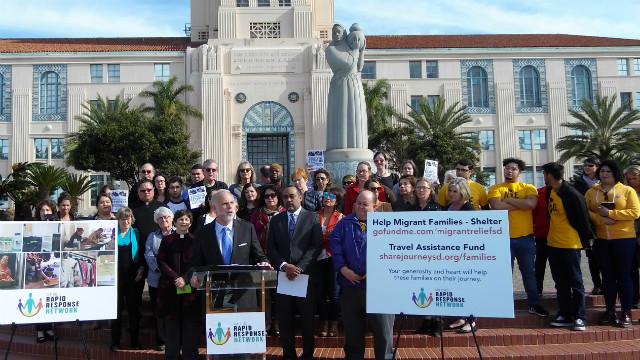
By Chris Jennewein Reprinted with permission from Times of San Diego, a member of the San Diego Online News Association Photo: Jewish Family Service CEO Michael Hopkins speaks to the press after the Board of Supervisors vote. Photo by Chris Jennewein January 8, 2019 (San Diego) – The San Diego County Board of Supervisors voted Tuesday to help a coalition of local nonprofit groups assist asylum seekers by providing temporary shelter on county property. “Now it falls to us to say, as leaders, what can we do? We have the obligation to help,” said newly elected Supervisor Nathan Fletcher at his first board meeting. The supervisors directed staff to locate county-owned property that could be used on temporary basis and established a task force to seek longer term solutions as well as solicit federal and state assistance. Any shelter proposal involving county money would need board approval first, as would any additional costs for support services. Since last fall, Immigration and Customs Enforcement officers have been dropping asylum seekers at bus stations and other public locations with identifying ankle bracelets but no assistance. A coalition of nonprofits led by Jewish Family Service of San Diego, the ACLU Foundation of San Diego & Imperial Counties, SEIU Local 221 and the San Diego Organizing Project have provided temporary shelter and meals to over 4,500 people, primarily women and children. Most of the refugees helped by the ad-hoc San Diego Rapid Response Network are housed for just 24 to 48 hours until travel arrangements can be made. Jewish Family Service CEO Michael Hopkins said he was pleased with the vote and singled out the efforts of Fletcher and Supervisor Greg Cox, but warned that the shelter currently used would not be available after February. “We are so pleased with the vote, but I do have to tell you there’s a long way to go,” Hopkins said at a press conference outside the county administration building. Two supervisors, Daine Jacob and Kristin Gaspar, voted against providing county property on a temporary basis, with Jacob saying the first priority is to house San Diego County’s own homeless population. “Our priority should be to take care of our own first,” Jacob said. “We do have a potential health crisis with the refugee situation, but we also have to press hard on the federal government to fix this.” San Diego has a long history of helping immigrants, from European refugees to Vietnamese boat people and more recently Chaldeans from Iraq. The ACLU’s David Trujillo noted San Diego’s “rich history of being a welcoming place for people looking for asylum” and said the community must continue to help. “Every asylum seeker has the right to humane treatment,” said Trujillo. “This is a leadership moment, and San Diego must provide leadership.”
HOUSEPLANTS 101

By Melinda Myers Photo courtesy Melinda Myers, LLC January 8, 2019 (San Diego) – Lift your spirits and improve your indoor environment by taking part in the indoor gardening movement. An apartment or home filled with tropical, succulent and flowering plants can provide beauty, extend your garden season, improve air quality and create a peaceful environment to de-stress. Though some may find indoor gardening a bit intimidating, don’t let past failures or the thought of tending living greenery stop you from enjoying the many benefits. Knowing some basics in care and making needed adjustments to the growing environment can turn past failures into success. Water, humidity and light are key to growing healthy plants. When you match these to a plant’s needs and the growing media, you’re sure to experience success. Use a container with drainage holes to avoid overwatering that can lead to root rot and plant death. It should be no more than an inch or two larger in diameter than the plant’s root ball. Growing in a larger pot results in the soil staying too wet, increasing the chance of root rot. Select a quality potting mix that holds moisture but drains well. Cacti and succulents prefer a fast-draining mix while tropicals and African violets prefer a mix that stays moist, not soggy, yet drains well. Set your plant in a location that’s free from drafts of hot and cold air, but in the preferred light conditions. An east- or west-facing window usually provides adequate light for most plants. Keep cacti, succulents and other plants requiring high light within two feet of an east- or west-facing window. Pothos, philodendron, Chinese evergreens and those that tolerate low light can be placed near a north-facing window or up to six feet back or off to the side of an east- or west-facing window. Shears, awnings and trees can impact the light reaching your plants. Adjust their location as needed. Always water thoroughly and pour off the excess water that collects in the saucer. Allow the top few inches of soil to dry before watering drought tolerant plants like cactus. Water tropical and flowering plants that prefer moist conditions when the top few inches of soil are barely moist, like a sponge that has been wrung out. Reduce maintenance and improve plant health with gravel trays. Fill a tray or saucer with pebbles. Allow excess water to collect in the tray. The pebbles keep the pot elevated above the water to avoid root rot. As the water evaporates it increases the humidity around the plant. When pest problems occur, consider an organic approach safe for people, pets and plants. Manage fungus gnats, those tiny fruit fly like insects found flitting around the house, with a naturally occurring bacteria, Bacillus thuringiensis israelensis, found in Summit Mosquito Bits (SummitResponsibleSolutions.com). Just sprinkle on the soil surface and repeat as needed until these pests disappear. Mites, aphids, scale and mealybugs can be controlled with an organic horticulture oil like Summit Year-Round Spray Oil. This product coats the pests and kills all stages from egg to adult. Repeat as needed to control any that were missed. Once the pests are managed, check the growing conditions and make needed adjustments to the growing environment. The more plants you grow, the easier it becomes and soon enough you may find yourself immersed in a tropical or desert paradise inside the comfort of your own home. Melinda Myers has written more than 20 gardening books, including Small Space Gardening. She hosts The Great Courses “How to Grow Anything” DVD series and the nationally syndicated Melinda’s Garden Moment TV & radio program. Myers is a columnist and contributing editor for Birds & Blooms magazine and was commissioned by Summit for her expertise to write this article. Myers’s web site is www.melindamyers.com.
DIANNE JACOB NAMED CHAIRWOMAN OF BOARD OF SUPERVISORS

By Michelle Mowad, County of San Diego Communications Office Photo: Supervisor Kristin Gaspar passes the gavel to Chairwoman Dianne Jacob. January 8, 2019 (San Diego) – Supervisor Dianne Jacob was unanimously voted chairwoman of the San Diego County Board of Supervisors for 2019 at an organizational meeting at the County Administration Center Tuesday. The Board also named Supervisor Greg Cox to serve as vice chairman and Supervisor Jim Desmond as chairman pro tem. Jacob accepted the gavel from Supervisor Kristin Gaspar, who served as chairwoman in 2018. Gaspar outlined several accomplishments in the past year, including an expanded substance abuse treatment program and adding additional cameras to a fire detection network that can provide real-time data for firefighters. She praised her staff and the County’s employees for their efforts during the year. “It is those 18,000 people in our County family who make this work. Thank you to all of you,” said Gaspar. As new chairwoman, Jacob will outline the County’s 2019 goals at the annual State of the County address on Feb. 6 at the County Administration Center. This will be Jacob’s seventh and final time serving as chair of the Board of Supervisors. She joined the board in 1993.
11 THINGS TO KNOW ABOUT THE GOVERNMENT SHUTDOWN IF YOU ARE A FEDERAL WORKER

By Tom Spiggle January 8, 2019 (San Diego) – If you work for the federal government, the partial shutdown has probably kept you up at night, leaving you with a lot of questions. It’s estimated that about 800,000 of the 2.1 million federal workers are at least partially affected by the shutdown. If you’re one of the lucky federal employees, you’re still getting paid and your only inconvenience may be having fewer coworkers on the job to help out. If you’re unlucky, you’ve been furloughed. That means you are not receiving your regular paycheck because you’re not allowed to go in to work. And if you’re extremely unlucky, you’re being forced to work, for free. For those who aren’t getting paid, this can be a confusing and extremely stressful time. Common questions include whether you’ll get back pay, if you can find another job during the shutdown and so on. I’ll try to answer these and other related questions. To help provide those answers, we’ll begin with a brief background into the government shutdown process. Why do we even have a shutdown? The United States government was designed with power divided among multiple branches of government, with each branch serving as a check on the other branches. Under the Constitution, Congress has the primary authority when it comes to spending government money. One specific set ofcontrols on how agencies spend their fundingis through the Antideficiency Act. This law prohibits agencies from spending more than Congress provides, or for spending it on things that Congress didn’t provide it for. Congress can appropriate funds by following the general lawmaking process: both chambers of Congress pass an appropriations bill outlining how the government will spend money. Then the President signs that bill into law. As with other laws that come out of Congress, a two-thirds majority vote in both houses can override a President who decides to veto the appropriations bill. Government shutdowns occur when this appropriations bill process fails to take place in a timely manner. This typically occurs when there is disagreement between the president and one or more chambers of Congress or between the two chambers of Congress. The current government shutdown is due to disagreement between the president and Congress over funding for a wall on the Mexican border. Types of shutdowns and workers affected We are currently experiencing a partial government shutdown, which means only parts of the many government agencies or departments are shutdown. For example, many federal law enforcement employees and most in the Department of Homeland Security will continue working (although without pay). Technically speaking, there are three types of workers affected by the government shutdown. First, there are “excepted” employees. These are workers whose paycheck ultimately comes from the appropriations bill that Congress is unable to pass or the President is unwilling to sign, but whose work involves the safety and security of human life and/or property. An example of an excepted employee would be an air traffic controller. Although they are sometimes referred to as “essential” workers, the term “excepted” is a more accurate description for these types of workers because they are exceptions to the rule requiring Congress to appropriate funds before these workers can get paid. A second group would be “exempted” workers. These are workers who aren’t directly affected when an appropriations bill fails to go into law. Instead, these workers and their respective agencies or departments receive funding through other means, such as multi-year budgets, or they raise their own revenue. The biggest group of exempted workers is the U.S. Postal Service. Finally, there are those who are neither exempted nor excepted. These may sometimes be referred to as “non-essential” or “non-excepted” employees. These are individuals who are furloughed. This means they aren’t allowed to come into work and do not get paid during the time they are furloughed. If you are a federal employee who is adversely affected by the government shutdown, chances are you’re an excepted employee or a non-excepted employee. The following questions and answers can apply for both these groups, although they may be most applicable to those who are furloughed. Question 1: Can I go to work if I’m furloughed? Yes and no. Furloughed workers may be required to briefly come in (for no more than four hours) to complete an “orderly shutdown”and take care of administrative tasks, such as submission of time cards.Or they may be required to complete their “orderly shutdown” tasks remotely. Besides completing “orderly shutdown” tasks, furloughed workers are legally prohibited from engaging in any work-related functions. In fact, they’re not even supposed to do something as simple as checking their work email. It’s common for supervisors to force their affected employees to turn in their work issued smartphones and computers to prevent employees from doing anything work-related. At the very least, employees will be told not to use any device to do work-related tasks, whether on a work-issued device or a personal one. Question 2: Will I get back pay? Excepted employees will get paid for the work they did during the shutdownonce appropriations bills or a continuing resolution has been passed for their agency; this depends on Congress and the President. As for non-excepted employees (those who are furloughed), the President and Congress must agree to provide this retroactive pay for furloughed time off. Historically speaking, Congress has always passed legislation granting pay to furloughed workers, although there’s no guarantee they will do so for this shutdown. Question 3: What if Congress doesn’t approve retroactive pay for furloughed workers? If Congress does the unthinkable and refuses to provide furlough pay, you have the option of applying for unemployment benefits. You may also apply for unemployment before Congress decides about pay for furloughed workers, but you will likely need to pay back any unemployment benefits you received if Congress eventually decides to provide you with retroactive pay. Keep in mind that there may be a one week or longer waiting period before you actually receive any unemployment benefits. Question 4: Can I find another paying job during my furlough? Yes, as long