
THERAPISTS PROVIDE TIPS ON HOW TO DISCUSS NEWS OF TRAGIC EVENTS WITH CHILDREN

Printer-friendly version East County News Service October 19, 2018 (San Diego) – In the days and weeks following a high-profile tragedy, violent confrontations, mass shootings, or natural disasters, news stories may cause stress and anxiety for the younger audience. It is normal for adults and kids to feel anxious after a devastating event, but there are ways to help minimize the stress and maintain a sense of normalcy. “With the pervasiveness and invasiveness of TV news and social media, children today have more access to disturbing news and images than ever before. The most common reason I’m seeing for children being referred to therapy (even as young as 4) in the last several years is excessive, and sometimes debilitating, anxiety,” said Susan Kelsey, a Licensed Marriage & Family Therapist specializing in mental health services for children and adolescents. Here are a few suggestions for parents to help reduce their child’s risk of becoming overly anxious during trying times: PRESCHOOL CHILDREN (0-5 YEARS OLD) First and foremost, parents should limit exposure to disturbing material as much as possible for these very young children – including visual images and overheard adult conversations. All children (even little ones) pick up on and respond to feelings that their parents are experiencing, so if parents are feeling overly anxious by the news, they should seek help to reduce their own anxiety Parents should answer any questions the child has in an age appropriate way – keeping in mind that small children scare easily and don’t have the capacity yet for critical thinking. EARLY CHILDHOOD TO ADOLESCENCE (6-19 YEARS OLD) Again, limit exposure to disturbing news and images (as age appropriate) Younger children in this group are beginning to develop more awareness of the world around them and will likely have more questions, fears and misconceptions. Encourage children to express their fears (either verbally or through art), and respond by listening to what they have to say, clearing up any myths or misunderstandings they have and discussing ways they are safe. Make sure there is plenty of time for children in this age group to engage in imaginative play and to focus on school. In other words, let them be kids. Sports, dance, and any other ways kids can move their bodies can be helpful in reducing anxiety. Where teens are vulnerable to anxiety and depression, teens also tend to be very empathic and intolerant of injustice – so conversations can focus on ways they can get involved in making the world a better, safer, and more tolerant place for all people in the future. Help exchange feelings of helplessness with feelings of empowerment. Ms. Kelsey also recommends that parents keep eating and sleeping routines in place for children, and to prevent children’s access to adult content on computers, phones and TV. In addition, children of all ages who are in the groups that are being targeted for hate and discrimination are especially vulnerable to anxiety and depression. Children are at risk on many levels. “Any parent who is concerned about their child’s mental health to seek counseling from a therapist who is experienced with children’s issues,” said Ms. Kelsey. For more information about how to find a therapist for children or adults, visit CounselingCalifornia.com. About California Association of Marriage and Family Therapists (CAMFT) CAMFT is an independent professional organization representing the interests of over 32,000 Marriage and Family Therapists. It is dedicated to advancing the profession, maintaining high standards of professional ethics, upholding the qualifications and expanding awareness for the profession. Printer-friendly version
SPIRITED COMEBACK LIFTS SDSU VOLLEYBALL PAST BOISE STATE
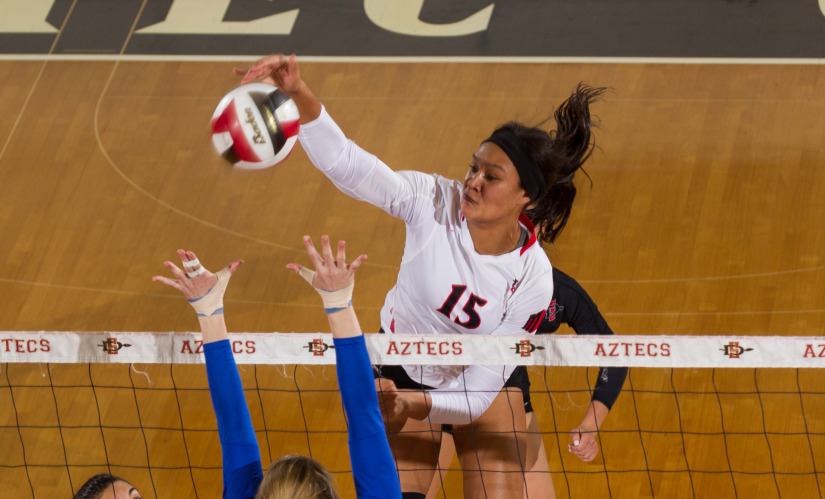
Printer-friendly version Aztecs erase 2-0 deficit; Harris knocks down season-high 18 kills Source: goaztecs.com Photo courtesy goaztecs.com October 19, 2017 (San Diego) – The San Diego State volleyball team produced a comeback for the ages Thursday, posting a five-set triumph over Boise State (20-25, 24-26, 25-20, 25-19, 15-10) in a Mountain West clash at Aztec Court. The Aztecs (10-12, 4-5 MW) recorded their first victory in nine outings this season after trailing 2-0 in sets to snap a six-match losing streak against the Broncos (11-10, 4-5 MW), who lost their fifth straight. SDSU had five players post double-digit kill totals, including Deja Harris, who totaled a season-high 18 put-aways and hit .548 to go with a match-high five blocks assists. In addition, Alexis Cage (16 kills, 13 digs) and Ashlynn Dunbar (13 kills, 13 digs) each recorded a double-double, while Baylee Little got into the act as well with a season-best 13 non-returnables, followed by Hannah Turnlund, who finished with 11 on the night. The Aztec fortunes were also bolstered by Gabi Peoples, who dished out a career-high 62 assists, while Devyn Pritchard continued her stellar play along the back row with a personal-best 33 digs. The two sides combined for 36 ties and 11 lead changes in the first two sets, with both teams knocking down 32 kills each during that span. However, the visitors benefited from 14 SDSU attack errors while committing just six miscues of their own. SDSU began its gradual ascent in the third frame, as the Scarlet and Black received consecutive kills by Turnlund, Cage and Harris to break an 8-8 deadlock and take the lead for good. The Aztecs increased their advantage to six on two occasions, including a 22-16 spread following a Dunbar put-away. However, the Broncos made things interesting shortly thereafter, scoring four quick points on a pair of aces by Sabryn Roberts, who also combined with Laney Hayes on a block, while Sierra Nobley added a kill. Stung, SDSU regrouped following a timeout, as Cage launched her fifth non-returnable of the set, while Little’s kill provided the clinching tally moments later on the heels of a Boise State attack error. The Aztecs held the Broncos to their lowest hitting percentage of the night (.085), helped by four team blocks, while Pritchard shoveled up nine digs. The two teams traded proverbial punches in the fourth stanza, totaling seven ties and three lead changes, before SDSU vaulted in front for good on Dunbar and Little’s combined block, while Cage tallied a kill to put the hosts up 17-15. Boise State scored the next point on a Nobley put-away, but the Aztecs finished with a strong 8-3 run to even the set scores at 2-2. Dunbar fueled the surge with three additional kills, while Sam McGrath secured the final point with a service ace. SDSU saved its best for last, hitting .562 in the decisive fifth set, blasting 10 kills with just one error on 16 attempts. Harris came up big once again with three put-aways during a timely 4-1 Aztec run that broke a 5-5 tie. Trailing 9-6, the Broncos remained in striking distance, trimming the deficit to two on four occasions, including a 12-10 margin following a Nobley kill. However, SDSU displayed its finishing kick this time, as Turnlund, Harris and Dunbar took turns launching kills to complete the comeback and vanquish the defending Mountain West champions. The Aztecs maintained the upper hand in kills (73-64), digs (83-68) and team blocks (8.0-7.0) while outhitting Boise State for the match .273 to .234. SDSU seemed poised to take control in the opening set after Harris collected a pair of kills to give the host school a slim 18-16 lead. However, the Broncos stormed to the finish with a timely 9-2 run, sparked by three Nobley kills, while Roberts added a solo block. Despite seven lead changes, the Aztecs found themselves in pursuit mode past the midway point of the second stanza, forging nine ties after Boise State went in front 16-15 on a Hayes kill. With the score knotted at 24-24, the Broncos got the last two points on a Nobley put-away and an SDSU attack error. Nobley led all players with 22 kills, while Roberts contributed 15 non-returnables and four blocks, including one solo stop. San Diego State will have little time to savor its victory as Utah State invades Montezuma Mesa on Saturday for an afternoon encounter, starting at 1 p.m. PT. Box Printer-friendly version
BADGERS BURROW INTO BACKCOUNTRY

Printer-friendly version By A.J. Herrington Originally published in the San Diego Reader Photo: remote wildlife camera, courtesy of the San Diego River Park Foundation. October 19, 2017 (Julian) — As I glance in the passenger-side rearview mirror, a dusty plume billows behind us, brightly lit by the low morning sun. Next to me in the driver’s seat, Shannon Quigley-Raymond guides her car along winding Eagle Peak Road, southwest of Julian. As we snake along the mountain roadway, she shares how three years of conservation work have recently come to fruition. Photo, right: The team saves images from the camera to a laptop. Quigley-Raymond is a River Ecosystem Manager with the San Diego River Park Foundation, a non-profit organization that works to preserve and improve the resources of the San Diego River and its watershed. She explains that as part of its mission, SDRPF has purchased more than 2,000 acres of land in the San Diego River headwaters area. The foundation conserves and documents the wildlife and other resources at these open-space preserves. Photo, left: remote wildlife camera, courtesy of the San Diego River Park Foundation. In 2014, while surveying a newly-acquired parcel of land, Shannon noticed several burrows that were quite a bit larger than the ground squirrel and gopher tunnels commonly seen. Puzzled, she took some photos and filed away a mental note of the discovery. Not long after, she attended a meeting of the San Diego Management and Monitoring Program, a group that works to coordinate and facilitate conservation in the county. Cheryl Brehme, a biologist with the United States Geological Survey, gave a presentation about an ongoing San Diego County study of the American badger, a California “species of special concern.” When Brehme showed a photo of a badger den, Quigley-Raymond recognized it right away. After conferring with Brehme and showing her the photograph that had been taken, a trip to the site was planned. Photo, left: remote wildlife camera, courtesy of the San Diego River Park Foundation. As they approached the burrow, things looked promising. The loose, sandy soil was well-covered with wild grasses, dry and swaying in the wind. Numerous small burrows betrayed the presence of the rodents that make up the diet of the American badger. When the suspect hole came into view, Brehme knew they were on to something. Closer inspection revealed tell-tale horizontal claw marks on the wall of the tunnel, and the recent presence of a badger was confirmed. Photo, left: remote wildlife camera, courtesy of the San Diego River Park Foundation. For the next three years, Quigley-Raymond and Brehme, with the help of SDRPF volunteers, attempted to collect more evidence and data of badgers at the preserves. Metal snags were placed at burrow entrances, in the hope of harmlessly grabbing small tufts of fur for DNA analysis. Remote wildlife cameras were set, only to have two disappear, and another rendered useless after being used for BB gun target practice. Undaunted, the researchers continued. In June of this year, a new set of burrows was found, and again a wildlife camera was set in place. After about a month, the memory card was retrieved, and Quigley-Raymond went through the laborious task of reviewing the 5,000 or so images. With a shutter that fires when activated by a motion sensor, a windy day on a grassy meadow can mean hundreds of photos of not much more than a hole in the ground. But in one of those shots, the corner of the frame contained what looked suspiciously, but not conclusively, like a badger. The next month was a similar story. Three images taken in very low light showed something moving toward the burrow, but again, a badger could not be confirmed. In August the camera was repositioned, to within just a few feet of the burrow under surveillance. This time, the empty hole became pay dirt. As Quigley-Raymond again flipped through thousands of images, she suddenly froze. “Badger! Badger!” she yelled, hardly able to contain her excitement. The SDRPF headquarters was nearly deserted on that Saturday morning, but from his office down the hall, foundation CEO Rob Hutsel rushed to join her at the computer. Together, they went through more than thirty photographs that clearly showed an American badger at the burrow. A few minutes after she finishes recounting the saga, Quigley-Raymond pulls to the side of the road, and the Subaru behind us follows suit. Inside are Katie and Eric Hengesbaugh, two volunteers with SDRPF. They’ve come along to learn the location and operation of the camera so they can help with the monitoring. Not long after, we’re joined by an SUV with government plates. Brehme and Devin Adsit-Morris, a fellow biologist from the USGS, grab their packs for the short hike to the den. After negotiating our way through a barbed wire fence, we enter the preserve. Within a few minutes, we see a steel fence post with the wildlife camera strapped to it, facing a hole nearly a foot in diameter. Loose soil, scattered by the badger while digging the burrow, litters the perimeter of the entrance. Brehme approaches the hole, leans in close, and visibly takes a deep whiff. “You can smell them if they’re in there,” she says matter-of-factly, to no one in particular. Satisfied that the den is currently unoccupied, the team turns their attention to the camera. The memory card is inserted into the laptop Quigley-Raymond had brought along, and the images saved. After reloading the camera and affixing it to its stake, the team returns to their vehicles, anxious for the analysis of the new images. Along the way, plans to return and continue the monitoring are discussed. Once back to the road, the team separates. Brehme and Devin are headed to their next task, and the SDRPF group has another camera nearby to check. They’re hoping for pictures of a mountain lion on that one. But that’s a different story from San Diego’s backcountry… Links: The San Diego River Park Foundation:
LA MESA HEALTH CARE LIBRARY TO HOST FREE MEETING ON EATING A FIBER-RICH DIET
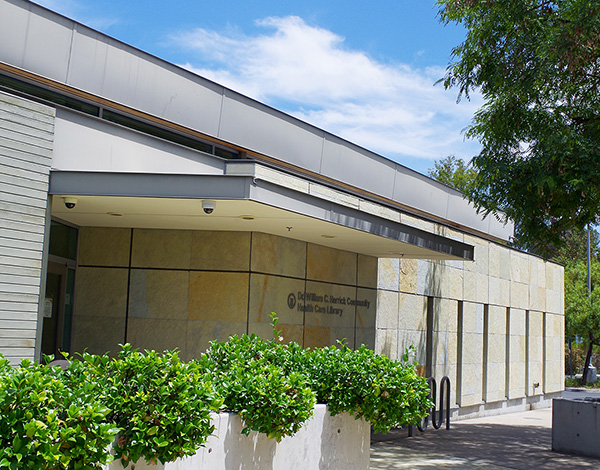
Printer-friendly version East County News Service October 19, 2017 (La Mesa) — The Grossmont Healthcare District’s Dr. William C. Herrick Community Health Care Library, 9001 Wakarusa St. in La Mesa, will host “Eating a Fiber Rich Diet,” a free program on the benefits of a fiber rich diet, from 10 to 11 a.m., Wednesday, Oct. 25. The program is part of the library’s “Wellness Wednesday” series, normally held on the fourth Wednesday of the month. Admission is free. Light refreshments will be served, including tasting samples of a fiber rich recipe. Advance RSVP is not necessary. The speaker at the program will be Linda Moskovics, author of “The Fiber Rich Kitchen Cookbook,” and a certified Healthy Hands Cooking instructor. Moskovics, an El Cajon resident, is a retired public librarian with a bachelor’s degree in linguistics and a master’s degree in library and information science, as well as a certificate in plant-based nutrition from the T. Colin Campbell Center for Nutrition Studies. Her book was published earlier this year. According to Kathy Quinn, Herrick Library director, “The typical diet of today’s society is very poor and lacking in fiber, which can contribute to major health issues. Research shows that sufficient dietary fiber is important for digestion and may play a role in reducing cholesterol and blood sugar. Because fiber makes you feel full faster, it can help with weight control. Our attendees will learn tips for fitting more fiber into their diet and suggestions about the best foods for fiber.” The Herrick Library, which opened in 2002, is a consumer health public library specializing in health research information, accessible both on-site and online. The library is operated by the Grossmont Healthcare District, a public agency that supports health-related community programs and services in San Diego’s East County region. For more information, call the library at (619) 825‑5010 or visit www.herricklibrary.org. Printer-friendly version
SDSU WOMEN’S TENNIS BATTLES IN FIRST ROUNDS AT ITA REGIONALS
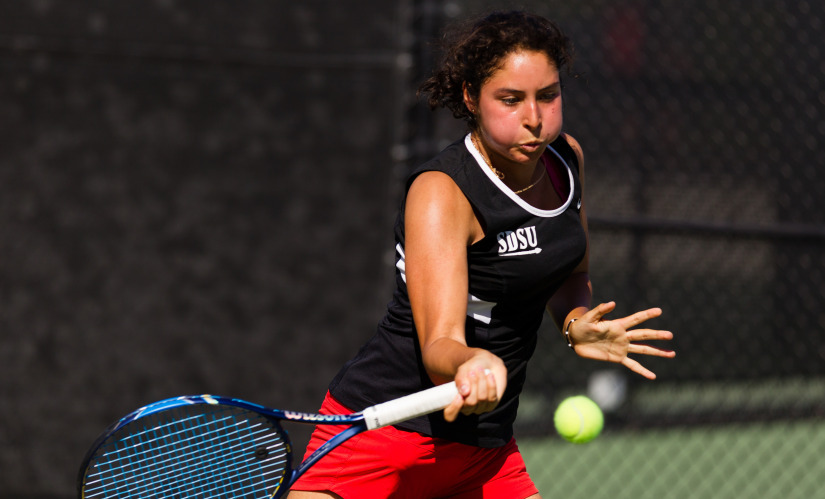
Printer-friendly version Aztecs split doubles, struggle in singles at Barnes Tennis Center Source: goaztecs.com Photo courtesy goaztecs.com October 19, 2017 (San Diego) – The San Diego State women’s tennis team opened day one of the ITA Southwest Regional Championships at the Barnes Tennis Center with challenging matchups that led to just two wins and seven losses in the first rounds of the event. The Aztecs hope to seize an opportunity to stay alive tomorrow in the championship bracket with one doubles pair advancing and two duos coming off round of 64 byes. In the doubles round of 64, junior Jenny Moinard and sophomore Mia Smith dominated against Flora Amiri and Yulin Chen of UCI, posting an impressive 8-1 win. Moinard and Smith will continue to the round of 32 tomorrow morning at 9 a.m., taking on Laura Gulbe and Dzina Milovanovic of Pepperdine. Seniors Jana Buth and Paola Diaz were not as fortunate, falling out of the championship bracket Thursday with a tough 9-7 loss to LBSU’s Carlota Casasampere and Georgia Gulin. The Aztec duo is set for a consolation match tomorrow morning at 9 a.m. against Caisey Emery and Genevieve Zeidan of CSUF. Junior Magda Aubets and freshman Nnena Nadozie received a first round bye and face Natalia Munoz and Lena Pacholski of LBSU on Friday at 9 a.m., who also had a bye in the round of 64. Sophomore Berta Acero and freshman Abbie Mulbarger also received a bye on Thursday and are set to play USC’s No. 5 seed Gabby Smith and Madison Westby in Friday’s round of 32. In the singles round of 128, Nadozie was able to take down CSUF’s Luxizi Meng, 6-2, 6-3, but was unable to overcome USC’s Constance Branstine in the round of 64, falling 6-4, 7-6. Nadozie is set to take on Yesica De Lucas (LMU) in the consolation draw on Friday at 12:30 p.m. Aubets received a bye in the first round of singles and played Maria Torres of USD in the round of 64, but dropped to Torres in three sets, 6-4, 3-6, 6-3. Aubets will play in the 11:30 consolation matches Friday and will compete against CSUN’s Mari Taslagyan. Mulbarger also enjoyed a round of 128 bye, and couldn’t get past Gabby Andrews (UCLA) in the round of 64, falling 6-3, 6-2. Mulbarger and USD’s Sophia Chow will face off at 11:30 a.m. in Friday’s consolation round. Diaz had a tough go against Siobhan Anderson (LMU) in the round of 128, and ultimately dropped a 6-4, 6-1 decision. She joins her teammates in the singles consolation rounds Friday at 11:30 a.m. and is set to play UCI’s Gillian Parker. Acero also faced a challenging duel against UCLA’s Kristin Wiley in the round of 64, falling 6-2, 6-2 in the match. Acero is scheduled to play CSUF’s Taylor Valenzuela in an 11:30 a.m. consolation match on Friday. Moinard was also unable to overcome her challenger, Monika Van de Vondel (CSUN), in the doubles round of 128 and dropped a 7-6, 6-3 decision. She is set to take on Masako Makiba of CSUF tomorrow at 11:30 a.m. in consolation play. Tomorrow’s action is set to begin with doubles play at 9 a.m. at the Barnes Tennis Center in Point Loma. Singles rounds will immediately follow. Complete results from each day of the Southwest Regional will be posted on GoAztecs.com. 2017 ITA Southwest Regional Barnes Tennis Center Oct. 19-23, 2017 Doubles Round of 64 Moinard/Smith (SDSU) def. Amiri/Chen (UCI) – 8-1 Casasampere/Gulin.(LBSU) def. Buth/Diaz (SDSU) – 9-7 Singles Round of 128 Nnena Nadozie (SDSU) def. Luxizi Meng (CSUF) – 6-2, 6-3 Siobhan Anderson (LMU) def. Paola Diaz (SDSU) – 6-4, 6-1 Kristin Wiley (UCLA) def. Berta Acero (SDSU) – 6-2, 6-2 Monika Van de Vondel (CSUN) def. Jenny Moinard (SDSU) – 7-6, 6-3 Round of 64 Constance Branstine (USC) def. Nnena Nadozie (SDSU) – 6-4, 7-6 Maria Torres (USD) def. Magda Aubets (SDSU) – 6-4, 3-6, 6-3 Day one results Printer-friendly version