
MEXICO BATTERED BY 8.1 EARTHQUAKE, TSUNAMI AND A HURRICANE
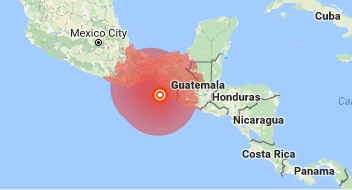
Printer-friendly version By Miriam Raftery September 8, 2017 (San Diego) – An 8.1 earthquake has struck Mexico off the west coast near Chiapas and Oaxaca overnight, killing at least several dozen people though that count is expected to rise dramatically. The quake, the strongest in a century to hit Mexico, and aftershocks are triggering tsunamis, one measuring 3 foot already and potential of waves up to 10 feet tall, CNN reports: http://www.cnn.com/2017/09/08/americas/earthquake-hits-off-the-coast-of-southern-mexico/index.html Many more fatalities and major economic loss are expected, the U.S. Geologic Survey predicts: https://earthquake.usgs.gov/earthquakes/eventpage/us2000ahv0#executive Meanwhile Mexico’s east coast is awash in heavy rains and strong winds from Hurricane Katia , a category 1 hurricane off Veracruz. A hurricane warning is in effect for Cabo Rojo to Laguna Verde. Mexico sent relief aid to Houston to help the U.S. during Hurricane Harvey rescue efforts. Thus far President Trump has not indicated whether U.S. will come to the aid of our neighbors in Mexico, where many buildings are reported collapsed from the earthquake , a red alert has been issued, and international relief efforts are being mounted. Printer-friendly version
COUNTY OPENS ZIKA OUTREACH CAMPAIGN
Printer-friendly version By Gig Conaughton, County of San Diego Communications Office September 8, 2017 (San Diego) – he County of San Diego is taking to TV, radio and even freeway billboards to remind the public that the Zika virus is still a threat here — especially to pregnant women, couples thinking about pregnancy, travelers, their families and neighbors. The outreach campaign that started this week urges people to fight invasive Aedes mosquitoes, which can transmit Zika and other illnesses if they first bite an infected person, by finding and dumping out standing water in and around homes so mosquitoes can’t breed. Zika is harmless to most people, but it’s been directly linked to a severe birth defect. The virus has made its way into mosquito populations in nearly 100 countries and two U.S. states, but not here. No invasive Aedes mosquitoes have tested positive for Zika in San Diego County or California. Public and environmental health officials want to keep it that way, by keeping mosquitoes from breeding, and away from contact with local residents who become infected while traveling. The County campaign will push its message through televised video and radio public service announcements, interviews, posters placed in bus stops and transit shelters, and even a large digital billboard along Interstate 5 near the U.S. – Mexico border. The campaign is intended to reach all county residents, but particularly pregnant women, couples who may want to become pregnant, travelers and people who commute back and forth between Mexico and the county. Officials want to reach pregnant women and couples thinking about pregnancy because Zika has been linked to microcephaly, a birth defect where babies’ heads and brains are smaller than normal. In March, a San Diego County woman gave birth to a baby with microcephaly after contracting Zika while traveling pregnant to countries with the Zika virus. It was the first such case in the county. Officials want to reach travelers and commuters to stress how important it is for them to protect themselves against mosquito bites while outside the U.S. so they don’t return home infected. Zika has been transmitted by mosquito populations in Mexico as far north as Ensenada, just 80 miles south of the border. There has been promising news about Zika so far in 2017. Case numbers appear to be dropping after Zika raced through the Western Hemisphere in 2015-16. All of San Diego County’s Zika cases remain travel-related. So far in 2017, 10 county residents have tested positive for travel-related Zika, including two infants born to women who became infected traveling. That means the only way for a county resident to get Zika here is to get bitten while traveling; get bitten here by a mosquito that bites an infected, returning traveler; or by having sex with an infected person. But all of that could change quickly. All it would take would be for a mosquito to bite an infected person, fly off, bite someone else and transmit the virus to them. That could create a chain reaction that could establish the virus here. And the county is entering the peak breeding months for invasive Aedes mosquitoes. County officials said this is what local residents need to know and do: Find and Dump Out Standing Water in and Around Homes County Vector Control officials said all county residents should look around their homes and yards at least once a week to find and dump out any standing water to make sure invasive Aedes mosquitoes do not have places to breed. Unlike native mosquito species, invasive Aedes mosquitoes prefer to live and breed right next to people, in yards and even inside homes. Invasive Aedes mosquitoes can reproduce in the smallest amounts of water, even in a bottle cap. Water from rain or sprinklers can collect in all kinds of items, including: plant saucers, rain gutters, rain barrels, buckets, garbage cans, old tires, wheelbarrows, even toys. The County’s Vector Control Program gives out mosquito fish for free that can be used to control mosquito breeding in water sources like unused swimming pools, ponds, fountains and horse troughs. Protect Yourself from Mosquito Bites — Especially Pregnant Women, Couples Considering Pregnancy and People Traveling to Countries with Zika Hot months are peak mosquito season — not only for invasive Aedes mosquitoes, but for native Culex mosquitoes that can transmit West Nile virus. Residents should protect themselves from being bitten by mosquitoes by taking simple steps. These steps are also especially important for pregnant women, couples thinking about having children and anyone traveling to countries where Zika is established. Use insect repellents with DEET, picaridin, IR3535, oil of lemon eucalyptus or para-menthane-diol for long-lasting protection. Pregnant women and women who are breastfeeding should use insect repellents registered with the Environmental Protection Agency and follow directions on the label. Do not use insect repellents on infants under two months of age. Wear long-sleeved shirts and pants. Keep windows and doors closed if possible and check window and door screens to make sure they don’t have tears or holes. Check Travel Advisories, Especially Pregnant Women and Couples Considering Pregnancy The Centers for Disease Control and Prevention publishes a list of countries and territories where Zika has been transmitted by mosquitoes at the CDC Zika Travel Information website. Anyone who travels to a country or area where Zika is established should protect themselves from mosquitoes while traveling, and for three weeks after they return home — even if they do not feel sick — to prevent the potential spread of Zika. Remember Zika Can be Transmitted Sexually and During Pregnancy Although Zika is mainly transmitted by mosquitoes, it can also be transmitted sexually. Consequently anyone who travels to, or who has intimate relations with a person who has traveled to, places with Zika should protect themselves during sex by using condoms or other barriers, or by avoiding having sex, even after they return home. Couples who are considering pregnancy should speak with a health care provider to discuss a safe length of time to
READER’S EDITORIAL: CONGRESS SHOULDN’T LET FLOOD INSURANCE PROGRAM EXPIRE

Printer-friendly version By Sarah Heck, 2017 Pacific Southwest Association of Realtors President Photo by Miriam Raftery: Flooded apartment in San Diego’s City Heights after a storm drain backed up September 7, 2017 (San Diego’s East County) — Unless Congress takes action, the government’s National Flood Insurance Program (NFIP) will expire on Sept. 30. While NFIP isn’t a household name, it’s often the only flood insurance available in a given market. That’s important, because if a property is in a 100-year floodplain, lenders will typically require flood insurance as part of the mortgage approval process. This isn’t just an issue for waterfront homes or homes in the direct path of hurricanes. Many homeowners in San Diego County who live near large storm drains or drainage channels are required to have flood insurance. More than 5 million homeowners in 22,000 communities nationwide rely on the NFIP to provide flood insurance. The 2,500 members of the Pacific Southwest Association of Realtors (NSDCAR), with an service center in El Cajon, encourage Congress to act now and approve H.R. 2874. The time for action is now and the time is running short to avoid a shutdown of the NFIP. If flood insurance isn’t available, then we will be the ones forced to inform our clients that their dream home is off the table until the NFIP is extended. And, consumers deserve better. The opinions in this editorial reflect the views of the author and do not necessarily reflect the views of East County Magazine. To submit an editorial for consideration, contact editor@eastecountymagazine.org. Printer-friendly version
ECM PADRES REPORT: PADRES AVOID SWEEP AND GET SHUTOUT OF CARDINALS

Printer-friendly version Like our sports coverage? Donate to help support ECM’s sports section! Type “Sports” on the donation line! Follow @ECMagSports on Twitter for live sports coverage and stories! Story by Liz Alper Photo: Wil Myers sealed the win for the Padres with a two-run home run in the seventh. Via @Padres on Twitter September 7, 2017 (San Diego) – The Padres needed to step up to the plate (literally) tonight if they wanted any chance of avoiding a sweep by the Cardinals. Lance Lynn started tonight for St. Louis against Clayton Richard. The Padres always have good intentions to avoid a sweep. Jose Pirela singled in the first to score Manuel Margot and the good guys took a 1-0 lead. Wil Myers sealed the deal in the seventh with a two-run blast to give the Padres the 3-0 win and avoid the sweep. Well, that was a fun homestand. Now the Padres go on the road to Arizona for the weekend to face the snakes. First pitch tomorrow night is at 6:40 p.m. Jordan Lyles starts against Patrick Corbin for Arizona. Printer-friendly version
HURRICANE IRMA DEVASTATES CARRIBEAN ISLES: DANGEROUS STORM HEADS FOR FLORIDA

Printer-friendly version By Miriam Raftery Photos: Hurricane damage in the Caribbean, courtesy of Organisation of Eastern Caribbean States September 7, 2017 (San Diego) – The Organisation of Eastern Caribbean States (OECS) has issued a report on devastating wrought by Hurricane Irma, a powerful category 5 hurricane that smashed into multiple Caribbean islands and is now on track to hit Florida this weekend. Evacuations are ordered in every Florida county. The storm could also veer north after Florida toward Georgia and the Carolinas. The storm has been clocked with maximum sustained winds of 185 miles per hour, one of the strongest ever recorded. Puerto Rico, a U.S. territory, was spared a direct hit, but did have winds up to 75 miles an hour. But many Caribbean states suffered catastrophic losses from winds as well as storm surges up to 20 feet and torrential rains. Several deaths have also been reported. On Anguilla, 90% of roads are impassable and 90% of utilities have been wiped out, as well as 90% of utility infrastructure plus damage to the airport, hospital, schools and fire stations. Barbuda and Antigua reported major roof damage, uprooted trees and power poles down. The British Virgin Islands reports major damage to homes and commercial businesses. Dominica had flash flooding. Power on Monserrat was shut off as a precaution, but there were no damages reported as of last night. Power is disrupted on St. Kitts and Nevis, where some homes suffered damage. The hurricane is expected to reach Hispaniola tonight, the Bahamas tomorrow, followed by Cuba and Florida. The National Weather Service has a hurricane in effect now for southern Florida for what it describes as a “dangerous major hurricane” and “life-threatening storm surge” over at least the next 48 to 72 hours. Florida’s Governor has issued a mandatory evacuation notice and a blunt warning to “get out now” since roads and bridges are expected to flood, trapping residents who don’t leave immediately. East County Magazine has received reporters of stranded travelers in some areas including the Bahamas being charged exorbitant rates for airline tickets to get out before Hurricane Irma strikes. If you have been price-gouged by airlines, please notify editor@eastcountymagazine. Printer-friendly version