
TROPICAL STORM LIDIA COULD BRING THUNDERSTORMS, ROUGH SEAS TO SAN DIEGO COUNTY THIS WEEKEND

East County News Service September 1, 2017 (San Diego’s East County) – If you’re planning a picnic, barbecue or other outdoor activity this Labor Day weekend, be aware there’s a possibility of widespread showers and scattered thunderstorms due to tropical storm Lidia. Tropical Storm Lidia has already wreaked havoc in Baja, Mexico, bringing flooding in Cabo San Lucas and closing airports at Cabo and La Paz. Some 20,000 tourists and thousands of residents have been evacuated to shelters there. The storm could reach our region starting Saturday, with the greatest chance of rainfall on Sunday, though far less severe with no more than an inch of rain expected in any local spots. Gusty winds are possible so be watchful for falling tree limbs or debris. A heat alert remains in place. High temps could ease somewhat on Sunday, but the weather will still be very humid, the NWS predicts. The chance of rain is low in the deserts, but highest in mountain and valley areas where thunderstorms could bring dangerous lightning and heavy downpours. Rough seas and gusty winds will likely bring Small Craft Advisory conditions to coastal waters starting Saturday night, says forecasters James Brotherton and Dan Gregoria.
VOTER’s WATCHDOG: CITIZENS OVERSIGHT FILES OPPOSITION TO AB-840, SAYS AMENDMENTS WOULD GUT ELECTION AUDITS IN CA

Watchdog group that won lawsuit says last-minute amendment inserted by election officials would allow 40 to 70 percent of ballots to be omitted from audits By Miriam Raftery September 1, 2017 (San Diego) — Citizens’ Oversight, a nonpartisan group that focuses on election integrity, announced today that it has filed written comments in opposition to CA AB-840, a bill which will make drastic changes to the one-percent manual tally of elections, which would omit 40% or more ballots from the scrutiny of this important audit process. Local Assemblywoman Lorena Gonzalez-Fletcher (D-San Diego) is a coauthor of the bill. ECM asked Vu late Thursday for comments. Vu replied via email, “The amendment came through and is sponsored by the California Association of Clerks and Election Officials (CACEO) and is supported by the Secretary of State and the County.”According to the State Senate analysis of the bill (available here), “The California Association of Clerks and Election Officials (CACEO) recognizes the effect any court ruling may have on the inclusion of all mail ballots as part of the one percent manual tally. Any adverse ruling would effectively redefine the purpose and intent of the one percent manual tally and change the long-standing practice many counties use. There is a high risk of counties not being able to certify their elections within the 30-day statutory timeframe. This risk is exacerbated with the dramatic increase in voters wishing to vote by mail throughout the State and the passage of recent legislation that increases mail balloting and the acceptance of them. As a result, CACEO is sponsoring this legislation to clarify existing law. “ County spokesman Michael Workman has previously disputed Lutz’s contention of any wrongdoing by the County or Registrar. He stated,”The 1% manual audit is to check the accuracy of the tabulation devices used to tally ballot…Over 1% of all ballots cast were manually tallied and zero discrepancies were found.” But Ray Lutz, founder of Citizens Oversight, says, “We noticed that Registrar of Voters Michael Vu in San Diego was cutting corners and violating the law when doing the audit process in the 2016 primary. We asked him to follow the law, he refused, so we took him to court and won. Now, he and other election officials friends are looking to gut the law so all counties will cut corners the same way. This is a bad idea and must be stopped!” Election officials in most counties are members of the California Association of Clerks and Election Officials, or CACEO. On August 24, CACEO sponsored an amendment of a bill which originally had nothing to do with the Election Code that relates to the election audit process, Section 15360, says Lutz. It added a section which he contends will “effectively omit all vote-by-mail (VBM) ballots which are not yet processed on election day and all provisional ballots from the audit process, which can comprise 40% to 70% of the ballots” in the election. “Voters are already suspicious of the election process,” continues Lutz. “Elections officials say the only errors that need be of concern are machine bugs. Voters know that electronic equipment can be hacked and votes changed on a massive scale. The one-percent manual tally audit is one step to help thwart and expose such attacks. To gut this audit process so that at least 40% of the ballots are known to never be audited invites hackers to make there changes to those ballots and never be detected.” This isn’t Vu’s first instance of controversy involving elections he’s overseen. In Ohio, a presidential election in a major county where Vu headed up elections led to conviction of felony misconduct by two employees working for Vu found guilty of rigging a recount, in the words of prosecutors, Free Press reported. The San Diego Union-Tribune reported in 2016 that “Vu was the top elections official in Cuyahoga County in 2004, when long lines and other irregularities plagued the presidential ballot. Some of the same problems occurred in 2006, and a special panel convened to examine that result blamed Vu and his staff.In 2007, two poll workers were convicted of felony misconduct related to the Cuyahoga recount of presidential ballots.” Vu himself was not charged with any crime. He resigned weeks later and was hired in San Diego County as Assistant Registrar that spring, later becoming Registrar. Citizens Oversight’s submission includes an alternative revision to 15360 which improves the effectiveness of the one-percent manual tally and allows the public to provide increased scrutiny. In addition, the proposed changes include an option not to do the one-percent manual tally at all, if election officials upgrade their equipment to the current generation of election equipment that shoots an image of every ballot and makes those images available for review by the public in a timely fashion. This new approach will allow anyone to perform a virtual hand-count of the election, or process them using their own tabulation equipment as a redundant check on the results. Citizens Oversight has been conducting a review of numerous counties’ election results in the most populous counties in California and in many other states using a methodology called the Snapshot Protocol. This method exposed what Citizens Oversight contends was election audit fraud in the 2016 primary in San Diego, where Registrar Michael Vu “not only did not audit the later VBM and provisional ballots as we assert is required in the election code, but he hired 40 people to work for a week to pre-stack the Early-VBM precincts so they would match the computer report. However, they did not match, so they just ran a new computer report as well,“ a press release by Citizens Oversight states. Citizens Oversight continues to seek to look at those ballots which Lutz says he suspects were tampered with in the 2016 primary under the California Public Records Act (CPRA), but Vu says the ballots are “sealed” and cannot be inspected. So another lawsuit has been filed on this issue. “There is no dispute
SUCCESS! EAST COUNTY DINING CLUB ‘S PREMIERE PARTY DRAWS A CULINARY CROWD

Next event is Sept. 21 at Tiramisu Trattoria in La Mesa September 1, 2017 (La Mesa) – Thanks to all who turned out to help make the launch of our East County Dining Club a big success! Over 75 people attend our premiere party at Fabrison’s Country French Restaurant in Jamul, where guests feasted on all-you-can-eat crepes and savored wines from the award-winning Deerhorn Valley Vineyard. If you haven’t yet joined our dining club (just $10 a year!) we strongly recommend doing so now since we expect future events to sell out. East County Dining Club members will receive early invitations and first options to reserve space at all of our future special culinary events, two free drawing tickets at their next event, and a free “Best of East County” cookbook we are compiling with recipes from top restaurants, wineries, farms and more in our region. Join us to savor the flavors of the world at great restaurants here in East County! How to join: send a $10 check per person to East County Magazine (write “Dining Club” on the memo line) and mail to 4438 Hideaway Place, La Mesa, CA 91941. If you would like to reserve space for our next event at Tiramisu Trattoria in La Mesa on Thursday, September 21 at 6:30 p.m., cost is $28 per person. All proceeds benefit our nonprofit community reporting and wildfire/emergency alerts. Thousands of prizes were won by lucky guests at our premier party including a barbecue/smoker grill, dance theatre tickets, art lessons,car washes, coffee lovers basket, cookbook, a jewelry-making class, Fabrison’s gift certificate, gym membership spa/salon gift basket and more. Vocalist Lenelle Wylie (photo, right) also entertained with her amazing voice. Lenelle recently starred in the one-woman show “Diva” produced by Visionary Dance Theatre. Author Reina Menasche (photo, left) signed copies of her award-winning books set in France. The event was a big success – and we promise we’ll bring a sound system to our next event since our only glitch was so many people our editor grew hoarse shouting out all those winning prize tickets! We had several local VIPs including El Cajon Councilmen Steve Goble and Gary Ken drick (Photo, left: Councilmembers Goble and Kendrick, with reporter Jonathan Goetz) Deerhorn Valley Antler Editor Kim Hamitlon came with a crowd from her community. (Photo, right, clockwise form bottom left: Carole Bradford, Kim Hamilton, Rob Deason, Susie Norton, Bob Hill, Sue Ellen, and John Martin.) Several of our reporters and radio hosts were also on hand including Kendra Sittick (our Jamul, Spring Valley and Rancho San Diego correspondent), Jonathan Goetz (El Cajon, La Mesa and Lemon Grove), Rebecca Jefferis Williamson (reporter at large and co-host of Destination East County on our radio show, (along with Jonathan Goetz) and our editor Miriam Raftery. (Photo, left, Rebecca Jefferis Williamson with chef Ramon.) Our hungry and friendly crowd ranged from ranchers and residents in Jamul to suburban and urban dwellers in La Mesa, Mount Helix, El Cajon, Spring Valley, Alpine, San Diego and other communities. If you haven’t yet visited Fabrison’s in Jamul, stop by and let them know you heard about them through East County Magazine! http://fabrisons.com/ Thanks to our generous sponsors! Fabrison’s Country French Restaurant, Deerhorn Valley Vineyards, Tiramisu Trattoria, Jamul Hardware, Jamul Carwash, Maxwell’s House of Books, Ava Hair Salon, Visionary Dance Theatre, Nainsook Gallery, and idea Field.
BRUSH FIRE IN DULZURA’S BEE CANYON

East County Wildfire and Emergency Alerts Update 11:54 a.m. The Sheriff advised residents through Alert San Diego that the fire is in the Bee Canyon area of Dulzura. No evacuations have been advised but residents are urged to stay tuned to local media and make sure your mobile phone is registered with AlertSanDiego to receive evacuation notices, www.ReadySanDiego.org and follow Cal Fire for updated fire information: https://twitter.com/CALFIRESANDIEGO Update 11:40 a.m. The fire is now 15 percent contained and has burned 120 acres, Cal Fire reports. Update 10:45 a.m. Fire is now 110 acres and still zero percent contained. SDG&E’s helicopter, several fixed wing aircraft and over 220 firefighters are among the resources at the scene. September 1, 2017 (Dulzura) — The #BorderFire burning in Dulzura has charred at least 50 acres of brush and is zero percent contained. The blaze began at 5:40 a.m. near State Route 94 and Marron Valley Road. There are no road closures at this time. The fire is burning to the north and east. Resources committed include 20 fire engines, 10 hand crews, 7 water tenders, 3 bulldozers, and 3 Type II helicopters. You can view video and a map at Cal Fire’s Twitter feed here: https://twitter.com/CALFIRESANDIEGO Photo, right, by Paula Maness, taken along State Route 94. Scanner Link to listen live: http://www.broadcastify.com/listen/feed/9733/web The Deerhorn Valley Antler reports that smoke plumes are now visible from both the Otay Mtn and Lyons Peak HPWREN cameras: http://hpwren.ucsd.edu/cameras/L/om-e-mobo-c.jpg (EAST CAMERA) http://hpwren.ucsd.edu/anim-a2/hpwren-iqeye14/hpwren-iqeye14.jpg (SOUTH CAMERA) Note, the incident commander has downgraded an earlier Cal Fire estimate from 70 acres to 50 acres. Sign up for free East County Wildfire and Emergency Alerts via email at the top right side of our homepage and you can also receive a free weekly e-newsletter. You can also follow EastCountyAlert on Twitter. Thanks to our generous sponsors of our wildfire and emergency alerts, Grossmont Healthcare District and SDG&E.
COUNTY PLAN TO SHORTEN AMBULANCE RESPONSE TIMES PRESENTED IN CREST TO FEW COMMUNITY MEMBERS
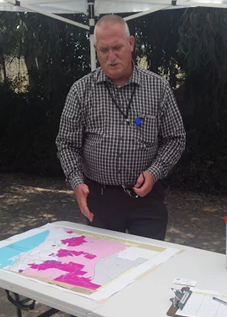
Improvements proposed after ECM investigative series on ambulance response times in unincorporated areas By Kendra Sitton August 30, 2017 (Crest) — Last week, County Emergency Medical Services (EMS) Administrator Andy Parr met with local communities to ask for input on EMS’s plan to improve ambulance service to the rural parts of San Diego because “the status quo of 30 min is no longer acceptable.” The updated plan goes before the Board of Supervisors on Oct. 10. If approved, when the contracts of the three ambulance companies expire in the next few years, they will have to comply with the new plan which will shorten response time. The actions follow a five-part special series by East County Magazine published in 2015, investigating slow ambulance response times in some unincorporated areas and changes in county ambulance providers. (See links to our five-part series at the bottom of this article.) On the map of the County, the areas with dense population growth designated as urban will now have a 12 minute response time. Rural areas, such as Alpine and Jamul, have fire department response in 13 minutes and will now have ambulances in 20. “Outlying” areas like Dulzura and Campo will shorten their response time to 25 minutes. Currently, deserts have “best effort ” time and no numerical suggestion exists. The plan would say 60 minutes response times for the desert. The County’s proposed changes to shorten response times are a big step in the right direction. While it may be impossible to reach every remote location as quickly as desired, every second counts in a life-threatening emergency. The American Heart Association reports that brain death and permanent death start to occur in 4–6 minutes after someone experiences cardiac arrest. In addition, long response times in the past have meant that it took more than the “golden hour” (the time frame that medical experts recommend for saving lives.) to reach a hospital following a trauma, stroke or other medical emergency in rural areas. A common problem in rural and outlying areas, as expressed by Teresa Greenhalgh, Program Manager of SDCFA Community Emergency Response Team (CERT), is that fire engines now arrive quickly but people must wait 30 minutes plus for an ambulance to arrive. “We’ve seen positive changes; we’d like to see that next step,” she said. Parr assured her that there are “Fire engines waiting for ambulance across San Diego County. We wish there were more ambulances, but we can’t afford to put an ambulance in every fire station.” He brought up that 25 years ago not all fire engines had EMTs on them. Now this is standard, which has vastly improved the care for residents. Greenhalgh countered that fire engines cannot answer other calls until the ambulance arrives, which could leave other residents underserved. In the East County areas being improved in this plan, three separate contractors work in each zone. Another goal of the plan is to force better cohesion between the companies so it functions as one area. The profitability of the ambulance companies could become a concern as they must conform to this new plan. Since the times are based on a feasibility study in which the actual time it takes ambulances to answer calls currently was studied, Parr is not concerned with their ability to improve response time. The hope of the plan is for a dynamic system to replace a static one so that all residents are better served. Parr views the plan as generally positive and believes it will pass through County approvals without controversy. At the final meeting for community input which Parr hosted in Crest on Aug. 25, only six residents attended the event hosted in a library parking lot under a canopy. Greenhalgh pointed out that all of the meetings he hosted were during the day when many people work. She said she was missing out on pay to attend the meeting because she viewed it as important. Parr admitted that the events were inconveniently timed and ill-publicized, but said he could have done a better job if his office had given him more time. The sparse attendees were all directly connected to the issues as CERT volunteers, a fire fighter, AMR employee and fire board member. No one simply interested in emergency services in their community made it to the meeting on the warm afternoon. Although no more meetings are scheduled, Parr said he could attend meetings if requested and residents could also call his office. Background: See our five-part special series raising concerns over changes in ambulance providers by the county and slow response times in rural areas: http://www.eastcountymagazine.org/county-changes-ambulance-service-without-public-notice-public-safety-advocates-voice-alarm https://www.eastcountymagazine.org/ambulance-updates-announced http://www.eastcountymagazine.org/county-responds-ambulance-service-questions-0 http://www.eastcountymagazine.org/how-do-countys-response-times-ambulance-service-stack-other-areas https://www.eastcountymagazine.org/fire-board-members-raise-concerns-over-ambulance-contract-response-times
MEDICAL EXAMINER: PEDESTRIAN, METH DEATHS UP IN 2016
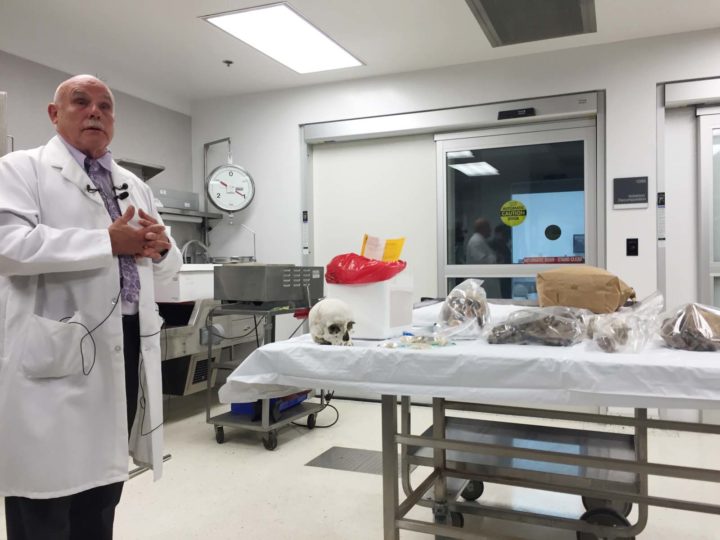
By Yvette Urrea Moe, County of San Diego Communications Office Photo: Chief County Medical Examiner Dr. Glenn Wagner in an examining room for death investigations. August 31, 2017 (San Diego) – Pedestrian fatalities reached their highest number in decades, while methamphetamine-related deaths and homicides also increased last year compared to recent years. Those were among the findings noted in the San Diego County Medical Examiner’s just-released 2016 Annual Report. “These statistics closely follow trends reported in 2015,” said Dr. Glenn Wagner, the County’s Chief Medical Examiner. “The report provides a view of recent death trends in San Diego County based on a subset of the total cases.” The report offers an overview of cases and examines trends in causes of death for the approximately 8,500 cases the ME’s Office investigates annually – a little less than half of the 19,000 to 21,000 deaths recorded in San Diego County every year. After an initial review, many of those cases are then determined to be sudden unexpected natural deaths. The data in the report focuses on the 3,070 cases in 2016 that the Medical Examiner’s Office fully investigated. Of those cases, 47 percent were accidental, including deaths related to prescription drug overdoses, motor vehicle trauma, and industrial or agricultural and home-based trauma. Another 33 percent were determined to be natural deaths, 14 percent were suicides, a little more than 4 percent were homicides, and in nearly 2 percent, the cause was undetermined. The report notes that of the 307 motor vehicle fatalities last year, pedestrian fatalities went up to 101 cases, excluding two suicide pedestrian deaths. This is an increase from 93 pedestrian fatality cases in 2015. The 101 unintentional pedestrian deaths were the highest number since 1994 when there were 103 cases. Another trend was a general increase over 15 years in unintentional deaths due to drugs and medications, up to 544 in 2016 compared to 268 in 2000. In illicit drug and prescribed medication deaths, methamphetamine remained the single largest cause in 2016 with 240 cases. The number of methamphetamine death cases is also at its highest number in 16 years, increasing steadily since 2000 when there were 62 cases. Among the substance-related deaths, alcohol had the second most cases with 106. Heroin overdoses were the third largest cause of deaths with 91 cases, and were most common in the age range 20 to 29. Opiates represented the largest group of medications in the 2016 drug deaths, which included heroin, morphine and benzodiazepines. In 2016, San Diego also saw four cases involving designer drugs. The drugs included an acetyl fentanyl death, a death from mitragynine (a plant-based opioid commonly referred to as kratom), and two deaths from U-47700, an opioid analgesic not intended for human use. The data also showed that homicide rates increased compared to the last three years. In 2016, there were 116 homicides, compared to 93 in 2015, 90 in 2014, and 88 in 2013. In 2012, there were 122 cases. Last year, 50 cases were due to firearms, 26 cases were due to cutting/stabbing, 22 were from blunt force, and seven were from asphyxiation. The other 11 were from less common mechanisms such as poisoning, drowning or environmental exposure. Suicides increased slightly last year with 431 cases compared to 427 cases in 2015. The County urges anyone who is struggling with depression or is concerned about a loved one to seek free mental health and substance abuse counseling. Call the County’s Behavioral Health Access and Crisis Line at (888) 724-7240. Suicide prevention and awareness information is also available at up2sd.org. As drug-related deaths continue to increase, so have the number of cases handled by the forensic toxicology laboratory. In 2016, the laboratory handled more than 2,100 cases, a hundred more cases than the previous year, and the highest increase in 16 years. In 2001, the laboratory handled fewer than 1,700 cases, but those numbers have steadily increased over the years. “In general, the findings are valuable to the law enforcement, mental health and drug rehabilitation communities and help guide how we direct resources to County initiatives like Live Well San Diego and the associated task forces on suicides, elder abuse, domestic violence, child fatalities, methamphetamine and prescription drug abuse,” said Wagner. “The death investigation work done by this office is a combination of service, education and research.” County Medical Examiner investigators are also involved in many research opportunities and are members of various multidisciplinary death review committees, including those that work to reduce trauma deaths and improve the trauma system. Pathologists, investigators and other staff also share their expertise at conferences and in academic settings, including providing a teaching rotation program for pathology residents from UC San Diego School of Medicine and Naval Medical Center Balboa, as well as brief clerkships for medical students from around the country.
GEORGE GASTIL APPOINTED TO UCSD CHANCELLOR’S COMMUNITY ADVISORY BOARD

Photo: Gastil, right, with UCSD Chancellor Pradeep Khosla’s Community Advisory Board By Jonathan Goetz August 31, 2017 (San Diego) – Lemon Grove resident George Gastil, a professor, former school board and city council member, has been appointed to Chancellor Pradeep Khosla’s Community Advisory Board (CCAB) for the University of California, San Diego (UCSD). Lemon Grove Councilman David Arambula nominated Gastil, and told East County Magazine, “I am truly honored to have successfully nominated fellow Lemon Grovian George Gastil to serve on the UCSD Chancellor’s Community Advisory Board.” Gastil teaches Early American History, U.S. History for Teachers, and California History at San Diego State University (SDSU), and Early World History, California History, and Early American History at Grossmont Community College. Gastil was elected to the Lemon Grove School Board in 1998, 2002 and 2006. He was on the board through two budget crises during which time the district cut administration on order to spend more money in the classrooms and worked on getting families involved in their children’s work in order to raise student achievement. Gastil also won election to the Lemon Grove City Council in 2008 and 2012. During the recent state budget crisis he kept essential city services running and throughout his tenure worked to increase community engagement. In his new role on the CCAB, he will work with other talented individuals seeking to build relationships between UCSD and community stakeholders. The CCAB advocates for UCSD within the community groups its members are affiliated, and advises the Chancellor, with “specific emphasis on the university’s role in the community.” Gastil and Arambula hope to inspire under-represented communities to apply for admission at UCSD. Gastil told East County Magazine “U.C. San Diego is working on building stronger connections with the communities of the East County. I want to make sure we are maximizing opportunities for collaboration between the University and the educational institutions, municipalities, and industries in our region.” Arambula stated, “George’s passion for education is only matched by his commitment to serve others and, in particular, the underrepresented populations within our communities. We are fortunate to have George on the board and look forward to the great things he will accomplish for UCSD and our beautiful East County communities.”
NURSES “URGENTLY NEEDED” IN HOUSTON AND SURROUNDING FLOODED AREAS

East County News Service August 31, 2017 (Houston) — Supplemental Health Care is working with multiple hospitals in Houston and surrounding flooded areas in southeastern Texas to help provide urgently needed registered nurses (RNs) of all specialties. “We need R Ns with a minimum of one year RN experience who can commit to traveling to Texas to help with Hurricane Harvey relief efforts immediately,” says Mary Lucas, chief talent officer for Supplemental Health Care. Lucas says RNs are “urgently needed” adding, “If you, or anyone you know, is an RN and would like to help, please contact us immediately at 888-265-1068. Together we can make a difference and provide invaluable support to those effected by Hurricane Harvey.”
CHIEF’S CORNER: LABOR DAY SAFETY TIPS
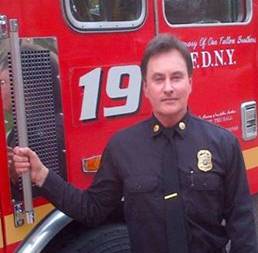
By Fire Chief Sam DiGiovanna August 31, 2017 (San Diego) – It’s Labor Day Weekend. Anyone up for a barbecue or picnic? Make sure to keep a close eye on the grill ensuring safety at all times. Keep children away from the grill as well as combustibles and vegetation. Warm weather is forecasted so make sure you keep hydrated, lay low, stay in the shade and wear sun screen. And don’t forget the pets! Water activity? Provide constant supervision to children in or near the water and always stay within arm’s reach of young children and inexperienced swimmers while they are in the water. Young children and inexperienced swimmers should wear approved life jackets. Whatever your water, hiking or travel plan is advise a trusted friend or family member the time you are going to hit the water, trails and road and expected to return. This way authorities have an idea where to search if you do not make it back home. Remember to protect your skin and eyes from the rays of the sun by wearing cover ups, sun screen, sunglasses and hats. Keep kids within sight and arms reach when in the water and never swim alone. No matter where your destination, you’ll want to take your time to ensure you and your family arrive safely. Drive safe, defensively, with courtesy and patience. “There are many of distracted drivers out there says Chief DiGiovanna. You don’t want us responding to your text so don’t text and drive!” Remember, do not drink and drive and always wear your seat belt. Happy Labor Day!
DOMAINE ARTEFACT WINERY IN HIGLAND VALLEY SECURES PRESTIGIOUS HONORS

Winery part of emerging Highland Valley wine region East County News Service August 31, 2017 (Escondido) – Located high above the San Pasqual Valley in Escondido, winery Domaine Artefact secured prestigious wins at the 37th San Francisco International Wine Competition and the Sunset International Wine Competition. The honors draw attention to an emerging, thriving wine region called Highland Valley, located just west of Ramona. The San Francisco International Wine Competition awards are divided into four levels: bronze, silver, gold and double gold. Judges know only the varietal and vintage of each wine being judged. The competition included over 4,300 wines from 30 countries around the world. Domaine Artefact San Francisco International Wine Competition Awards 2016 Grenache Rose “Les Printemps” – Silver 2015 Syrah – Silver 2015 Red Rhone Blend “As the Crow Flies” – Silver 2016 White Rhone Blend “Les Beaux Blancs” – Bronze “These wins are special to us for the validation of our hard work and passion for our craft,” said Mark Robinson, who runs the winery with his wife, Lynn LaChapelle. “We’re elated to win, and we’re thrilled for the exposure it provides for our blossoming Highland Valley wine region.” Domaine Artefact also won awards for three out of the three wines it submitted to the Sunset International Wine Competition. The winery picked up a coveted gold, a silver and a bronze award from for its 2016 Les Beaux Blancs, 2015 As the Crow Flies and 2016 Les Printemps Rosé, respectively. Sunset Magazine will publish a list of the gold and silver winners in its October issue. “Owning and running a winery has been of a dream of ours for many years, and we’re thrilled to receive such high honors for our first estate red and second estate white wine bottling,” said LaChapelle. Domaine Artefact, a family-owned winery and vineyard, is dedicated to growing Rhône grape varietals and vinifying and blending them in traditional and innovative manners. Founded in 2014, Domaine Artefact consists of over 15,000 vines on 30 acres of land in Escondido, California’s Highland Valley. The winery is named for the artifacts, some dating up to 8,000 years old, unearthed on the property during an archaeological survey commissioned by the winery. The artifacts were curated and now reside in the San Bernardino Indian Museum.