
SIX ALL-MW TRACK & FIELD HONORS FOR SDSU

Four of the five individual honorees are repeat All-MW Indoor Track and Field performers Source: goaztecs.com Photo courtesy goaztecs.com February 27, 2017 (San Diego) – After a third-place finish at the Mountain West Indoor Track and Field Championships and four event titles, San Diego State track and field garnered six All-Mountain West Indoor Track and Field honors, the conference office announced Monday. Henderson was named the Mountain West Indoor Track and Field Championships Women’s Outstanding Performer of the Meet after breaking the SDSU and meet all-time marks in the 60- and 200-meter dashes to take first in both events. She ran the second-best 60 (7.17) and sixth-best 200 (22.81) in NCAA Division I this season at the conference meet. Henderson won the 200 at the 2016 MW Indoor Track and Field Championships, and has now earned All-MW Indoor honors in the event each season in the Scarlet and Black. An All-Mountain West Outdoor Track and Field performer in the shot put (2016), senior Rachel Alesi executed a personal-best throw of 48-06.00, the fifth-best mark in the program record book. Capturing the second All-MW Indoor Track and Field Team honor of her career, sophomore Marissa Berry won the pole vault title after recording a 13-foot, 9.25-inch mark, a personal best. The mark, which is the sixth best in SDSU history and fifth best MW Indoor Championships history, tied junior Bonnie Draxler’s height in the event at the 2016 MW Championships. The Aztecs have now won 22 MW titles in the pole vault out of a possible 35 tries (indoor and outdoor). Junior Simone Glenn finished second in the 200, clocking in at 23.55 for third all-time. This is the second All-MW Indoor Track and Field honor for Glenn in the 200, after she took third in the race at last year’s championships. Freshman Andrenette Knight snagged silver in the 60-meter hurdles after she crossed the finish line in 8.40, ranked No. 8 in program history. San Diego State’s 4×400-meter relay team of junior transfer Monique McPherson, senior Tyra Lea, Glenn and Knight won the event with their 3:40.16 time surpassing their school record, set at the Don Kirby Elite Invitational earlier this month, by just 0.02 second. The win in the relay was the Aztecs’ first since 2013. The NCAA Division I Indoor Track and Field Championships are on Fri., March 10 and Sat., March 11 in College Station, Texas. SDSU’s Mountain West Awards Women’s Outstanding Performer of the Meet Ashley Henderson All-Conference Selections Rachel Alesi (shot put) Marissa Berry (pole vault) Simone Glenn (200 meters) Ashley Henderson (60 meters, 200 meters) Andrenette Knight (60-meter hurdles) 4×400-Meter Relay (Monique McPherson, Tyra Lea, Simone Glenn, Andrenette Knight)
PADRES’ MISERABLE SPRING TRAINING CONTINUES WITH LOSS TO ANGELS

Like our sports coverage? Donate to help support ECM’s sports section! Follow @ECMagSports on Twitter for live sports coverage and stories! Story by Liz Alper Photo via @Padres on Twitter February 27, 2017 (Tempe, Ariz.) – Thanks to Fox Sports San Diego and our sports editor being sick, ECM got their first look at the 2017 Padres today when they faced the Los Angeles Angels in a spring training exhibition. J.C. Ramirez started on the hill for the Angels against the new Friar from the Atlanta Braves, Tyrell Jenkins. The Padres have been having a miserable spring, but today, they finally broke through. In the second, catcher Austin Hedges singled up the middle to bring home Hunter Renfroe and the Friars went up 1-0. It went away in the Angels’ half of the third when Kole Calhoun lined to right to score Andrelton Simmons from second and the game was tied at one. The Angels continued in their half of the fourth with a single by Danny Espinoza to score C.J. Crohn and the Angels went up 2-1. Though Espinoza was caught in a rundown for the final out, left fielder Cameron Maybin scored and the Angels ended the fourth up 3-1. The Padres threatened back in the fifth when Wil Myers singled to bring home Christian Bethancourt to make the score 3-2 Los Angeles, but the Angels stopped them before they could tie. But they did in the seventh. Dusty Coleman hit a solo home run to tie the game at three. The Angels answered in their half of the seventh, however, with Kaleb Cowart’s double to score a run and give the Halos the lead again at 4-3. Catcher Jose Briceno singled to score Cowart and the Angels had a two-run lead again, 5-3. They were able to carry that till the end and the Padres’ atrocious spring training continued. Tomorrow, the Padres return to Peoria to face the Giants. First pitch is at 12:10 p.m. and you can watch the game on FSSD.
TRUMP ORDER ALLOWS DEPORTATION OF MILITARY SPOUSES, CHILDREN AND PARENTS

By Miriam Raftery February 27, 2017 (San Diego) – President Donald Trump’s recent executive order allows for deportation of military members’ spouses, children and parents. His action eliminates protections that the Defense Department put in place during President Barack Obama’s administration. The Obama era program, called Parole in Place, prohibited deportations of undocumented immigrants if they are spouses, children or parents of active duty military personnel, unless they had been convicted of crimes. Nathan Fletcher, a Marine Corps combat veteran and former Assemblyman, is speaking out against Trump’s action, which could rip apart families even while a U.S. soldier is deployed overseas. In an editorial published in the San Diego Union-Tribune, Fletcher states, “The Trump administration’s draconian and hastily drafted immigration orders rescind a key protection for military families so that now even military spouses and children can be rounded up and deported. This will weaken our armed forces. It will harm thousands of military families. And it’s wrong.” Fletcher noted that Homeland Security explained that it wanted military personnel to stay focused on their mission, not worried about family members left behind. Fletcher concludes, “The least we can promise those willing to give their life for our country is that their immediate family members can remain in that same country.” Trump’s policy breaks a promise made to recruits, opening the door for rounding up family members of those fighting to protect our country, or what Fletcher calls “a slap in the face to thousands of deployed troops with immigrant roots.” San Diego is home to about 134,000 uniformed military members and Department of Defense personnel, as well as about 33,000 military families so the impact of Trump’s action in our region could have devastating effects on our armed services families. Fletcher called on President Trump to reverse his action and fix what Fletcher calls a “terrible mistake.”
SAN DIEGO RIVER SCIENCE FIELD STATION BREAKS GROUND

East County News Service February 27, 2017 (Lakeside) – There is a big dig going on at the River Park, where excavation is underway to build a foundation for the San Diego River Science Field Station. According to the Lakeside River Park Conservancy, the San Diego River Science Field Station will become a hub for science education and research, allowing students, citizen scientists and PhDs to “rub shoulders and cross pollinate our knowledge and investigations of the San Diego River.” The Operating Engineers Training Trust and their students are hard at work at the site, gaining practical experience. For more information, visit http://www.lakesideriverpark.org/scientific-research.
COURT CASE CHALLENGES GOVT. ATTEMPT TO FORCE MUSLIMS TO SPY ON THEIR COMMUNITIES

By Miriam Raftery February 27, 2017 (Washington D.C.) – Three American Muslim men placed on the No-Fly List by the FBI contend that FBI agents told the men they could get off the list if they agreed to serve as spies in Muslim communities. According to the Center for Constitutional Rights, which is representing the men in court, the FBI wanted to collect information on U.S. Muslims in general, not people suspected of crimes. Even more startling, CCR states in a press release, “In 2015, only days before the first major court hearing in their case, Tanvir v. Lynch, the men received letters from the U.S. government confirming their removal from the list and effectively conceding what the men have always known: that they never posed a security threat of any kind and that the FBI only listed them to coerce them into spying on their faith community.” A judge dismissed their claims seeking damages, but now the men are appealing that dismissal. On Wednesday, attorneys for the men will argue that they suffered significant emotional and financial distress as a result of their placement on the No-Fly List. “They were unable to see wives, children, sick parents, and elderly grandparents overseas for years; they lost jobs and were stigmatized within their communities – and because without consequences for constitutional violations like these, they are more likely to be repeated,” a press release from the Center for Constitutional Rights concludes.
SANDAG APPROVES INDEPENDENT INVESTIGATION OF INACCURATE REVENUE PROJECTIONS FOR MEASURE A

By Miriam Raftery February 27, 2017 (San Diego) – By a unanimous vote, the San Diego Association of Governments (SANDAG) board of directors voted Friday to authorize an independent investigation into why SANDAG provided inaccurate revenue projections in the ballot description of Measure A, the regional transportation initiative rejected by voters. A Voice of San Diego investigation found that SANDAG used a model that likely resulted in an over-estimate of the $18 billion in revenues that SANDAG predicted would be generated by the proposed tax increase over 40 years to fund transportation projects. Numerous members of SANDAG’s board sent a letter prior to the meeting asking for an independent investigation. The board blamed staff, claiming staffers failed to inform board members of the problem. An investigation could determine whether that’s true, or whether staffers are being made scapegoats if any board members knew of the revenue project shortfall and covered it up. Supervisor Dianne Jacob questioned whether the omission of accurate projects may have been done on purpose. “Was there something intentionally done? Was there information withheld that the public should have and could have known about? And then, after we find that out, would it have made a difference in the outcome of Measure A?” she asked, adding that SANDAG’s credibility was “on the line.” SANDAG Chairman Ron Roberts stated, “It’s been implied that there may have been a conspiracy to hide all of this from all of us on this board,” adding, “If there was, I want to know about it — I want to find out who was in on it.” Staff is tasked with recommending an outside investigator within two weeks. SANDAG’s board, compromised of officials from all cities in the region as well as the county, will ultimately choose who will investigate the association. SANDAG’s board approved a multi-step work plan to improve data integrity and accuracy. For details, see http://www.sandag.org/index.asp?newsid=942&fuseaction=news.detail.
FLASH FLOOD WATCH ISSUED

February 27, 2017 (San Diego)–The National Weather Service has issued a Flash Flood Watch for the coast, valleys and mountains of San Diego County below 5000 feet for late this morning into this evening. A low pressure system from the northwest will tap a plume of subtropical moisture directed into northern Baja to bring periods of locally heavy rainfall from late this morning into early this evening. The most significant rainfall is expected from central and southern San Diego County into northern Baja. Rainfall for central and southern San Diego County is expected to range from around one inch near the coast…to 2 to 3 inches in the mountains. Urban and small stream flooding is expected with isolated flash flooding possible. Stay safe! Receive free East County Wildfire & Emergency Alerts via email by signing up at http://www.eastcountymagazine.org/wild-fire-alerts; you can also receive our free weekly e-newsletter with top news and events in East County. You can also follow EastCountyAlert on Twitter to receive brief text alerts on your mobile phone. We recommend all of the above, since you don’t know what forms of communication will be working during a major regional emergency.
PADRE DAM’S WATER RECLAMATION PROGRAM MOVING FORWARD
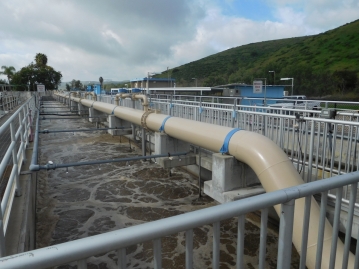
By Mike Allen Photo, left: shot of early stage treatment of reclaimed water at PD water recycling plant just north of Santee Lakes. February 27, 2017 (Santee) — While the recent rainy weather has improved what was a critical drought situation for much of California, officials at the Padre Dam Municipal Water District continue work on a regional water reclamation program to convert sewage discharge into drinkable water. The still-controversial “toilet to tap” process has yet to be officially implemented, but it’s not that far off. An advanced water purification demonstration program, now in its second year, is planned to be finished by 2021. By then, the reclaimed and purified sewage could provide up to 30 percent of the district’s water demands. Photo, right: Ryan Hughes, PD employee, explaining part of the process at the advanced water purification system at the plant. Padre Dam isn’t alone in pursuing the costly water reclamation program. Similar systems have been operating in the state and around the nation for years. “In fact, if you’ve been to Disneyland, you drank retreated water,” says Melissa McChesney, Padre Dam’s spokeswoman. Orange County has been delivering reclaimed and purified sewage water to its customers since 2008, and now produces some 100 million gallons daily. During a recent tour by the district, officials said the rationale for setting up a reclamation system is clear. The costs of water, nearly entirely sourced from the Colorado River, continues to rise, and the cost for treating sewage is also increasing. Padre Dam customers now pay about $1,700 per acre foot for water, among the highest rates of 25 water districts in the county. But by 2021, the estimated cost will be about $2,000 an acre foot, officials said. An acre foot is the standard water measure and equals the volume covering one foot over one acre, or about 326,000 gallons. The cost for treating sewage is certainly going to rise because of planned upgrades to the Point Loma Sewage Treatment Plant, which handles about 60 percent of the district’s discharge. The remainder, about 2 million gallons daily, is treated here. By implementing a water reclamation program, regional users would have a reliable, drought proof supply and one that would reduce the costs for transporting sewage down to Pt. Loma, the district says. “Padre Dam is now 100 percent importing its water,” McChesney said. “This (reclamation program) gives us a lot more local control and the ability to provide some of the water supply to our customers.” Photo, left: Paul Clark, director of operations, shows how pumps work at the El Monte Pumping Station in Lakeside. An early leader in water conservation, Padre Dam has been recycling its water since the late 1950s when late General Manager Ray Stoyer had the district build an extensive water treatment system that became Santee Lakes. That system, since expanded and moved north, has become a world-renowned model for producing grey water for non-potable uses such as landscaping. The current water purification program takes that recycled water and puts it through an additional four steps of treatment involving chlorine disinfection, membrane filtration, reverse osmosis, and finally, ultra-violet oxidation. While impressive, and well-tested, some Santee residents taking the tour weren’t all on-board with the concept, with one asking why not pursue desalination as an alternative supply. The answer is desalination costs about twice as much. The $1 billion Carlsbad desalination plant that opened in December 2015 has the ability to supply about 50 million gallons of water daily to the county, or about 8-10 percent of the county’s supply. Joining Padre Dam in the advanced purification program is the Helix Water District, San Diego County, and the city of El Cajon. These entities operate a complex web of sewage collection systems that rely on reservoirs, holding tanks, and pumping stations, all of which run on electrical power. Like other water districts, Padre Dam maintains back up power systems in the event of massive electric power failure. At the Lakeside station, residents saw one 2 million watt-turbine generator that the district got at a deep discount in the early 2000s, said Paul Clark, the district’s director of operations. The Caterpillar generator was sold off at an auction from a failed dot com business in San Diego, Clark said. “We paid about $200,000 for a generator that was almost brand new and cost about $600,000, and maybe had only nine hours of running time on it,” he said. The pumping station, which is at about 500 feet above sea level, pushes water to a point above 1,000 feet. Eventually water is pumped more than 2,600 feet above sea level to Viejas Mountain at the district’s eastern boundary. In all, the Padre Dam district covers 72 square miles and includes all of Santee, parts of El Cajon and Lakeside, Blossom Valley, Crest, Harbison Canyon and Alpine. The far-flung area combined with a limited customer base translates to higher average bills for the district’s 24,000 plus customers. The average Padre Dam customer pays $86 per month compared to $62 for San Diego County users. Other water districts have fewer acres to cover, and more customers, meaning expenses are shared by more and so bills are lower, said General Manager Allen Carlisle. There may be more water agencies than the county deserves to have, Carlisle said. “Do I think some districts should be consolidated? Yes.” In any event, costs for everything including replacing pipes and maintaining the extensive systems isn’t getting any cheaper, Carlisle said. “We are investing in your system, and we are investing in reliability….and it comes at a cost.”
PHOTO OF THE WEEK: ROADRUNNER IN SANTEE

East County News Service February 26, 2017 (Santee) — John Locke of Santee was jogging Friday morning on Park Center Drive south of Riverwalk Drive on the east side of Town Center Community Park in Santee when he spotted this Greater Roadrunner running along the top of the wooden fence alongside the park property. “He paused and looked at me, almost like he was posing, so I took a quick picture using my phone,” says Locke. “I checked the settings and when I looked up, he was gone. I thought of your Best Photos feature and wanted to submit the picture. I think it can remind us that in spite of the city’s growing residential and business infrastructure, Santee stays in touch with nature.”
SAN DIEGO COUNTY BAR FOUNDATION AWARDS $110,000 TO RECIPIENTS OF INDIGENT CRIMINAL DEFENSE FUND

Three local nonprofits receive grants to support legal assistance programs East County News Service Feb. 26, 2017 (San Diego) – The San Diego County Bar Foundation awarded $110,000 from its 2016 Indigent Criminal Defense Fund to three San Diego nonprofits that offer legal defense programs for individuals and families. The charitable arm of the San Diego County Bar Association, the Bar Foundation created its Indigent Criminal Defense Fund to further and support indigent criminal defense programs, projects and activities in San Diego County. The Bar Foundation, which recently also awarded $100,000 in funding to 12 local nonprofits as part of its annual grant cycle, invests in legal assistance and advocacy for people and communities in the region impacted by poverty, abuse and discrimination. The 2016 Indigent Criminal Defense Funds were awarded to: California Veterans Legal Task Force – $30,000 to help veterans secure criminal defense assistance for charges they are facing, with the hope that they will receive mental health treatment rather than custody. The program also provides legal students with hands-on experience providing legal assessments, experience with mental health issues and knowledge about veterans’ legal needs. www.cvltf.org St. Vincent de Paul Village – $30,000 to fully fund the Homeless Court Program, a special San Diego Superior Court session for homeless defendants to resolve outstanding misdemeanor offenses and warrants. The funds will support 100 percent of the program’s case management, operation expenses and the salary of a Homeless Court Representative. http://my.neighbor.org Think Dignity – $50,000 to support “The Homeless Youth Legal Advocacy Project,” which works with homeless youths who have aged out of foster care to reduce sentences, and expunge and seal their juvenile records so the young person can seek employment with a clean record. www.thinkdignity.org “It’s a well-known fact that San Diego has one of the largest homeless populations and highest concentration of homeless vets in the country,” said Bar Foundation President Micaela Banach. “Through our Indigent Criminal Defense Fund, we are able to help people who are in desperate need of legal assistance and have nowhere else to turn.” The Indigent Criminal Defense Fund is made possible by a grant from the San Diego County Bar Association through extra funds from its Private Conflict Counsel program. For more information about the San Diego County Bar Foundation, or to make a donation, visit www.sdcbf.org. About San Diego County Bar Foundation The San Diego County Bar Foundation (SDCBF) is the charitable arm of the San Diego County Bar Association (SDCBA). Through this partnership with the San Diego County legal community, SDCBF aims to benefit underprivileged communities in the region, by providing them with access to support, funding and public service programs with legal services. The foundation’s beneficiaries include more than 40 legal aid and public interest organizations. For more information, visit www.sdcbf.org.