
TYSON ROSS GETS OPENING DAY NOD

Photo credit to UCinternational on Wikipedia By Liz Alper February 21, 2016 (San Diego) – In an obvious choice, Padres manager Andy Green has named Tyson Ross the Friars’ Opening Day starting pitcher. Ross was 10-12 with a 3.26 ERA and 212 strikeouts in 196 innings in 2015. This is his fourth season with the Padres. New manager Andy Green also announced Friday that James Shields and Andrew Cashner will be the two and three starters, respectively. The final two spots are to be determined. The Padres open their season against the division rival Los Angeles Dodgers on April 4 at Petco Park.
FORECAST: HOT, HOT, HOT!

East County News Service February 21, 2016 (San Diego’s East County) — A heat wave is moving into our region, with temperatures forecast to climb to 15 to 20 degrees above normal Monday and Tuesday. Gusty offshore winds are also expected, reaching up to 45 miles an hour through mountain passes and on slopes. Hot weather is also lowering humidity, though fire weather is not yet expected to reach critical levels. Cooler temperatures are expected mid-week, along with potentially high surf along coastal areas.
ANDERSON WITHDRAWS FROM SUPERVISOR RACE

By Miriam Raftery February 21, 2016 (San Diego’s East County) – State Senator Joel Anderson has announced that he is withdrawing from his race to unseat Supervisor Dianne Jacob. Anderson indicated that he will instead file to run the 2nd Supervisorial District in 2020, when it will be an open seat due to term limits. Anderson, a Republican, made the announcement Friday at a Lincoln Club meeting. He later issued an official statement thanking his supporters. “After many discussions, it’s become apparent that moving forward in this race for Supervisor would potentially jeopardize other East County races’ resources, and I wanted you to be among the first to know that I have decided to withdraw from the 2016 race,” Senator Anderson said. While voicing disappointment at the decision, he added, “The effort to make our vision a reality will continue. I believe our County has enormous potential, and I want to ensure that it’s a place where our kids and grandkids can live and work.” Voice of San Diego reports that Anderson can start his 2020 campaign with a substantial war chest. That’s because he announced his entry into the 2016 race just one day before Supervisors passed a campaign finance limitation that restricts Supervisorial candidates to just $25,000 in donations from political parties. Anderson took $200,000 from the San Diego Republican Party for this year’s race. Voice of San Diego reports that legally, he can transfer that money to another campaign account. So due to a loophole in the state’s campaign finance law, he can start his 2020 campaign with that $200,000 in party money, while anyone who runs against him will be bound by the $25,000 limit. Anderson’s withdrawal narrows the race to a two-man field, with Democrat Rudy Reyes the remaining challenger to Supervisor Jacob, who has served six terms spanning nearly a quarter century. Supervisor Jacob called the announcement “a victory for my constituents and all the people who have worked so hard over the last year to build a strong campaign.” But she added, “It’s not over until June, so I will continue to build support over the next few months. I look forward to serving taxpayers and my communities.”
SDG&E RESPONDS TO QUESTIONS ON ALPINE ELECTROMAGNETIC FIELD (EMF) LEVELS

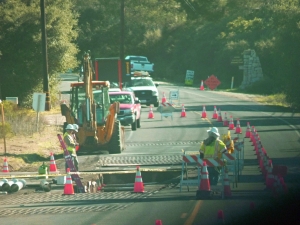
By Miriam Raftery Photo: Sunrise Powerlink (left) transmits 500 kilovolts of electricity above ground across most its its route, but was installed underground in Alpine, where it flows beneath the main street in the rural mountain town. February 20, 2016 (Alpine) – East County Magazine reached out to San Diego Gas & Electric (SDG&E) after reviewing results of two studies measuring electromagnetic field (EMF) levels in Alpine. (The first study, done by an engineer and contractor, found high levels along Alpine Blvd. above the underground Sunrise Powerlink. The second, commissioned by the County Office of Education, measured levels at Alpine Elementary School. It found relatively low levels at most places on the campus, though two outside areas nearest the boulevard were higher, one substantially so. View details here.) Those reports raised concerns among some community members about potential health risks for chlidren, though medical studies have shown conflicting results on this issue. We asked SDG&E if it has plans to measure EMF levels at other locations, what EMF levels it would consider safe, what fixes or mitigation might be possible, and what EMF research the company supports. Below are our questions and the answers provided by Allison Torres, SDG&E media representative: Q: Will schools NOT included in the Alpine Unified School District will be tested (i.e. the charter school, the preschool, and the site of the proposed Alpine high school)? A: SDG&E will perform EMF measurements if requested by a customer, and will take the measurement on the requesting customer’s premises. For customer privacy reasons, the results will only be shared with the customer. Q: Is the conduit for the underground Powerlink metal or PVC? Is it encased it concrete? A: The conduit is PVC per SDG&E standard and is encased in concrete. Q: There seems to be dispute within the medical and regulatory community over what levels of EMFs are safe. What level would SDG&E agree is high enough to be of concern medically? A: The science and health communities, not SDG&E, are responsible for determining whether an exposure is “high enough to be of concern medically.” The CPUC has on several occasions acknowledged that there is no basis for adopting numerical standards for magnetic field exposure. In particular, the CPUC decision approving the Sunrise Powerlink project stated that, “The Commission has examined EMF impacts in several previous proceedings [CPUC Decisions D.06-01-042 and D.93-11-013]. We found the scientific evidence presented in those proceedings was uncertain as to the possible health effects of EMFs and we did not find it appropriate to adopt any related numerical standards. Because there is no agreement among scientists that exposure to EMF creates any potential health risk, and because CEQA does not define or adopt any standards to address the potential health risk impacts of possible exposure to EMFs, the Commission does not consider magnetic fields in the context of CEQA and determination of environmental impacts.” Additionally, no California or U.S. Federal Government agency (including the Environmental Protection Agency) has adopted health-based standards for magnetic field exposure, and neither has the World Health Organization. Although science has been unable to determine whether there are health effects from EMF exposure, we recognize the concerns of our customers. Until research and the scientific community provide greater direction, the company, under the direction and regulation of the California Public Utilities Commission, will continue to take proactive measures to reduce EMF levels whenever possible. Q: If high levels are found in areas that are of concern, such as inside the school, homes or businesses (after ruling out other causes such as microwaves or computers) what is the level measured inside such locations from Powerlink that would make SDG&E believe that mitigation is needed? What possible fixes are there? The expert I spoke with said there are ways to shield underground lines, so the question is was that done initially, and if so, are there areas that were not adequately shielded that may need a fix? A: The CPUC EMF Policy requires utilities to identify the no-cost measures undertaken, and the low-cost measures implemented, to reduce the potential EMF impacts. Per this policy, SDG&E applied no-cost reduction measures to the Sunrise Powerlink underground by splitting the bundled phase conductors of each circuit and reverse-phasing the conductors in the conduits. Reversing one set of phase conductors can cause the magnetic fields to partially cancel the fields from the other set, which successfully reduced EMF levels by over 60%. Q: How does SDG&E support EMF research? A few examples of our support include: SDG&E supports EMF research by actively participating as a member of the Electric Power Research Institute (EPRI) Electric and Magnetic Fields and Radio-Frequency Health Assessment Program. This program addresses key environmental health and safety issues related to public and worker exposure to electromagnetic field environments associated with electric power system infrastructure. EPRI is the sole EMF research entity in the United States that brings together scientists and engineers as well as experts from academia and the industry to conduct research and development relating to the generation, delivery and use of electricity for the benefit of the public. SDG&E’s EMF Services, Safety division attends at least two EMF/RF research and informational conferences each year to stay abreast of the current EMF research and developments.
ALPINE EDUCATION FOUNDATION AGREES TO FUND INDEPENDENT EMF STUDIES
Superintendent issues correction: EPA has not issued recommended EMF safe levels. Meetings Feb. 23 and 25 will address EMF issues in Alpine. By Miriam Raftery February 20, 2016 (Alpine)—The Alpine Education Foundation has agreed to fund hiring a professional independent expert to measure electromagnetic frequency (EMF) readings along the route of the buried Sunrise Powerlink in Alpine, AEF president George Barnett has informed East County Magazine. “It provides `we’ in Alpine to have some ownership in the matter,” said Barnett, who adds that implications of earlier, informal readings are “worrisome. They suggest radiation levels in excess of current guidelines for public safety.” The Alpine controversy arose after a study conducted by engineer Robie Faulkner and contractor Michael Milligan found high EMF levels along Alpine Blvd – so high that the authors recommended that children in Alpine be tested regularly for leukemia, which some studies have linked to EMF exposures, though some other studies found no link or were inconclusive. Levels over 4 mG (.4 microtessla) were found to double the risk in a couple of studies, with a slight increased risk at somewhat lower levels. Just how low is safe for long-term exposure remains an open question. The Alpine Union School District asked the County Office of Education to take separate measurements. Last week, the COE did arrange for testing at 18 sites. Initially a letter from the Superintendent said all levels were under 2.5 mG (equivalent to .25 microtessla), in some cases, far under that level. That was a slight exaggeration (View data and map of tested areas here. ) Sixteen of those measured under 2.5 mG. But two sites measured over, one substantially, though not at classrooms. A bridge on the school parking lot measured 6.6 mG, while a landing between the upper and lower lots measured 2.9 mG. These are areas closest to Alpine Blvd. and farther away the levels dropped off sharply. The County expert in this field is expected to visit the site Tuesday to offer an assessment. Alpine Union School District Superintendent Bruce Cochrane, in a letter to parents last week regarding testing on electromagnetic frequencies at Alpine Elementary School, stated that the results showed levels “within the Environmental Protection Agency (EPA) -recommended limit of 2.5 milliGauss (mG).” But the U.S. EPA website states, “In the United States, there are no federal standards limiting electromagnetic fields from power lines and other sources to people at work or home.” We asked Superintendent Cochrane to back up his statement. He responded, “Hours have been spent diving into all the particulars of international scientific guidance around these guidelines. After reviewing all that can be found, I think it may have been better stated that the generally accepted guidance is 2.5 milliGauss (mG). This is another reason why we are working with the San Diego County Office of Education to bring out an actual expert in this field. Our hope is to have this person assess AES on Tuesday, because we want to make sure we are doing right by our students.” Cochrane earlier forwarded several websites listing generally accepted guidelines of 2.5 milliGauss, stating that some based on a Swedish set of guidelines. Here are the links: http://www.safespaceprotection.com/electrostress-from-home-appliances.aspx http://www.emrshieldingsolutions.com/commonly-asked-questions https://www.defendershield.com/electromagnetic-field-emf-health-dangers/ http://www.wellnesscenter.net/resources/EMF/What_are_EMFs.htm Barnett elaborated in an e-mail to ECM, “Generally, the EPA comments appeared to be directed at being reassuring. What this all says to me is that we individuals don’t know much at all; but that the matter is unsettling and worrisome until parents and residents are told something more definitive. I would hope that is based upon facts specific to Alpine’s situation. Bruce is trying to signal the Alpine community that the district is pretty promptly getting on top of the issue, and that the County and the County Board of Education are involved. AEF thought that a professional 3rd party measurement to specific technical guidelines and an assessment will help in any determinations. AEF thought we could be of service by agreeing to fund that. It provides `we’ in Alpine to have some ownership in the matter.” Barnett, who also serves on the Alpine Community Planning Group, said planning Group members have also voiced concerns and several have taken actions as individuals after the first report’s results were presented at last month’s meeting. Also, an APCG member working in consultation with the Alpine Education and Alpine PTA president has worked to help select a professional, licensed technology firm to solicit an independent proposal for EMF measures along Alpine Boulevard and permanent EMF monitoring at Alpine Elementary, Barnett told ECM in an e-mail. Note: Barnett also corrected a misstatement made to our media outlet last week, when he indicated the ACPG had taken action. After Alpine resident Lou Russo pointed out that the EMF issue was not on the agenda last week and no vote was taken, Barnett clarified, that rules prohibit formal action on non-agendized items regardless of urgency, “even in the face of potentially serious matters such as radiation exposure to the community’s children.”“Since rules prohibit action on a non-agendized item, individual board members stepped forward to voice concerns to the county and school district.” He praised the efforts of Alpine Union School District Superintendent Bruce Cochrane, the County Department of Education and others. “The local and county government agencies have responded with alacrity, depth of understanding and with great concern regarding people’s fears for their children first, and then for the rest of the community residents.” The tests thus far have focused only on the street itself and the Alpine Elementary School site. But street measurements near the site of the proposed Alpine High School site were much higher than in front of Alpine Elementary. There are other schools along Alpine Boulevard, including Alpine Charter High School and a preschool. In an e-mail to ECM, SDG&E media relations spokesperson Allison Torres indicated that SDG&E will perform EMF measurements if asked by a customer at the customer’s premises. “For customer privacy reasons, the results will only be shared with the customer,” she
READER’S EDITORIAL: BROWN ACT REQUIREMENTS AND TIME LIMITS ON SPEAKING

An open letter to the Grossmont Union High School District Board regarding its ban on any public citizen speaking over 3 minutes total for all agenda items combined By Nick Marinovich, former member, Citizens Bond Oversight Committee for the Grossmont Union High School District February 20, 2016 (San Diego’s East County) — As a Citizen who actively participates in the governance process, I have indicated at several board meetings my frustration with not being able to adequately make my points when there is a three minute total time any one Citizen can speak at a regular board meeting. Government Code Section 54954.3 states: (a) Every agenda for regular meetings shall provide an opportunity for members of the public to directly address the legislative body on any item of interest to the public, before or during the legislative body’s consideration of the item, that is within the subject matter jurisdiction of the legislative body, provided that no action shall be taken on any item not appearing on the agenda unless the action is otherwise authorized by subdivision (b) of Section 54954.2. (b) The legislative body of a local agency may adopt reasonable regulations to ensure that the intent of subdivision (a) is carried out, including, but not limited to, regulations limiting the total amount of time allocated for public testimony on particular issues and for each individual speaker. (c) The legislative body of a local agency shall not prohibit public criticism of the policies, procedures, programs, or services of the agency, or of the acts or omissions of the legislative body. Nothing in this subdivision shall confer any privilege or protection for expression beyond that otherwise provided by law. This upcoming agenda illustrates my point. I wish to speak under non-agenda public comment regarding the need for campaign limit donations related to the Bond Program and possible violation of the law on the way the Bond Feasibility Report was conducted in light of the recent Attorney General Opinion. I also wish to speak on: N-1 (Trustee Boundaries), N-3 ($620,000 in additional legal fees for the Alpine law suit including “Public Relations” Costs), N-4 (Reappointment of Mark Zacovic to Bond Committee), and P-2 (Performance Audit). These individually could take up three minutes and not cover my points. In summary, it is my contention that your regulations on Public Speaking are not reasonable and has the effect of prohibiting public criticism. The opinions in this editorial reflect the views of the author and do not necessarily reflect the views of East County Magazine. To submit an editorial for consideration, contact editor@eastcountymagazine.org
COMMUNITY FORUM TO DISCUSS ELECTROMAGNETIC FIELDS FROM SDG&E UNDERGROUND TRANSMISSION LINES – FEB. 23 IN ALPINE

East County News Service February 20, 2016 (Alpine) – A community forum to discuss electromagnetic fields from SDG&E’s underground transmission lines will be held on Tuesday, February 23 at 6 p.m. in the Alpine Elementary auditorium (1850 Alpine Blvd.) You’re invited to join the Alpine Union School District, Supervisor Dianne Jacob and members of her administration for this informal discussion. Everyone in the community is encouraged to attend and bring your questions or concerns.