
SNOWY, WINDY WEATHER TO SOCK REGION STARTING TONIGHT
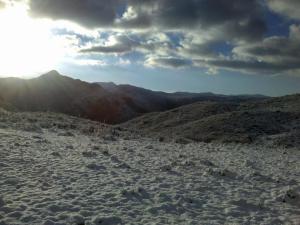
By Miriam Raftery December 10, 2015 (San Diego’s East County) – A low pressure trough moving south into our region is forecast to bring strong westerly winds, showers and mountain snow tonight through Friday, meteorologist Mark Moede with the National Weather Srevice in San Diego advises. Wind gusts could reach 60 to 70 miles per hour, posing hazards to high profile vehicles in mountains and deserts, including on I-15, I-8, and I-10. There is also a chance of thunderstorms, hail and brief, heavy downpours possible. San Diego County mountains could receive up to two inches of snow above 5000 feet in elevation, with traces down to 4500 feet. Coastal waters will also have hazardous boating conditions with steep seas greater than 10 feet. Watch for more showers and strong wind starting late Sunday through Monday night, when mountain snow could dip to 4,000 feet or lower.
LIGHTS FANTASTIC: HOLIDAY LIGHT SHOW IN SANTEE

By Miriam Raftery December 8, 2015 (Santee) – Michael Balazs has created the ultimate Christmas light show at his Santee home “to bring smiles to the neighborhood children and adults alike.” This year’s show at 9773 Roe Drive, Santee features 28,000 lights synced to eight musical songs ranging from Party Rock to Carol of the Bells. It’s all synced to FM radio so people can get out of their cars and dance to show their holiday spirit. This year, he switched to professional LED lighting – and slashed his electricity bill to a shockingly low $50 to $70 a month, he says. “I do this light show in memory of my father, who passed away from cancer in 2009,” he explains. “Christmas was his favorite time of year and following his death, I knew this would make him look down and smile.” He began his elaborate holiday decorating five years ago and today, helps bring awareness and raise money for the American Cancer Society, Children’s Cancer Charity and Santee Santas. Some visitors have offered donations to help him buy new lights or pay his power bill, but he says “I refuse to take them and instead ask for them to donate money to a cancer charity.” Creating the light show is a major production that takes 10 volunteers a month or more to set up, plus 8 to 10 hours for each minute of music to synchronize the songs and several days to tear-down after Christmas. “I would really like to see more smiles come from it,” says Balazs, a member of the U.S. Navy. “The only thing I get from this is purely people saying how much they enjoyed watching the show. And when I walk outside and see little kids in front of the house dancing to the music and lights it makes me smile and I know my father is looking down smiling as well.” The show features Light-O-Rama Conrollers, 478 computer-controlled channels and three comic color LED ribbons capable of producing 1.5 million colors of light. The old show, before LED lighting, needed 80 amps of power and about 8,000 watts at full power. Now his power is “a fraction of that, he says. Show times: 5:30 p.m. to 10 p.m. Sunday through Thursday and5:30 to 11 p.m. on Friday and Saturday nights through January 1st. For more information, visit http://www.dbchristmas.com/, view videos of Balazs’ past light shows at https://vimeo.com/user2831260 or see his Facebook page at www.facebook.com/dbchristmas.
MY WORLD INTERRUPTED
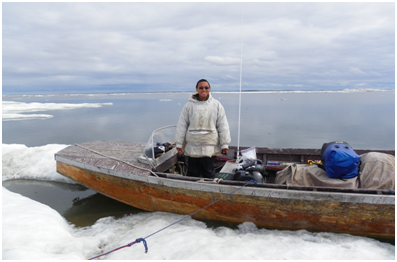
By Esau Sinnok, Arctic Youth Ambassador Source: U.S. Department of the Interior December 10, 2015–Close your eyes and picture your best memory with your family and friends. If you’re like me, that memory is filled with the warmth and comfort of a familiar home. I hope that, unlike me, you are never asked to put a price on that home because of the effects of climate change. Welcome to Shishmaref, Alaska, population: 650. We’re a small Iñupiaq community where everyone knows each other. Shishmaref is a barrier island that has been eroding and flooding for the past 50 years — even before disruption from climate change was widely recognized. Over the past 35 years, we’ve lost 2,500 to 3,000 feet of land to coastal erosion. To put this in perspective: I was born in 1997, and since then, Shishmaref has lost about 100 feet. In the past 15 years, we had to move 13 houses — including my dear grandma Edna’s house — from one end of the island to the other because of this loss of land. Within the next two decades, the whole island will erode away completely. During my lifetime, I’ve seen unusual weather patterns that villagers have never witnessed before. It rained during winter last year and ice formation is coming later in the year. My grandfather remembers when 30-35 years ago ice used to form fully in late September or the middle of October. It is December, and the ice barely formed enough for us to safely cross it. The lack of ice has affected our hunting, fishing and other traditions. We use handmade wooden boats to hunt and fish in the surrounding areas of Shishmaref as well as snowmachines to get around in the winter time. Every year it gets harder and harder to collect enough meat for the winter. Tomcod and whitefish are a large part of our winter diet, but since the ice forms later in the year, it’s more difficult for us to gather enough food. Our village is so remote that it is only accessible by airplane, and we only get fresh food products from other parts of Alaska every one to two months. If we can’t hunt and fish to feed ourselves in the winter, we will starve. In 2001, my people voted to relocate along the coast of mainland Alaska, but the estimated cost is $200-250 million. The reality of moving is very complicated. There is not enough funding for relocation efforts. And even though we made this decision, everyone wants to stay — especially the older generations who have spent their whole lives in Shishmaref. But we realize we have no choice. It really hurts knowing that your only home is going to be gone, and you won’t hunt, fish and carry on traditions the way that your people have done for centuries. It is more than a loss of place, it is a loss of identity. Once you see how vulnerable my community is to sea-level rise and erosion, you won’t be able to deny that Arctic communities are already feeling the impacts of climate change. Despite this reality, I appreciate every day that I get to wake up and see the scenery that’s still here and that I’m able to call this place home. For now. While it’s too late to save the island of Shishmaref, we still have a little bit of hope that we’ll be able to preserve our traditions and stay united as a culture. That’s why I am determined to speak up for my community. This year, I became an Arctic Youth Ambassador — a program started by the Interior and State Departments in partnership with Alaska Geographic. It gives Alaskan youth the chance to share our perspectives on issues in our communities. As an ambassador, I not only attend the Arctic Council meetings, but I’m also invited to travel with the Arctic Council. This week, I am in Paris, France, for the United Nations climate talks. It’s only the second time in my life that I have left Alaska, and it’s been a powerful experience. This week, I met with Secretary Jewell and other indigenous people. This meeting gave me insight into how issues of the Arctic and climate change are being handled by our world leaders. My reason for attending the 21st Conference of Parties in Paris — COP21 — is to tell leaders that climate change is affecting the Arctic more than other places of the world, and if the ice in Greenland melts, these villages and islands will be under water. I hope that world leaders will hear my message and rise to the challenge because it is not just a political issue to me. It’s my future.
BIOMETRIC ENTRY/EXIT TESTING AT OTAY MESA BORDER CROSSING

Source: U.S.. Customs and Border Patrol December 10, 2015 (Otay Mesa)–U.S. Customs and Border Protection will begin testing new biometric technology at the Otay Mesa pedestrian crossing this week to enhance identification of certain non-U.S. citizens entering and exiting the U.S. CBP uses biometrics in order to accurately verify who arrives in the United States and who leaves. Acording to CBP, the new technology is being tested to see if it is a solution to help better match entry and exit records along the land border, and to help protect a traveler’s identify against theft. The test applies to foreign visitors who are normally subject to fingerprinting when they apply for U.S. visas and other travel documents. U.S. citizens will not be screened with biometrics. “CBP is committed to developing a system that provides biometric exit data on non-U.S. citizens in a way that does not disrupt air, sea, or land port operations, but, rather secures and facilitates travel and trade,” said San Diego Field Operations Director Pete Flores. “This test will help inform on next steps to developing and implementing biometric exit in the land pedestrian environment.” Improved technology for comparing entry and exits along the land border will enhance CBP’s ability to secure the border, address immigration overstays, identify persons of interest and improve reporting and analysis of international visitors to the U.S. This technology test is a direct result of recommendations from the 9/11 Commission, and addresses outstanding Congressional mandates to biometrically record the entry and exit of non-U.S. citizens. The project will be deployed in two phases. Beginning on Dec. 10 certain non-U.S. citizens entering the U.S. will utilize new kiosks equipped with biometric capture technology in the pedestrian lanes to provide a facial photograph and iris images. The second phase will begin in February 2016, with biographic data provided from everyone departing the United States similar to the information provided when departing by air. Certain non-U.S. citizens will also provide their biometrics upon departure during this phase. The test will run through June 2016. For the entry phase of testing, the existing entry kiosks used by pedestrians at the Otay Mesa border crossing will be temporarily replaced with new kiosks equipped with a camera to take a facial photograph and iris images of certain non-U.S. citizens upon their entry to the United States. Processing for U.S. citizens will remain the same. During the exit phase of testing, all travelers will provide their travel documents, such as their passport, passport card, or other RFID-enabled travel document, identical to what they already provide when entering the United States. In addition, certain non-U.S. citizens will provide facial and iris biometrics to compare to their entry record. No biometric data will be requested from U.S. citizens either on entry or exit. The images taken during the testing will be used for purposes of this limited project only and will not be retained or shared with any other party or system. CBP remains committed to protecting the privacy of all travelers. CBP’s Entry/Exit strategy includes three core pillars: identify and close the biographic gaps and enhance the entry-exit system; perform targeted biometric operations; and transform the entry/exit process through the use of emerging biometric technologies. Currently, CBP relies on biometric screening—digital fingerprints and photos—to secure our borders and ensure that foreign travelers presenting themselves for admission to the United States are who they claim to be. CBP plans to test additional technology in FY2016 to further its goal of capturing entry/exit data to secure and facilitate legitimate travel in a way that does not disrupt operations.
COVERT CANYON APPEAL FILED; OWNER MARC HALCON SPEAKS OUT AS CONTROVERSY HEATS UP
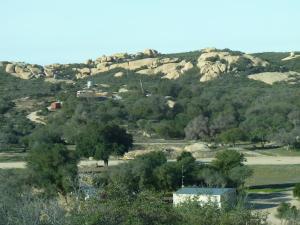
Planning Commission to hear appeal Friday; ECM tours site; environmentalists threaten lawsuit By Miriam Raftery December 10,2015 (Alpine)—An appeal filed yesterday on behalf of three environmental groups and neighbors of Covert Canyon will be heard by the County Planning Commission tomorrow at 9 a.m. If the appeal is denied, a letter signed by appellants’ attorney Marco Gonzalez states, “the Environmental groups and Appellants intend to file suit and seek injunctive relief before the matter is heard by the Board of Supervisors.” In addition to Clark and Robin Williams, the closest neighbors, Gonzalez’ letter states he is representing the Cleveland National Forest Foundation, Save Our Forests and Ranchlands, and Coastal Environmental Rights Foundation. A staff report recommends denying the appeal and upholding the Planning Director’s decision to reclassify the use of the property as law enforcement. Yesterday, East County Magazine visited Covert Canyon for a tour and exclusive interview with owner Marc Halcon, who also owns the American Shooting Center in Kearny Mesa. Halcon says he has been the target of misinformation and wants to set the record straight. We also spoke with Gonzalez, regarding contentions by opponents, who claim they have been targeted for harassment and sthur that the county’s actions set a disturbing precedent. Both sides have taken aim at each other in a battle that has broad implications for private property rights, environmental protection, and the need for enhanced training of first responders in an era when domestic terrorism looms as an increasing threat. The current controversy The County Planning Director signed a stipulated enforcement agreement that allows Covert Canyon to resume firearms training for military, law enforcement and governmental groups on weekdays from 7 a.m. to 7 p.m.—activities previously shut down by the County at the site pending application for a Major Use Permit. Recreational shooting would also be allowed on weekends. A CBS news video shows what the noise sounds like from a group of machine gun shooters at the site. At that time, the county sent Channel 8 news a statement which read in part, “Our preliminary review of this video gives us concern that this incident is a Zoning Ordinance Violation. It appears to be paramilitary training, which would necessitate a Major Use Permit.” The Planning Director contends that these activities are allowable under the “law enforcement services” definition in the County Zoning Ordinance. Supporters say such training is needed and that adequate facilities are not available elsewhere. Halcon says he is making major changes to improve fire safety and protect the environment, citing several examples. But opponents have filed an appeal claiming the approval constitutes an abuse of power without first conducting California Environmental Quality Act (CEQA) review. They contend fire improvements are not enough. They also contend that the county’s expanded definition of law enforcement opens the door to firearms or military-type training on rural properties across the region. The Williams’ claim they fear driving through a shooting range to get home, have been targeted for harassment and deprived of peaceful enjoyment of their property, while Halcon claims that he has been victimized by false claims made by the Williams. The site A long, deeply rutted dirt road through federal forest land leads up to the remote and aptly named Covert Canyon site in Japatul Valley south of Alpine. The road continues past a locked gate, providing the only access to neighbors Clark and Robin Williams’ home on a hill on the opposite side of the valley. The site is surrounded by Cleveland National Forest. We observed ponds, some dry, some with water, as well as groves of mature oak trees covering much of the property. A home, small office and a few storage sheds appeared to be the only structures. A long firing range runs through the heart of the property. Two other firing ranges banked by 12-foot-high berms are at one end of the site, one abutting forest land behind. At the opposite end, the property drops off into a valley where in wet years, a waterfall cascades downward. A blue jay flitted past and a woodpecker alit in a tree during our tour; we also observed a few ducks on a pond. At the firing range farthest from the Williams’ home, a shooter with a handgun was taking target practice. It was loud enough to need earphones at the range, though back at the property line near the Williams home the shots were audible, but far from deafening. This was just one shooter with small arms, however. Multiple shooters or large-caliber guns would be considerably louder. Halcon says he has had a noise study done that showed compliance with the county’s 50 decibel limit. But is a frequent barrage of multiple gunshots from military or assault-type weapons, as envisioned, compatible with rural living? That’s a key question in the controversy. Other key concerns include fire risk and environmental impacts. History Halcon (photo, right), who did anti-terrorist force protection for the Navy for seven years, says he bought the property in 2005 with the intent to offer firearms training both for recreational purposes (legal if no money is exchanged) and for commercial purposes. He says the County told him to get a permit from the Sheriff but eventually concluded that “doesn’t exist.” His project amounted to a “square peg in a round hole” that staff wasn’t sure how to address. He says the Sheriff’s Department advised him that as long as activities were private, not public, he could proceed. Covert Canyon began offering training to various military and governmental groups from homeland Security and the Marines to local police departments. The Williams’ appeal contends that their view shifted from watching wildlife drinking at ponds to seeing “dozens of men in camouflage fatigues milling about Covert Canyon day in and day out” shooting “handguns, shotguns, assault rifles and 50 calber long guns that look like something straight out of the movie Rambo…The sound of each shot