
EAST COUNTY ROUNDUP: LOCAL AND STATEWIDE NEWS
June 16, 2015 (San Diego’s East County) — East County Roundup highlights top stories of interest to East County and San Diego’s inland regions, published in other media. This week’s top “Roundup” headlines include: LOCAL Judge upholds ruling for Alpine vs. Grossmont (U-T) FAA eyes changes to flight paths around SD airports (U-T) Nearly 40K SD homeowners ‘underwater’ (U-T) There’s Still Not Much Transparency Surrounding Those Transparency-Boosting Body Cameras (Voice of SD) County approves 175-acre land deal (U-T) Tow company campaign trickery alleged (U-T) Lemon Grove Woman Fears for Safety After Posting Surveillance Video of Theft (NBC) STATE Bills show power rate disparities (U-T) In Los Angeles, a national model for how to police the mentally ill (CS Monitor) For excerpts and links to full stories, click “read more” and scroll down. LOCAL Judge upholds ruling for Alpine vs. Grossmont (U-T) A judge has ruled that the Grossmont high school district must set aside voter-approved bond money to build a high school in Alpine. The decision earlier this week means Grossmont and two groups from Alpine will meet in court later this year…. / Grossmont had requested in February that he dismiss the case. He denied that this week…. / The matter has been set to be heard in a civil case at Superior Court in downtown San Diego on Dec. 4. FAA eyes changes to flight paths around SD airports (U-T) Federal aviation officials want to tweak flight paths around San Diego County and other Southern California airports to reduce air traffic congestion and carbon emissions — a move that sparked noise complaints when rolled out elsewhere. / The Federal Aviation Administration will hold a public meeting on June 22 in San Diego to provide details on its proposed changes in flight routes. Local airports affected are Lindbergh Field, Palomar Airport, Brown Field, Montgomery Field, Gillespie Field and military bases at Miramar and North Island. Nearly 40K SD homeowners ‘underwater’ (U-T) 8.6 percent of local property owners owe more on their homes than they’re worth There’s Still Not Much Transparency Surrounding Those Transparency-Boosting Body Cameras (Voice of SD) One of the fundamental challenges of police body cameras boils down to privacy: How can we empower citizens and hold police accountable, while protecting both groups? Unfortunately, neither the San Diego Police Department nor civil liberties experts can offer much clarity yet on how average folks might practically benefit when they’re the ones captured on body camera footage. County approves 175-acre land deal (U-T) Board approves $1.4 million to purchase 175 acres for East County’s Santa Ysabel preserve. Tow company campaign trickery alleged (U-T) Advantage Towing and owner Ayman Arakat is suspected of laundering donations to every candidate seeking the Mayor’s Office in 2012 except the winner, Bob Filner. Lemon Grove Woman Fears for Safety After Posting Surveillance Video of Theft (NBC) San Diego Police will investigate online threats received from an East County woman who says she’s being retaliated after posting surveillance video of a man stealing items from inside her car. STATE Bills show power rate disparities (U-T) Utility companies charge more than public agencies, especially for heavy users…. / Especially for heavy users, bills are higher at the investor-owned utilities SDG&E, Edison and PG&E, overseen by the California Public Utilities Commission. In Los Angeles, a national model for how to police the mentally ill (CS Monitor) By partnering beat cops with mental health clinicians, the Los Angeles Police Department has reduced incidences of force used on individuals with mental illness and has connected thousands of individuals with counseling and support.
‘JURASSIC WORLD’ IS MORE OF THE SAME – AND THAT’S A GREAT THING
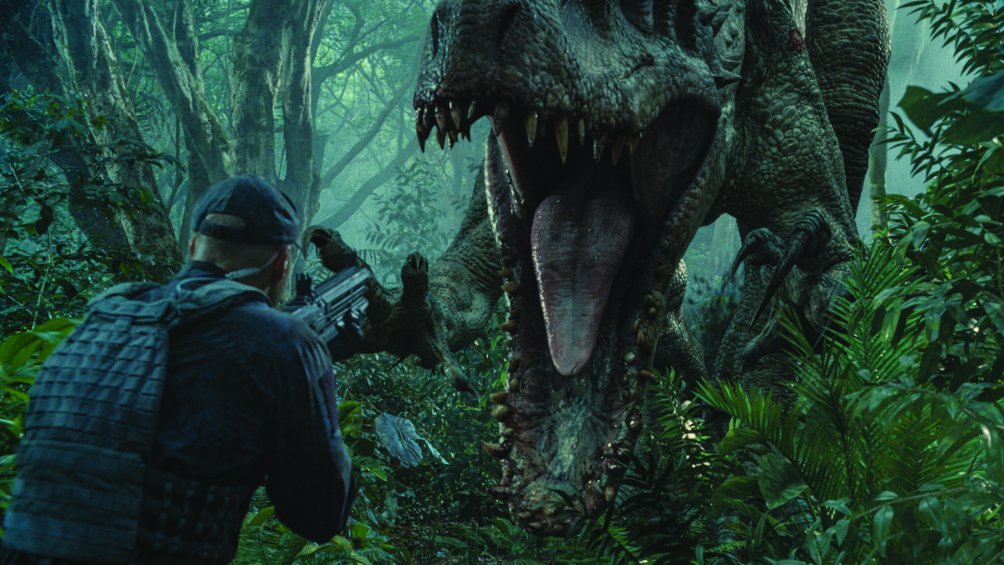
Posted By Spencer Moleda, TMV Movie Critic The Moderate Voice (reprinted with permission) June 16, 2015 (San Diego’s East County) – “You can’t repeat the past”, Nick said to Jay. “Can’t repeat the past? Why of course you can!” And we all know how it ended for Jay Gatsby, so after three films, why should it end differently for megalomaniacs and a few incautious geneticists? If there is any thematic through-line throughout the Jurassic Park films, it is that if you attempt to make a business out of nature, it will make a business out of you, and with that business comes an uncompromising bulldozer of carnage that only nature at its least sympathetic can create. The message of Jurassic World arguably boils down to the same idea, only there’s a slight nuance this time around — our failure comes not from our inability to comprehend nature but from our selective desire to do so. In a TED talk recorded nearly a decade ago, the great Jane Goodall, godmother of modern primatology, described the line between humans and animals as being “a very wuzzy line”, and that it is “getting wuzzier all the time”. This is taken to heart by characters like Owen, a raptor trainer played by Chris Pratt who sees the humanity in even our most vicious creations. He’s far from a glaze-eyed dreamer, however — he simply realizes that only by acknowledging these dangerous animals as complex minds with habits, feelings, and needs can we ever truly understand them, even at their most brutal and unhinged. This is what the analysts can’t seem to understand; viewing these animals through a glass window is not the same thing as protecting yourself, and just because you’ve assigned them a number doesn’t make them any less alive than you or I. “Hold the phone”, you might be thinking. Raptor trainer? You read right. Jurassic World, the latest incarnation of the late John Hammond’s prehistoric theme park, is arguably larger than ever, and this time, it’s in full swing. Thousands of guests arrive by boat and plane to the shores of Isla Nublar just for a chance to see creatures from the most distant epochs of our Earth’s history. This is in spite of the calculations of analysts, who claim that in light of their resurrection, the sight of a dinosaur packs no more surprise than the sight of an elephant. “If only”, I thought. Nevertheless, Claire, played by the ever-welcome Bryce Dallas Howard, announces the release of a newly designed creature, neither dinosaur nor animal, to up the wow-factor and produce more thrill for their customers’ dollars. With this, new security measures have been put into place to ensure the safety of every visitor and crew member, including, yes, a trainer of velociraptors. Do you have any suspicion that, gee, things just might not go as smoothly as calculated? If there’s any suspension of disbelief in this particular installment, it’s that after three separate tragedies in three separate films, people still haven’t decided this whole park idea isn’t worth pursuing. I imagined the immortal Werner Herzog out of frame, lost in ponder about what is clearly a depressing portrait of people’s refusal to learn from past disasters. This is no longer human curiosity gone awry – this is the kind of intense stupidity that Herzog himself describes as he gazes intently into the eyes of an incurious chicken, unthinking and, crucially, uncaring. Where the film succeeds is in making this part of the point. Some genuinely have learned, but these intelligent, measured people are on the payroll of others who either don’t get it or intentionally try not to. These are entities like the military, who’s interest in velociraptors only extends as far as their applicability as weapons and combat aids, completely oblivious to just how unpredictable they can be. I was reminded of the scenes from Michael Mann’s The Insider, specifically the recreated documentary footage of the big five tobacco CEO’s testifying in a court of law, claiming that they had no knowledge of tobacco’s addictiveness. Yeah. Okay. But back to the wow-factor. It is astonishing that after over two decades of technological advance and its inevitable abuse, seeing dinosaurs roam side-by-side with human beings has not lost an ounce of the magic it first had. Fill up our screens with orcs, apes, and dragons all you’d like, but they will never be more than fantasy. Show us a diplodocus or a parasaurolophus ad infinitum and each time will bring the same wonder as the first. I asked myself why this was even as I was watching it, trying to hold back the tears every time a dinosaur graced the screen, and it may be because we as humans are infatuated with that which is just beyond our grasp. After four films and a hundred years of scientific discovery, 65 million years seems almost cruelly within reach. That has always been the greatest draw of the Jurassic Park films; for the price of a movie ticket, we can see spectacles of nature that, in the cosmic scale of things, we seem to have only just missed. Now, what of the human stories? If there is a criticism of Jurassic World, it is that the plots and people have about as much dimension as a Roger Corman B-movie. Threads pop in and out with very little elegance, and the drama is perhaps less than groundbreaking. There. By acknowledging the film’s defects, I have hereby cemented my integrity as a proper film writer. I also don’t give the slightest damn, and I don’t suspect you will either. Jurassic Park began life as a pulp novel, and it has retained both those charms and those moments of creakiness in every installment. What matters is that these stories, as silly and popcorn-stuffed as they are, work best when they are drawn with childlike fascination, brought to life by actors and artists who are in love with the world they’re inhabiting. The characters are about as stock as one