
FLETHER HILLS RESIDENTS PLAN LAWSUIT OVER GILLESPIE FLIGHT SCHOOL TRAINING AND LEAD POLLUTION

East County News Service March 4 meeting planned for Fletcher Hills residents with attorneys February 25, 2015 (El Cajon) – Fletcher Hills residents are planning a lawsuit over loss of property values, quality of life and lead pollution associated with increased air traffic at Gillespie Field Airport. “The skies above our neighborhood have become a training ground for international flight school students, practicing an average of 140 to 190 touch & go operations everyday. They are burning leaded Avgas that coats our roofs, our patios, our plants and solar panels,” writes Sue Strohm with Advocates of Safe Airport Policies (ASAP) in a letter to Fletcher Hills neighbors. “We have spoken to supervisors, congress members, city councils, development councils, flight schools, and the FAA. All we have gotten in return is lip service, while the flight schools continue to expand.” Over two dozen households have consulted with two San Diego law firms on legal alternatives. Both firms, Blood Hurst & O’Reardon, LLP and Hurst & Hurts, have had attorneys conduct initial investigations on viability of the case and have agreed to take it on a contingency fee basis with a small retainer, Strohm says. Residents will request compensation for reduced property values and noise abatement techniques, like dual pane windows and ceiling insulation. In addition, the group seeks compensation for loss of the “use and enjoyment” of homes and yards. Those who have additional losses, such as an impact on a home based business or clean up from fuel deposits, may seek compensation for those amounts. The lawsuits may also be able to achieve reasonable restrictions on flight training hours, Strohm says. The attorneys will be available to speak with area residents starting at 6:30 p.m. on Wednesday, March 4th at the Hillside Recreation Center at 840 Buena Terrace off Fletcher Parkway. “Every property owner should understand the options available to resolve this problem,” Strohm says. Seating is limited; residents who plan to attend are asked to email info@gillespiefield.com with your name and number of attendees. “Join your neighbors who are sick and tired of being bombarded everyday,” the letter sent to residents concludes. “It’s time to stop serving as collateral damage.”
ALASKA, WASHINGTON D.C. EASE RESTRITIONS ON POT
By Miriam Raftery February 26, 2015 (San Diego)–Alaska has become the 3rd state to legalization the recreational use of marijuana, with limits similar to those in place in Colorado and Washington state, the other states where marijuana is now legal for adults to own in small quantities for personal use. In addition, city leaders in the District of Columbia, or Washington D.C. also voted Thursday to allow legal marijuana possession by adults of up to two ounces for private use in private homes only. Mayor Muriel Bowser and the city’s Police Chief made the announcement after approval of a ballot initiative by voters. But House Republican leaders sent a letter threatening Mayor Bowser that there will be “severe consequences” for violating federal law, which still prohibits all marijuana use and possession. The letter, signed by Representative Jason Chaffetz, Chair of the House Oversight committee, warns, “We’re not playing a little game here.” The city plans to move forward despite the threat from Congressional leaders, reminding district residents that the new law only applies to “home grown” marijuana grown indoors and used at home, not in public places, and driving under the influence is prohibited. “Residents spoke loud and clear when they voted to legalize small amounts of marijuana in the District of Columbia,” Mayor Bowser said, the Washington Post reports. Unlike states, however, the District of Columbia is subject to Congressional review of all city laws, so the conservative-controlled Congress could potentially snuff out the new-found freedoms passed by D.C. voters. To prevent the nation’s capitol city from going to pot.
MAJOR TRAIL CHANGES PROPOSED TO THREE SISTERS FALLS
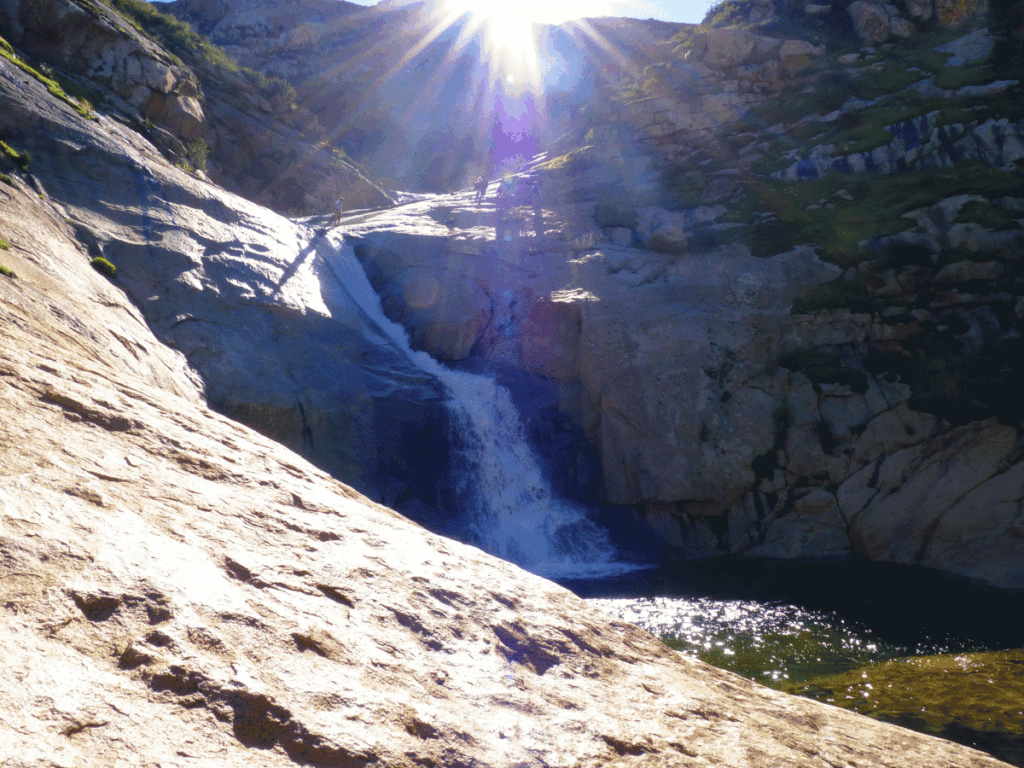
Public comments due by March 25 By Miriam Raftery February 25, 2015 (San Diego’s East County)–Three Sisters Falls is one of the most beautiful natural attractions in East County – a trio of waterfalls and natural swimming holes in a wilderness area within Cleveland National Forest. But the falls are also among the most difficult scenic sites to access. Now Cleveland National Forest’s Palomar Ranger District is planning a major recreation management project at Three Sisters Falls, located near Boulder Creek Road between Santa Ysabel and Descanso. The proposed action is to adopt and/or construct a Level 2 System Trail to Three Sisters Falls, to decommission and restore existing user-created trails, and to clear and construct a primitive dirt or gravel parking area off of Boulder Creek Road, also adding a kiosk with educational materials. The purpose of this project is to address concerns related to public health and safety, resource impacts from unmanaged recreation use, and compromised access along Boulder Creek Road for area residents and emergency vehicles during high-use periods at Three Sisters Falls, says district ranger Joan Friedlander. The user-created trails cross steep, rugged terrain and riparian areas. Last year, an average of 100 to 200 people a day used the trails to Three Sisters Falls, exceeding 400 people a day at peak periods. This has resulted in public health and safety issues including heat illness, traumatic injuries resulting from hikers falling as they attempt to reach the falls, and lost hikers. (photo, right: user-created trail requires rappeling with rope down a rocky face) There have also been problems of widespread soil erosion, watershed impacts, plant and wildlife impacts, and impediments to traffic flow on Boulder Creek Road including impeding access to emergency vehicles and area residents. While the U.S. Forest Service believes the proposed changes will improve safety , access and environmental protections, one key issue is that improving access could also increase the number of visitors to Three Sisters Falls. That could necessitate a permit system to restrict dailyvisitors, as was implemented after changes were made to trails leading to Cedar Creek Falls. A letter sent February 25, 2015 by Cleveland National Forest initiates the 30-day scoping period for the Three Sisters Falls Recreation Management Project Environmental Assessment (EA). A project description and map are available online at: http://www.fs.usda.gov/project/?project=46285 . You can submit electronic comments at comments-cleveland@fs.fed.us with the subject line Three Sisters Falls Recreation Management. Comments may also be mailed or hand delivered during business hours (M-F 8:00 am to 4:30 pm) to: Joan Friedlander, Attn: Bjorn Fredrickson, Palomar Range District, 1634 Black Canyon Road, Ramona, CA 92065. Finally, comments may be submitted by FAX to (760) 788-6130. Names of commenters will be part of the public record subject to the Freedom of Information Act. Any comments received by March 25, 2015 will be included in the project record.
SAN MIGUEL FIRE VOTES TO OPEN FINANCE COMMITTEE TO PUBLIC, PRESS
East County News Service February 26, 2015 (Spring Valley) – As a result of an East County Magazine (ECM) inquiry, San Miguel Fire District’s Board voted this week to make its finance committee a permanent standing committee, which means that the committee’s meetings will now be open to the press and public. Previously, the finance committee was deemed an ad-hoc committee by the district, which argued that it did not need to allow public access. ECM contacted Californians Aware (CALAWARE), an organization that protects public access under Califoirnia’s sunshine laws. CALAWARE General Counsel Terry Francke advised that the Finance Committee could be construed as a standing committee subject to the Ralph M. Brown open government act, after he reviewed district records on the committee’s creation. While the Board disputed that it should be required to open records or prior meetings, following an ECM request to open future meetings to the public, the Board voted to make the committee a permanent standing committee and do just that. Directors Ek, Johnston, Kiel, McKenna, McMillan and Rickards voted in favor; Director Vacio was absent. ECM has previously reported on a state investigation of the district’s finances which found major discrepancies . Specifically, the report indicates the state launched its investigation because the district understated revenues in fiscal years 2010-11 and 2011-12 by $557,878 and $2,357,252 respectively. In addition, the state contended that expenditures were over-stated by $827,298 and $987,833 during those two years while grant revenues were overstated by more than $1.8 million in fiscal year 2011-12. San Miguel has since formed a partnership with CAL-FIRE to handle firefighting services for the district. ECM asked CAL-FIRE public information officer Kendal Bortissier for an explanation regarding the differences in the reporting of revenues. Bortisssier says the numbers used in the State Controller’s Office report were unaudited numbers that did not reflect findings of the independent audit completed about six months later. “The actual independent audit is the official reporting of the District’s financial position,” he said. The district has not provided details as to exactly why it was off by hundreds of thousands of dollars, or in one case, over $2 million in its initial report–but those bookkeeping discrepancies will cost taxpayers the full expenses of the state’s investigation. ECM has asked the District to disclose the cost of that investigation but has not yet received a response.
CHAMBER’S “CABARET” EVENT SHINES SPOTLIGHT ON LOCAL HEROES

By Miriam Raftery February 26, 2015 (La Mesa)—The La Mesa Chamber of Commerce celebrated the accomplishments of local police, fire, medical response and senior volunteers at its annual “Salute to Heroes” banquet on February 18th at the Town and Country Hotel’s Golden Ballroom. The event also featured installation of officers and a “Come to the Cabaret” theme complete with New York cabaret singer Devlin, pianist Chris Drury, and a cabaret cake cooked up by Grove Pastry Shop. This year’s honorees were: Cody Brackney and Kyle Granger, paramedics with American Medical Response: These partner paramedics have helped many community members with medical problems, including coming to the aid of an elderly patient run over by an SUV, who survived thanks to their swift actions in treating the patient and transporting the victim to a trauma center. Captain Todd Nelson, Heartland Fire and Rescue: A 17-year veteran of the fire service, Captain Nelson is deeply involved in the La Mesa Fire Department and La Mesa Fire Explorer Program. He serves on several committees and organizes the annual Fire Station Pancake Breakfast, also serving as a strong leader of the Apparatus Committee which helped secure two near vehicles for La Mesa’s fleet—a plan that took hundreds of hours to help improve safety for the community. Officer Bill Wilson, La Mesa Police Department: Officer Wilson has served with the department for 7 years and has been the Traffic Unit’s lead investigator on three major injury accidents, including a fatality, due to completing advanced coursework. He takes pride in his job and even when working his regular shift in traffic, he also volunteers to help patrol on radio calls. Maxine Lynch, La Mesa Police Department: Maxine Lynch has worked for the department for 34 years, supervising the Retired Senior Volunteer Program for the last two decades. She also supervises the Live Scan Operations and manages the Graffiti Tracker program, as well as organizing and participating in numerous annual events ranging from the RSVP 20th anniversary gala to the Flag Day Parade and the LMPD Citizens Academy. Barbara Burgess and Lorraine Sheibley, Retired Senior Volunteer Patrol, La Mesa Police Department: These volunteers work tirelessly to help seniors in La Mesa. One example of their commitment was helping a senior who was evicted and homeless. The found him, called his social worker and his doctor, helping find a home for him to live on his limited income. They stayed in touch with him through visits the he appreciates. A writeup in the Chamber program states that these volunteers’ “caring and giving spirit is endless. They go the extra mile every day to ensure that La Mesa’s at risk seniors are a little safer.” La Mesa Chamber president Mary England also presented a special award to retiring La Mesa Police Chief Ed Aceves, who received a standing ovation, plus flowers for his wife. Many elected officials from across East County were also in attendance, including Supervisor Dianne Jacob, Santee Councilman Rob McNellis, Lemon Grove Councilman George Gastil, representatives from Congressman Duncan Hunter and Congresswoman Susan Davis’ offices, and several La Mesa’s City Council members.
FREQUENT SAUNA USE PROTECTS MEN AGAINST CARDIAC DEATH
Source: University of Finland February 25, 2015 (San Diego)–Frequent – even daily – taking a sauna can reduce the risk of cardiac death, according to a recent study carried out at the University of Eastern Finland. The 20-year follow-up study discovered that men taking a sauna 4-7 times a week were 63% less likely to experience a sudden cardiac death than those taking a sauna once a week. Furthermore, the occurrence of death due to coronary artery disease and other cardiac events, as well as overall mortality, were less frequent in the group taking saunas several times a week. The effects of sauna use on mortality were studied in the Kuopio Ischaemic Heart Disease Risk Factor Study (KIHD), involving more than 2,000 middle-aged men living in the eastern part of Finland. Based on their sauna-taking habits, the study participants were divided into three groups: those taking a sauna once a week, those taking a sauna 2-3 times a week, and those taking a sauna 4-7 times a week. The more frequently saunas were taken, the less likely were sudden cardiac deaths, deaths due to coronary artery disease and other cardiac events, as well as deaths due to other reasons. Moreover, the time spent taking a sauna was linked to the risk of cardiac death. Those who spent more than 19 minutes in the sauna at a time were 52% less likely to experience a sudden cardiac death than those spending only 11 minutes in the sauna at a time. The risk of death due to a cardiac event was also otherwise smaller in those spending longer times in the sauna. According to Docent Jari Laukkanen, the study leader, the mechanisms of why taking a sauna protects the heart are not yet fully understood, and further research is still required. However, taking a sauna may reduce blood pressure and maintain blood vessel elasticity. The findings were published in JAMA Internal Medicine.
BLIZZARD BREAKS RECORDS ACROSS NORTHEAST
By Miriam Raftery February 25,2015 (San Diego’s East County)–While San Diegans are enjoying the sunshine lately, the Northeastern U.S. has been gripped by record cold temperatures and snow – a LOT of snow. Just how deep is it? Lowell, Massachusetts received 111 inches –that’s over nine FEET of snow! About eight feet of snow fell in Boston, and seven to eight feet of snow in parts of New York and Pennsylvania as well. Some residents found snow above the tops of their doorways, forcing them to dig tunnels to get out. Cars have been buried under mounds of snow. Internet videos show startled pets leaping into snow drifts and vanishing, then resurfacing. Boston bicyclists built a snow tunnel when their usual commuting path was blocked by the heavy snowfall. Some residents have been spotted skiing through downtown Boston and even sledding off roofs – an activity that promptly drew warnings from public officials for safety’s sake. The Siberian Express has brought record-breaking cold across the Midwest, too, with wind chill factors reaching 40 below zero in parts of northern Minnesota and North Dakota. Temperatures dipped to 30 below across some northern regions—that’s colder than Anchorage, Alaska! Subzero temps are being recorded as far south as Ohio. Another winter storm is set to hit –bringing even more snow! Here in San Diego County, warm, sunny skies are forecast for the rest of this week, though a storm this weekend could bring ran and even snow to our mountains in East County. But don’t expect much sympathy if you’re talking to friends and relatives in the eastern U.S. – and just be glad you don’t have to dig a snow cave next time you want to take a stroll outside your front door!
CHARGERS IN EAST COUNTY? GILLESPIE FIELD SPORTS VILLAGE PROPOSED
View a presentation on the Gillespie Field Sports Village concept by clicking here. Tune in Friday to our radio show at 5 p.m. on KNSJ 89.1 FM to hear our interview with Robert Germann, proponent of the Gillespie Field Sports Village. By Miriam Raftery February 26, 2015 (San Diego’s East County) – Imagine a new Chargers stadium and sports entertainment complex next to Gillespie Field on vacant land formerly occupied by the El Cajon Speedway. Sounds far-fetched? The 250-acre site is surrounded by four major freeways and a trolley stop close by. Approximately 180 acres are currently vacant—and none of this land has been used for aviation. Chargers fans’ future is in limbo, with the team threatening to move to Los Angeles County and share a stadium with the Raiders. The team wants a new stadium, but thus far San Diego county and city leaders have not come up with a solid plan for an alternative location and environmental contamination prevents rebuilding on the existing Qualcomm stadium site. The Gillespie Field Sports Village concept is the brainchild of Robert Germann. “Let’s focus on more than football,” he says. “Let’s create a `village’ where the Chargers, sports enthusiasts, families, business and opportunists can come together under one roof. There should be no desire to relocate to LA.” Germann believes the project could serve as a travel and tourist attraction that would boost the economy and most importantly, provide jobs here in East County, while keeping the Chargers in town at a location that is easily accessible. “Football season supplies the multiplier effect and generates revenue for countless businesses,” he says, citing restaurants, bars, retail stores, grocery stores and hotels as examples. There are hurdles to overcome, such as Federal Aviation Administration approvals and support from multiple political entities. It’s been estimated that a new Chargers stadium could cost upwards of a billion dollars. Germann proposes shared funding with the NFL, Chargers, County of San Diego, the cities of Santee and El Cajon, tribes that would stand to benefit by bringing sports fans closer to casinos, and potentially private donors such as heavyweights in East County County including Jimmie Johnson (the project could even include a new raceway, Germann suggests), Taylor Guitars, which has its manufacturing facility near Gillespie Field, and others. For local cities, some of the buy-in could come in the form of land swaps to offset cash investment. What about the much-heralded Aerotropolis redevelopment plan backed by local Chambers and the East County Economic Development Council? Germann says his plan would be compatible with that concept, since the main runway at Gillespie would be contained and nearby industrial sites would not be included in the sports complex plan. Thus they would still be ripe for redevelopment, though perhaps with a revamped name. Chargeropolis, anyone? What would need to go would be flight schools that have recently increased training of foreign pilots at Gillespie – a problem that has plagued neighbors, including Germann, a Santee resident who in the past has called for the airport to be moved but has since come to the conclusion that retaining the main runway for private pilots while adding the stadium and sports facility is a better use of the land. Germann unveiled his proposal just days before a different group of Gillespie neighbors in Fletcher Hills announced plans to sue the county over complaints that the flight school students have increased noise, safety risks, and lead pollution from aviation fuel at their homes. Those residents would likely welcome a shut-down of the flight schools, though it remains to be seen whether some may have issues with traffic, lights or noise from a pro-sports stadium. As for Germann, he says he has no vested interest (such as land speculation) other than a desire as a Chargers fan to keep the team close to home and as a bonus, to reduce flights over the homes of residents, including his home behind Rattlesnake Mountain. The Gillespie site has major infrastructure on flat land with nearby construction and concrete companies. A new stadium at Gillespie could be shared eventually by the Aztecs, local community college teams and other East County sports. Imagine a CIF high school football championship there, soccer, or other uses. The site straddles the cities of El Cajon and Santee. El Cajon has the highest poverty rate (29%) in San Diego County, with unemployment rates as high as 60% in the Iraqi immigrant community here and in double digits among some other groups. So bringing jobs to the region makes economic sense. The biggest obstacle may well be wooing the Chargers away from downtown San Diego, where no doubt the city will be offering incentives to keep the Bolts. But where? It could take a decade or more to develop a suitable site, and the Chargers may not be willing to wait that long to “bolt” to a new location. “The clock is ticking,” Germann observes. “The public desires the right decision and the Team does not need to keep threatening to relocate.” He urges civic leaders to put our region on the map and “Give the community of San Diego what they have been asking for thirteen years,” i.e. a permanent home for the Chargers with a new state of the art stadium and if built at Gillespie, a sports and entertainment complex as an added bonus for the community.
MONSTAH SUPERPAC TAKES ON SAN ONOFRE NUCLEAR WASTE ISSUE, TARGETS ISSA
Click here to hear our interview on KNSJ with David Eisentein, the San Diegan who founded the Monstah SuperPac Feb. 28 “Magic at Magicopolis” launch event planned February 26, 2015 (San Diego) — Monstah Superpac, a San Diego-based political action committee dedicated to protecting public health and safety, aims to “make the nuclear waste at San Onofre disappear.” The SuperPac’s first target? San Diego Congressman Darrell Issa, over his failure to address the public safety hazards posed by those radioactive wastes, buried in canisters just 5/8 of an inch deep in an active earthquake zone. A nuclear disaster at San Onofre would place 20 million Southern Californians within a 50 mile radius at serious risk, potentially displacing residents in multiple counties including San Diego. MonstahPac is rolling out its Network 2016, billed as the “final frontier in our fight against nuclear danger at San Onofre,” with a “Magic at Magicopolis” event Saturday, February 28th. The event will be held from 5 to 10 p.m. Saturday at Magicopolis, 1418 Fourth Street in Santa Monica. Celebrities are expected to be in attendance. Monstah Pac is the brainchild of David Eisenstein, a Carlsbad resident who set out to counter the “dark money” 501c4 SuperPacs funded by conservative billionaires and big business interests. In an interview with the East County Magazine Radio Show on KNSJ, Edelstein said he seeks to level the playing field created by the Supreme Court in the Citizens United case which allows virtually unlimited donations to candidates through SuperPacs. MonstahPac also plans to take aim at other politicians who are deniers of climate change, seeks to support candidates who back causes such as recycling, gun safety, police body cameras, and wider use of automated external defribrillators to save lives during sudden cardiac arrest. In the KNSJ interview, Eistenstein suggested that another San Diego Congressman, Duncan Hunter (R-Alpine) could be next in the crosshairs for MonstahPac due to his stances on nuclear issues and climate change.