
NEW! LOOK UP STATE LEGISLATORS’ VOTING RECORDS ONLINE
Printer-friendly version January 13, 2010 (Sacramento) – The Sacramento Bee has launched a new database where you can look up the voting record of every state legislator in California. Wondering how often your legislator broke party ranks, missed a vote or voted to support your interests instead of special interests? Look up your State Senator or State Assemblymember’s voting record by name, or if you don’t know your legislator, just enter your zip code. You can also enter a bill number to see how all legislators voted. http://www.sacbee.com/votingrecord/ Printer-friendly version
Bridging Worlds Trailer
Printer-friendly version Bridging Worlds Trailer from EC Magazine on Vimeo. ABOUT BRIDGING WORLDS A video trailer created by Khari Johnson, Miriam Raftery, and Diana Barreto San Diego’s East County has fast become hubs of refugees relocated from war-torn regions around the globe. Our community has the largest number of Iraq War refugees in America, as well as numerous refugees and asylum-seekers from Africa, Asia and other places. Nearly 400 refugees each month are flooding into East County. Their stories span the breadth of human experience and illustrate the triumph of the human spirit. They are survivors of war, torture, genocide, religious persecution, starvation, years of living in refugee camps, family separation, and harrowing escapes, arriving in a new land where they face both new barriers and opportunities. “Bridging Worlds” is a video trailer created by East County Magazine (www.EastCountyMagazine.org) to document some of these stories. The short film was created with simple equipment and a volunteer narrator in just one week, to meet a deadline for a federal grant application. This video shows some compelling personal narratives and many key issues faced by a generation of newcomers who are bridging worlds upon arrival in our region. Our mission is to expand our award-winning nonprofit media outlet to include a new BRIDGING WORLDS website or website section devoted exclusively to refugee issues in our community. We aspire to obtain grant funds, donations, and sponsors that will enable us to obtain professional-quality video and sound equipment, editing software, and hire a team of professional videographers and journalists to fully document the personal stories, challenges and achievements of refugees in our region, as well as provide a wealth of tangible online resources and other resources for the refugee community. Their challenges are enormous. Many arrive here speaking little or no English. Some speak obscure dialects. Some have lived their entire lives in refugee camps and are illiterate even in their own languages. Others are highly educated professionals—doctors, teachers, engineers– but are unable to obtain licensing in America. Finding jobs and bringing family here to join them are constant challenges. Federal aid has been slashed. Few people realize that in late 2009, the U.S. government cut aid to refugee families from eight months to just one—forcing them onto state assistance programs. Many of those programs are falling to the budget axe in our cash-strapped state. Losing cultural identity is another issue, as refugees forge bonds with others from their homelands in an effort to keep their music, arts, storytelling and other traditions alive. A Refugee Summit was convened in fall 2009 at Cuyamaca College locally, as we reported in November. Our coverage drew praise from the Chancellor and other event partners in business, education, the faith-based community, and social service providers. These community leaders and the refugees themselves seek ways to share information and resources, but lack a common vehicle to communicate. We aim to fill that gap and more by creating our “BRIDGING WORLDS” website that will be devoted exclusively to refugee stories and issues. Our vision is to document their compelling narratives, much as journalists documented stories of Dust Bowl victims in the 1930s and holocaust survivors after World War II. Starting with a series of webinars published online, we ultimately aspire to produce a documentary film and have commitments of support from prominent filmmakers once we obtain funding. Beyond documenting refugees’ stories, we seek to identify both needs and positive programs that have been implemented locally by nonprofits, private organizations, companies, government entities and educators that are achieving positive results for the refugees. Such programs could be replicated in other regions with high concentrations of refugees. We will also identify barriers to successful assimilation and where possible, potential solutions. East County Magazine also seeks to create online community resources for refugees and those who serve the refugee populations. At the Summit, we learned that refugees often have trouble finding translators, locating text books in their native languages, and learning even such basic skills as how to read grocery labels, where to find cultural programs, how to access public transportation, and how to connect with employers willing to hire refugees. We can provide such information online, available free to all. In addition, we plan to launch an online discussion forum on refugee issues. Our vision also includes creating an online gallery showcasing arts, music and other cultural elements from the various groups of refugees who now call East County home. Connected to that effort, we have also forged a partnership with another local nonprofit, Sacred Rocks Reserve (a secular facility that recently won a national prize for its sustainable business practices). Owners of Sacred Rocks Reserve seek to create an artists’ colony where refugees can develop artistic skills in a serene retreat, also creating a revenue stream for the refugee artists by selling their works through local galleries and a portal on our site. That project will also give refugees job-training skills in creating green/sustainable buildings to house refugees as well as studios and gallery space at the artists’ colony. East County Magazine will document the progress of the arts colony project and host events at the facility. East County Magazine is an award-winning nonprofit , nonpartisan online media outlet founded in November 2008 with a grant from San Diego Foundation for Change. We are published by the nonprofit 501c3 Heartland Foundation, best known for helping Cedar Fire victims rebuild their lives, providing job training in low-income communities, fostering public art and community education, and emerging on the forefront of the green jobs revolution. In October 2009, East County Magazine swept the San Diego Press Club awards with 18 journalism prizes, beating out far more well-funded contenders. We were named best general interest website in San Diego County and second best news site (after the Pulitzer-prize winning San Diego Union-Tribune). Our awards included honors for investigative reporting, general news reporting, and multi-cultural coverage. We have letters of support
5 WILD MICE TEST POSITIVE FOR HANTAVIRUS IN SAN DIEGO COUNTY
Printer-friendly version January 13, 2010 (San Diego) — County Vector Control officials confirmed today that five wild mice trapped during routine monitoring tested positive for Hantavirus. “As the weather cools, rodents will begin to seek shelter indoors. It is important to keep mice out of houses, garages and sheds to prevent infection.” said Jack Miller, Director of the County Department of Environmental Health. “People contract Hantavirus by inhaling the virus, often when they are cleaning up rodent droppings and nesting materials. Wet cleaning methods should be used to prevent inhaling the virus.” One harvest mouse was collected near the Tijuana River Valley. The remaining four harvest mice were collected in the Los Penasquitos Canyon Preserve. Vector Control randomly samples wild mice to determine the extent of the virus. Hantavirus is carried by wild rodents, primarily deer mice. The virus is found in rodent droppings and urine and can be inhaled by humans when it becomes airborne. The airborne virus can cause Hantavirus Pulmonary Syndrome (HPS), which can begin with symptoms similar to the flu, but in rare cases, can lead to severe breathing difficulties and even death. There is no vaccine or specific treatment for Hantavirus. Several precautions should be taken to avoid exposure: * Eliminate rodent infestations immediately. * Avoid rodent infested areas and do not stir up dust or materials that may be contaminated with rodent droppings and urine. * Clean up rodent droppings and urine using the wet cleaning method described below. DO NOT SWEEP OR VACUUM INFESTED AREAS. Instead, use wet cleaning methods: * Ventilate affected area by opening doors and windows for at least 30 minutes. * Use rubber gloves. Spray a 10 percent bleach solution (2 tablespoons bleach to 1 cup of water) onto dead rodents, rodent droppings, nests, contaminated traps, and surrounding areas and let the disinfectant stand for at least 15 minutes before cleaning. Clean with a sponge or a mop. * Place disinfected rodents and debris into two plastic bags, seal them and discard in the trash. * Wash gloves in a bleach solution, then soap and water, and dispose of them using the same doublebag method. Thoroughly wash your bare hands with soap and water. * For more information, contact the County Department of Environmental Health at (858) 694-2888 or visit the department’s Hantavirus Web page. Printer-friendly version
HOW MUCH CRIME IS IN YOUR NEIGHBORHOOD? FIND OUT AT CRIMEMAPPING.COM
Printer-friendly versionSan Diego Sheriff Announces New E-Tool January 13, 2010 (San Diego) — Sheriff Bill Gore today announces the initiation of a new Internet tool for the residents of San Diego County. Crimemapping.com, a creation of San Diego-based Omega Group, retrieves crime data, maps it by address, and positions it in crime categories for web users to view. Sensitive crimes, such as domestic violence and sex crimes will not be posted. People using the site can see mapped crime, generate summary reports for various time periods (a 90-day window), directly link to crime prevention information, and sign up for e-mail alerts. The address is www.crimemapping.com. The link will also be available on the Sheriff’s Internet site as a Public Resource, as well as the Crime Prevention and Crime Analysis pages. Crimemapping.com also has the capacity to automatically e-mail notifications of recent crimes and then go from mapped crime to real action: each crime on the map will link back to the Sheriff’s crime prevention information page, contract city information ~ if applicable ~ and the Sheriff’s main website. “This is giving our citizens timely information for informed action,” commented Sheriff Gore. “The website sums it up well when it says, ‘Well-informed people make better decisions.’” All users have to do is enter an address or select a specific city within the Sheriff’s jurisdiction. The map will display crime reports filed through the previous day. Crimes are mapped by street information and may not be associated with a property when viewed over a satellite image. Users will click on a crime and the reported date, time, and general location will be displayed, along with links to prevention resources, city, and Sheriff’s Internet sites. For areas and types of special concern, users may register for automated e-mail alerts. Printer-friendly version
BOOK REVIEW: POLICE AND PUBLIC SECURITY IN MEXICO
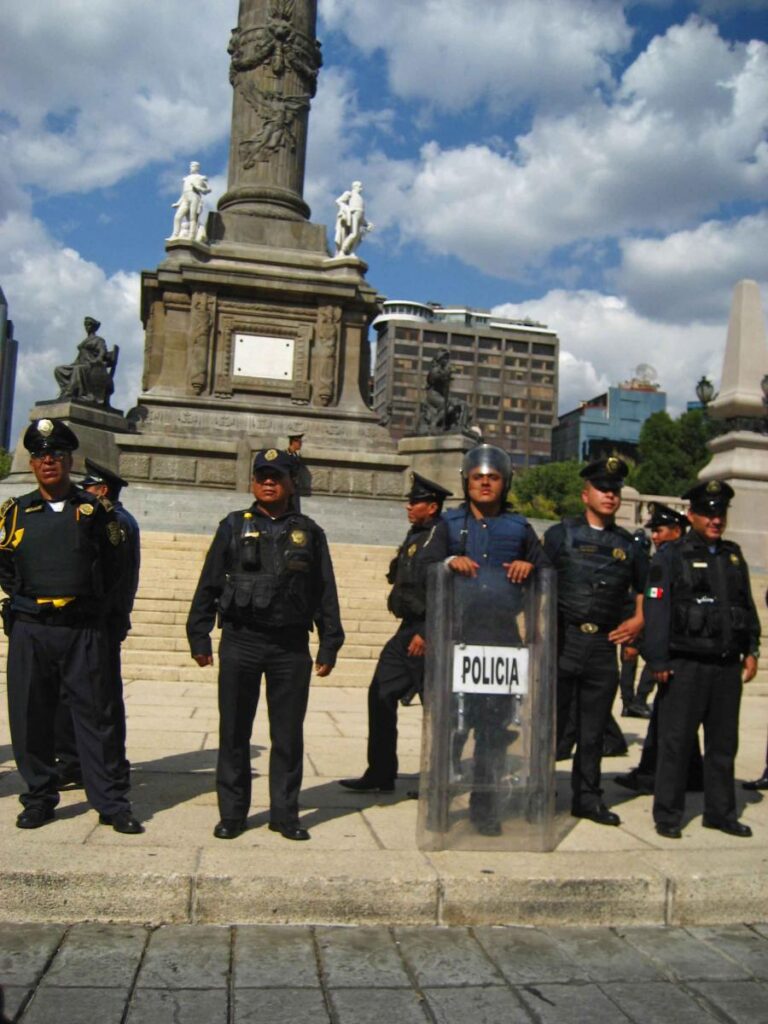
Printer-friendly version Edited by Robert A. Donnelly and David A. Shirk Book Review by: Dennis Moore January 13, 2010 (San Diego’s East County)–Yajaira Mota Orozco,a San Diego mother of two children, lost her life while eating at a restaurant in Tijuana. During December, she became the 88th victim of alleged gang and drug violence in a single month, underscoring the theme of a new book edited by Robert A. Donnelly and David A. Shirk, Police And Public Security In Mexico. Behind the death of 23 year-old Orozco is the escalating gun violence between rival gangs in Baja California. This book is a must read for those of us wanting a better understanding of the dynamics of the relationship between the United States and Mexico, as it concerns the drug culture and violence across our borders. As 2009 closed, 124 homicides were recorded in Tijuana in the month of December alone, making it the most violent month of the year. 2009 ended on a very somber note in Baja California, with the beheading of a state auto theft investigator after he was abducted from his home. Two other men were shot to death outside a tire store and another victim was killed at a taco shop. As a former resident myself of Tijuana for two years, I saw firsthand evidence of the circumstances that brought about this violence. Robert A. Donnelly and David A. Shirk have taken a scholarly approach in examining this violence through the insight and observations of several authors. This monograph is the compilation of insights from a number of authors, edited by Donnelly and Shirk. The premise of this book seems to be that the continued presence of the military (as opposed to the police) serving as the principal peace providers in Mexico is fraught with peril. Donnelly holds a Master’s degree in Latin American Studies from the University of California, San Diego (UCSD), and bachelor’s degrees in journalism and history from the University of Georgia. He is Program Associate at the Mexico Institute of the Woodrow Wilson International Center for Scholars in Washington, D.C. As Program Associate, Donnelly manages a MacArthur-funded research project on the patterns and practices of civic engagement and political participation by Latin American immigrants in eight U.S. cities. He also manages the Institute’s borderlands research project, examining ways for enhanced collaboration on joint management by the United States and Mexico. Prior to coming to the Mexico Institute, Donnelly was Coordinator of the Justice in Mexico Project at the University of San Diego’s Trans-Border Institute over 2006-2008. From 1997 to 2002, he worked as a journalist in Mexico, writing for trade publications, wire services, newspapers, and magazines. Shirk is the Director of the Trans-Border Institute and Associate Professor in the Political Science Department at the University of San Diego. Dr. Shirk received his B.A. at Lock Haven University and his M.A. and Ph.D. in Political Science at the University of California, San Diego (UCSD). He conducts research on Mexican politics, U.S.-Mexican relations, and the U.S.-Mexican border. Dr. Shirk is the principal investigator for the Justice in Mexico Project (www.justiceinmexico.org), and has been a fellow at the UCSD Center for U.S.-Mexican Studies (1998-99 and 2001-2003) and at the Woodrow Wilson Center in Washington, D.C. (2009-10). Publications by Dr. Shirk include Contemporary Mexican Politics, co-authored with Emily Edmonds-Poli (Rowman and Littlefield Publishers, 2008), Reforming the Administration of Justice in Mexico, co-edited with Wayne Cornelius (University of Notre Dame Press, 2007), and Evaluating Accountability and Transparency in Mexico, co-edited with Alejandra Rios Casares (Trans-Border Institute, 2007). The body of work of Donnelly and Shirk makes them eminently qualified to give this balanced presentation of Police And Public Security In Mexico, and along with the various authors profiled in this monograph, gives us all a clearer picture of just what is going on south of our borders. I recall while living in Tijuana the ominous presence of the military driving about in jeeps and larger vehicles, with guns quite noticeable. I also recall the early instances when President Calderon had the military patrolling the streets in Baja California, after guns of the local police had been confiscated, due ballistics tests to determine whether some police guns may have been used in crimes. It got to be pretty comical around that time, as the local Tijuana policeman replaced their guns with slingshots in their holsters. As noted by the editors, in recent years, Mexico has faced a grave public security crisis. From 2006 to 2009, rampant cartel-elated violence has killed more than 13,000 people, including hundreds of police and military personnel. Given the inability of domestic law enforcement agencies to adequately address these challenges, Mexico has deployed tens of thousands of troops to restore order and combat violent organized crime groups. In addition, Mexican and U.S. officials initiated unprecedented measures to promote cross-border collaboration in law enforcement and security, including the multi-billion dollar Merida Initiative to share responsibilities in fighting the war on drugs. These developments raise a host of questions about the course of Mexican public security and the prospects for strengthening the rule of law, according to the editors and a myriad of authors involved in this monograph. This monograph brings together the works of nine exceptional scholars who present timely analysis of these questions, provide a thorough assessment of Mexico’s principal domestic security challenges, and offer insights on how to tackle them, again, according to the editors. This monograph is part of the Justice in Mexico Project coordinated by the Trans-Border Institute at the Joan B. Kroc School of Peace Studies at the University of San Diego, and generously supported by The William and Flora Hewlett Foundation and The Tinker Foundation. The Justice in Mexico Project examines key aspects of the rule of law and the challenges related to reforming the administration of justice in Mexico, and provides access to relevant data and analysis through its website: www.justiceinmexico.org. One of the moist poignant points was made by author Maria Eugenia Suarez de Garay,
GIRLS HIGH SCHOOL BASKETBALL: WOLFPACK GANGS UP ON LADY SULTANS
Printer-friendly versionby Christopher Mohr January 12, 2010 (Santee) – What started out as a competitive game between two rival schools from Santee soon became a rout as the host Wolfpack of West Hills High School surged past the Lady Sultans of Santana High School with a comfortable 54-31 win. In a contrast of strategies, both teams played a tight game at the start as the first quarter ended in an 11-11 tie. Santana attacked from the outside with three-point shots from Alyssa Padberg and Delia Files. West Hills’ scoring was a mix of perimeter shots and layups by Sherika Miller, who contributed six points in the first quarter. The second quarter bore no resemblance to the first. West Hills went on a 9-2 run that allowed them to pull ahead and go into the locker room with a 22-13 lead. The shooting touch that allowed Santana to keep the game tied in the first quarter abandoned them in the second as West Hills turned up the pressure on defense. The Lady Sultans made one out of 10 shot attempts in the second quarter, a hardship difficult to overcome against one of the better girls teams in the San Diego Section. The tough defense of West Hills became nasty in the third quarter as the Wolfpack went to a full court press to ensure they would maintain their lead. They equaled their first half score with a 22 point third quarter. Santana continued to struggle on offense and could only score seven points. "We kind of tightened down on defense because the game was getting close and so we just tried to lock down on defense a little more," Miller said about the game, "We really wanted to win, the stuff we were working on in practice, like the rebounding drills and the defense translated into the game and helped us win." With 2:31 left in the third quarter, West Hills made wholesale substitutions, allowing reserves to play the rest of the game. Santana actually outscored West Hills in the fourth quarter, but it was well after the damage had been dealt. Miller led West Hills in scoring with 13 points while Padberg equaled that total to lead Santana’s scoring effort. West Hills improves to 8-5 on the season and plays next Monday at Monte Vista (7-6). Santana drops to 4-12 with the loss and hosts Steele Canyon (2-7) this Friday. Christopher Mohr is a freelance writer in the San Diego area and is a huge fan of the Chargers, Padres and Detroit Red Wings Scoring Summary __________________________________________ Santana 11 2 7 11 – 31 West Hills 11 11 22 10 – 54 __________________________________________ Santana Padberg 13, Files 9, Panknin 4, Conley 4, Gross 1 – Total: 31 West Hills Miller 13, Hays 8, Bennett 8, Naderhoff 7, Aguirre 6, Clark 6, Brown 4, Ingraham 2 – Total: 54 Printer-friendly version
ON THE SILVER SCREEN: HEATH LEDGER’S SWAN SONG, “DOCTOR PARNASSUS,” A VISUALLY SUMPTUOUS, WELL-ACTED TREAT
Printer-friendly version By Brian Lafferty January 12, 2009 (San Diego’s East County)–While watching The Imaginarium of Doctor Parnassus I could not help but remember a film with elements similar to it. That film would be The City of Lost Children, a 1995 French film co-directed by Jean-Pierre Jeunet (Amelie) and Marc Caro. Like The City of Lost Children, Doctor Parnassus contains eccentric characters (in both physical appearance and personality), lush cinematography and set design, and an interesting narrative that is barely coherent yet rewarding at the same time. I loved it. The movie begins with the hasty introduction of Doctor Parnassus’ (Christopher Plummer) sideshow. The sideshow is made up of several weird characters. One of them is Percy, a dwarf (Verne Troyer of Austin Powers fame) who dresses up in weird costumes including, to my shock and surprise, in blackface. Rounding out the cast is Parnassus’ daughter Valentina (Lily Cole) and Anton (Andrew Garfield) whose act involves dressing as the Roman God Mercury and introducing the show. Anton is in love with Valentina but she doesn’t reciprocate. It is revealed that Parnassus is thousands of years old, the result of a wager he made the Devil himself (Tom Waits) and learning he had been tricked. After rescuing Tony (Heath Ledger), an amnesiac stranger who apparently attempted suicide, the Devil makes another bet with Parnassus: five souls in two days or else he loses his daughter whom he has come to collect as a result of another deal. Parnassus then enlists the aid of Tony, who turns out to have dark secrets, in acquiring those five souls using the Mirror. The Mirror is a device which allows those who enter it to literally enter a world of their own imagination, guided by Parnassus. Doctor Parnassus is a beautiful mess. It may sound like a negative way to describe it but it’s not. It contains flashbacks, scenes set in the mirror that are visually sumptuous, a third act that is wild and unravels at an alarming rate, among other things. The story was barely coherent but I loved the challenge. The film engaged me in ways that many pictures don’t. Rather than spoon-feeding us everything at the beginning, Doctor Parnassus lets the story build slowly and the mysteries slowly reveal themselves. Even toward the very end I learned new things about the characters. I love movies that make me think and this picture worked on that level. The cinematography and set design are spellbinding in both the mirror and the real world. The real world is dingy and has a beautiful garishness. My favorite moments of the film were those set in the Mirror. In one scene a woman imagines an undersea world full of gigantic high-heel shoes and perfume bottles. She and Tony (played by Johnny Depp taking over Ledger’s role in this sequence) ride on a lily pad that takes them up the water, encountering jellyfish and other sea creatures, and into what looks like the Egyptian desert. What I loved is that Gilliam went full force in these scenes; on a scale of one to ten, with ten being the most visually striking, these sequences would get a ten. My only gripe, although it’s a small one, is I wanted to see more of them. Another treat for those familiar with director Terry Gilliam’s films and previous work are the small references peppered throughout. Some of the visual effects like the statue with the tongue rolling out Red Carpet-style look like the Monty Python animations (also done by Gilliam) created using 3D software. In the scene with the revamped sideshow, Lily Cole is dressed like the goddess Venus, who was played by Uma Thurman in Gilliam’s 1988 film The Adventures of Baron Munchausen. The performances in this film are top-notch. Ledger’s last performance is great, although nowhere near the caliber of his previous Oscar-winning role as the Joker in 2008. That doesn’t mean the supporting cast is overmatched. The remaining ensemble cast, to my surprise, enhances the picture with equally exceptional acting. Verne Troyer is funny as the dwarf who orders everyone around. Lily Cole exudes a powerful innocence in her character, Valentina. Johnny Depp, Jude Law, and Colin Farrell at first look odd in their scenes in the Imaginarium (having taken over for Ledger, who died before completing those scenes) and the reasons for the changes in appearance aren’t made clear. Regardless, I was able to buy it once I got used to it. The Imaginarium of Doctor Parnassus is a fun movie. It’s not one of the best movies of 2009 but it knows what it is and what it wants to accomplish and it does it well. Some scenes, which I will not reveal, reeked of irony considering the fate of its late star. It didn’t diminish my appreciation in any way. In fact I don’t look at Doctor Parnassus as a eulogy. Instead, I view it as a celebration, a film that succeeded despite death of its star and, through the efforts of Gilliam, the cast, and crew delivered a thoroughly entertaining film. A Sony Pictures Classics release. Director: Terry Gilliam. Screenplay: Terry Gilliam and Charles McKeown. Original Music: Jeff Danna and Mychael Danna. Cinematography: Nicola Pecorini. Cast: Heath Ledger, Christopher Plummer, Andrew Garfield, Verne Troyer, Lily Cole, Tom Waits, Johnny Depp, Colin Farrell, and Jude Law. Runtime: 123 minutes. Rated PG-13. Brian Lafferty welcomes letters at brian@eastcountymagazine.org. You can also follow him on Twitter: @BrianLaff. Printer-friendly version