
HATE CRIMES SUMMIT OCT. 1 IN EL CAJON SEEKS TO STEM VIOLENCE IN OUR AREA
Printer-friendly versionMost Local Hate Crimes Are Committed by Youths Under 21 United for a Hate Free San Diego, a coalition of faith and community leaders, presents the 2nd annual Hate Crimes Summit on Thursday Oct. 1 from 6-8 p.m. at the Ronald Reagan Community Center, 195 E. Douglas Ave, in El Cajon. A series of violent, hate-motivated incidents in East County and elsewhere in San Diego County have prompted community leaders to take action on in hopes of raising awareness and preventing future violence. In our region, most hate crimes are committed by minors under the age of 21, according to the coalition’s website, highlighting the need for better education and intervention programs to prevent such violence. In some cases, crimes were not reported or prosecuted as hate crimes, instead being labeled gang violence or other offenses by law enforcement although victims were taunted with racial, ethnic or gender-based slurs prior to physical attacks. Whether to file charges for hate crimes is a decision made by the District Attorney, however law enforcement can issue recommendations based on an investigation. Those who engage in hate-motivated behaviors denigrate our democratic way of life, our heritage and the strength that comprises the foundation of our community and our Nation,” the coalition’s website states. James McElroy, Southern Poverty Law Center, will be the keynote speaker for the event. SPLC is the primary national organization which tracks hate crimes and hate groups. McElroy, in a recent appearance in East County, said hate crimes are increasing nationally and that several hate groups are active in East County. Other panelists will include representatives from the Sheriff’s and District Attorney’s offices. A hate crime is defined as a crime based on the victim’s real or perceived race, ethnicity, religion, sexual orientation, or age. Accurate reporting is needed to document whether hate crimes are rising and to identify areas where outreach or beefed-up enforcement efforts may be needed, organizers of the Summit believe. “We cannot be silent anymore,” Estela de Los Rios from the Center for Social Advocacy told East County Magazine. She cites concern for the safety of youths in East County, noting several violent attacks on minority high school students, including a Latino student who lost an eye after being shot at close range by a b.b. gun fired by an alleged member of a white supremacist gang. An African American student was beaten severely enough to require reconstructive surgery. Targets of hate-related assaults in our region have also included gay and lesbian individuals, Muslims and Jews. Swastikas and other hate-related graffiti have been sprayed on vehicles and buildings, creating a climate of intimidation. Hate-related attacks have occurred on campus and at private parties, as well as on the streets of East County. Some cases are not reported, due to concerns over retaliation, leaving victims living in fear, added de Los Rios, who recalls suffering taunts and rocks thrown at her as a child. The event is free. Advanced registration is required. For more information or to RSVP, visit Crystal at the Center for Social Advocacy, 619-444-5700 ex. 310 or email UnitedForAHateFreeSanDiego@gmail.com. For additional information, visit http://hatefreesandiego.org. Printer-friendly version
SDSU GETS RECOVERY ACT FUNDING FOR CARBON CAPTURE RESEARCH
Printer-friendly version September 19, 2009 (San Diego)–Congressman Bob Filner (D-San Diego) announced that a $299,993 Recovery Act grant has been awarded to San Diego State University (SDSU) Research Foundation through the U.S. Department of Energy. Funds will be used for a web-based carbon dioxide (CO2) subsurface modeling project and will create training opportunities for graduate and undergraduate students to develop skills for implementing and deploying carbon capture and storage technologies. “If we are serious about cutting greenhouse gas emissions, then we need trained scientists to find ways to limit carbon emissions from coal-fired utilities,” said Filner. “This funding for SDSU carbon capture research is the key to making so-called ‘clean coal’ a potential reality.” The SDSU web-based CO2 subsurface modeling project will build a comprehensive simulator to model carbon injection into sequestration sites. Specifically, the project seeks to understand how carbon sequestration into a water-filled reservoir would affect the subsurface based on resulting chemical reactions. Carbon capture sequestration is the process of storing carbon underground to reduce the accumulation of C02 in the atmosphere. About 70% of America’s commercial electricity is derived from fossil fuels, which produce 40% of our annual C02 emission when combusted, according to the U.S. Environmental Protection Agency. Carbon capture has the potential to reduce those emissions, however critics contend that the process is unproven and that more research is needed to assure that carbon sequestrian won’t harm the environment or communities over the long term. Some environmentalists contend that "clean coal" is an oxymoron. During transportation and after storage underground, a sudden or slow leak of C02 could pose serious risks including asphyxiation, contamination of drinking water, destruction of plants and animals, and earthquakes, the Sierra Club cautions, citing scientific sources to bolster its arguments. In addition, additional energy must be expended on the storage and transportation of C02. Nor does carbon capture address other problems caused by coal, such as environmental damage from strip-mining. "Under almost any scenario, coal-fired electricity with captured and stored CO2 will be an expensive and energy-intensive proposition," the Sierra Club states on its website at www.sierraclub.org/energy. "As a nation, we should focus our resources on seizing the cheapest, cleanest, quickest, most reliable methods to displace carbon emissions while meeting our energy needs." Printer-friendly version
GROSSMONT HOSPITAL COMPLETES CONSTRUCTION ON TOP 3 STORIES OF EMERGENCY & CRITICAL CARE
Printer-friendly version September 18, 2009 (La Mesa)– Grossmont Healthcare District (GHD) and Sharp Grossmont Hospital, East County’s largest hospital, have jointly announced that construction is now completed on the top three floors of the Emergency and Critical Care Center – the first infrastructure improvement project that was financed by voter-approved bonds at the publicly owned hospital. A ribbon cutting ceremony was held on Wednesday, to dedicate the recently completed $41 million build-out of three upper floors located directly above the hospital’s existing Emergency Department and Intensive Care Unit. The 75,000-square-foot expansion features 90 new patient beds, including 24 intensive care beds on one floor and 66 medical/surgical beds on two other floors. The addition brings the total bed count at the hospital to 536. Patients are scheduled to be admitted to the new floors beginning the week of Sept. 21. Patients and their family members will discover that the three new floors showcase soaring windows that provide ample natural light and views of the surrounding hills, along with lounge areas and sundeck terrace patios. Private rooms are equipped with flat-screen TVs, showers, and reclining chairs or couches that convert to beds for loved ones. Rooms also are equipped with extra storage capacity and new state-of-the-art medical equipment for improved diagnosis and treatment. Some equipment is located in headwalls for easy access for nurses. The critical care and acute care beds are configured into stations, or “pods,” and arranged near various nursing stations with sleek, modern furniture along shorter, rounded hallways. To learn more about the Emergency and Critical Care Center and to take an online tour, visit www.sharp.com/grossmont. “We are very grateful to taxpayers and donors for their support of their publicly owned hospital, and proud to see the completion of the Critical Care Center,” said James Stieringer, 2009 GHD board president. “We are making good on our commitment to assure that patients’ needs are met at the hospital, and that their reasonable expectations are exceeded.” “This expansion is the latest step in Sharp Grossmont’s journey to transform the health care experience for the people of East San Diego County,” said Michele Tarbet, Sharp Grossmont Hospital, Senior Vice President and CEO. “This project is one of the most efficiently designed medical facilities in the country. We are proud to provide outstanding clinical care right here in East County. And, everyone at the hospital is dedicated to making the health care experience better, treating patients and their families the way they want to be treated. We at Sharp Grossmont are committed to meeting the future health care needs of the community.” Sharp Healthcare manages the hospital under a 30-year lease that was executed with the District in 1991. The District serves as landlord of the hospital, including ownership of the property and buildings, on behalf of East County residents. Several years ago, GHD board members realized that major capital improvements were needed at the hospital. As a result, the District sponsored a $247-million bond measure, called Proposition G, which appeared on the June 2006 ballot. Voters approved the GHD-sponsor Prop G measure by more than 77 percent, well above the two-thirds voter requirement. There was no organized opposition, and no ballot argument against Prop G filed with the Registrar of Voters. The completion of the E&CCC is the first of several construction projects at the 55-year-old hospital that will be financed by Prop. G. Prop G-related construction is expected to continue until 2013. Work is continuing simultaneously on several other Prop. G-related projects, including construction of a new Diagnostic and Treatment Center and Central Energy Plant, along with the remodeling of the hospital’s East Tower. Another Prop. G project will be the construction of the Dr. John W. Hardebeck Health Occupations Training Center (HOTC), which will feature classroom and lab space for the training for future generations of nurses and other healthcare professionals. The HOTC is named after a former GHD board member who passed away in April 2008.For more information about GHD, visit www.grossmonthealthcare.org. Sharp Grossmont Hospital is the largest not-for-profit, full-service acute care hospital in San Diego’s East County, serving the community for more than 50 years. To learn more about Sharp Grossmont Hospital, visit www.sharp.com/grossmont or call 1-800-82-SHARP (1-800-827-4277). Printer-friendly version
SCHOOL BOARD LEARNS A LESSON, FACES WRATH OF PUBLIC: HUNDREDS CONFRONT LMSV BOARD OVER CENSORSHIP OF LIVE OBAMA SPEECH
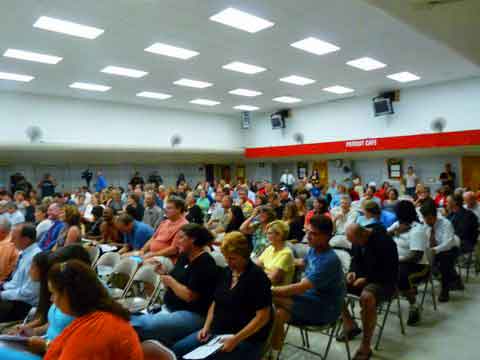
Printer-friendly version 3 BOARD MEMBERS APOLOGIZE, BUT TAPED SPEECH STILL NOT SHOWN TO MANY STUDENTS “If you were students in my class, you would not pass.”—Maureen Paolini, teacher and graduate of the LMSV district “My father marched with Dr. King…I do not appreciate that you told my child that the President, because he had a black face, was not as important to listen to as all the other presidents that came before.” – Sheryl Mullins, teacher and parent by Gayle Early La Mesa (September 17, 2009)—La Mesa-Spring Valley (LMSV) School District Board members endured over two hours of scathing public criticism Tuesday night, including frequent chants from the crowd urging three Board members to resign. After what amounted to public shaming before several hundred riled parents, teachers, students, and community members, three Board members issued a formal apology to students and families for their majority decision to delay airing President Barack Obama’s national back-to-school address on September 8. Yet even a taped version of the speech has still not been shown to many students in the district. Tuesday’s Board meeting was moved from the district office to Parkway Middle School auditorium due to heavy turnout–far larger than the average five to 10 people attending LMSV board sessions. But for many in the crowd, “sorry” wasn’t enough. Several speakers called for immediate resignations or threatened recalls, triggering reactions from Board members ranging from scowls to tears. “To convene on Labor Day and take a special vote is reprehensible. To determine 12,800 students could not hear the President of the United States live, talk to them, is a disgrace,” said parent Fred Neubecker. “I myself do not agree with President Obama’s political decisions. But I am an American and so are my children. As President of the United States, he deserved due respect…. There must be accountability for your actions. Your tears of apology are a waste of time….It was your responsibility to have thought of the outcome before you voted. I respectfully request your resignations.” Many others agreed. “As an educator I’ve had to explain to many, many colleagues what happened regarding this issue. I have to say, it’s been humiliating,” Rob Coppo said. “It’s a lesson on disrespect, on censorship, and on partisan politics. I frankly am sick of it,” said Anne Isaaks, a LMSV parent. “You’re a disgrace to our district, San Diego, and our country,” said parent Lori Scribner. “Has this country lost its mind?” asked Jay Steiger, a parent and PTA volunteer and officer. A Lone Voice Speaks on Board’s Behalf Only one person in the audience spoke in favor of the board’s decision. Lyle Arvidson, a retired maintenance worker from LMSV school district and Vietnam veteran, said, “President Obama changed the speech topics from what the public had been informed it would be by the media….The Board had to make this call before the speech. I support their decision on this.” A few cheered and applauded his comment, but no one else testified at either this meeting or last week’s in support of the board’s position. Several board supporters with flag-adorned chairs left after Arvidson spoke. The board previously said it received more e-mails in opposition than support prior to its Labor Day vote. Kids Speak Out Some of the most moving statements among three dozen speakers came from the youngest members of the audience, Parkway middle school sixth grader Sophia Bacting and Fletcher Hills elementary student Paolo Paolini. Bacting missed soccer practice to come speak to the board. “I would ask you, ‘do you like your news taped? And shown weeks after it happens?” she told board members. “President Obama wants to speak to the children, not the adults…This was a once-in-a-lifetime chance to hear the President speak directly to me, and I missed it. How often in life do you get a chance to be a part of history? I was deprived of my right to choose.” She added, “Many kids at Parkway do not have computers. They will not be seeing the President’s speech. Because here at Parkway, it will not be shown. It is now old news. The opportunity to impact troubled kids with a positive message has been lost. What a shame,” the student observed. “How many kids would feel great about themselves and the difference they could make in this world, if they would have seen our President speak to them?… In this instance, what we have learned is to fear our President. He must have something very bad to say if our school will not show his speech live. That sends out a bad message to all kids. We should respect our President. He’s the one that leads us all.” Young Paolo Paolini stepped up to the podium and said, “I’m here because I am very disappointed in you. You let the bullies win—a few mean people who didn’t like the President. And you let them bully you…. I hope it wasn’t because he was black, because that would be very depressing.” Both kids got standing ovations. Teachers, Parents, and Administrators Air Views A fifth-grade teacher from Fletcher Hills Elementary, Denis Blevins, who has taught for 21 years, testified, “I had to look into the eyes of my students on Tuesday morning, September 8, and for the first time, not be able to answer a question they had. And for the past15 years I’ve been teaching Family Life.” Blevins challenged the board to apologize to students and teaching staff directly. He quoted from the President’s speech: “‘We need every single one of you to develop your talents, skills, and intellect so you can help solve our most difficult problems. If you don’t do that, if you quit on school, you’re not just quitting on yourself, you’re quitting on your country.’ Holding the speech up to the light, Blevins added, “Maybe if I tilt my head to the right and squint my eyes a little bit I can see the insidious message there.” The LMSV school board’s vote
PICKIN’ & STRUMMIN’ AT THE JULIAN BLUEGRASS FESTIVAL SEPT. 19-20
Printer-friendly versionJulian (September 18, 2009 ) — A decades old Julian tradition returns when the gates open on September 19th and 20th to the 39th annual Julian Bluegrass Festival. Sponsored and presented by the Julian Lions Club at Frank Lane Park, the annual event is the oldest bluegrass festival in California and this year’s edition boasts one of its strongest line-ups. On Saturday pickin’ and strummin’ will be provided by Trails & Rails, Judy Taylor & the Wild Oats Band, Heloise Love, the Bayside Dixie Stompers, and Sara Petite & the Tiger Mountain Boys. Sunday kicks off with gospel music from This Just In!, followed by bluegrass from the Scott Gates Band, the Blue Creek Band and Chandler Station. The Festival runs from 9 a.m. to 6 p.m. on Saturday and 9 a.m. to 5 p.m. on Sunday with tickets available on the event days at Frank Lane Park, the Julian Chamber of Commerce until September 12th and on-line at Julianbluegrassfestival.com. Adult tickets are $15 with children under 16 admitted free when accompanied by a paid adult. The festival coordinator is Terry Cox, (760) 705-0953. Further information is available at info@julianbluegrassfestival.com Printer-friendly version