
VIGIL COMMEMORATES ASSAULT ON GAY ACTIVIST IN LEMON GROVE, COMMUNITY LEADERS CALL FOR TOLERANCE
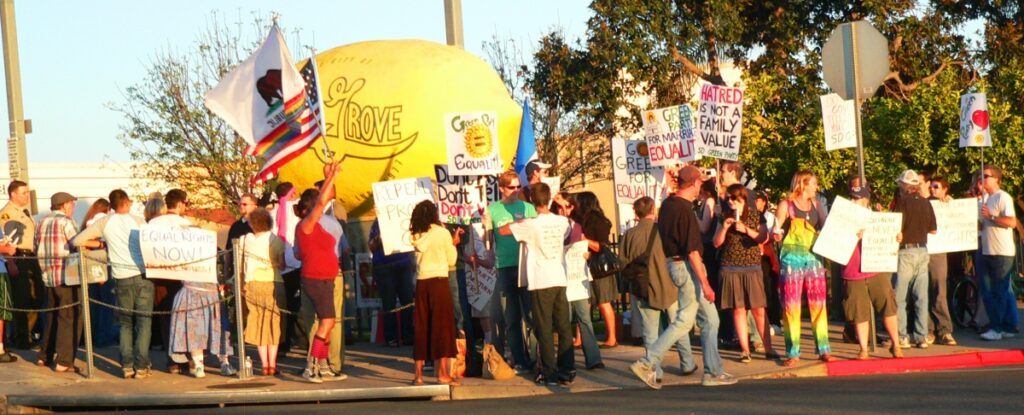
Printer-friendly version By Miriam Raftery June 28, 2009 (Lemon Grove) – Gay rights supporters from throughout San Diego County held a candlelight vigil Friday in Lemon Grove, denouncing the assault on San Diego Pride director Ron DeHarte during a gay rights rally in Lemon Grove earlier this month (http://www.eastcountymagazine.org/?q=node/1370). Leaders also cited a savage assault in San Diego that left a gay woman with facial fractures as evidence that new laws are needed to allow prosecution for hate crimes targeting gay and lesbian people. Soured by the Lemon Grove attack, leaders strived to create lemonade–calling for tolerance, not hate, in the community. “What happened here really could happen anywhere,” said Lemon Grove Councilman George Gastil (photo), noting that this city is among the most diverse communities in San Diego County. “I can tell you that there are some people who wanted to be here today, but they are afraid," said Gastil, a former school board member and long-time Lemon Grove resident along with his wife and children." We need to reach out to people, including people in churches that are more conservative. It’s the uncomfortable conversations that will make a difference.” Chris Ward, chief of staff for Assemblyman Marty Block, read a statement from the Assemblyman in which he quoted slain gay rights leader Harvey Milk, adding, “The incident that sparked this vigil here is a symbol that there is much more to be done.” Steve Whitburn, who ran for San Diego City Council last election, cited rising violence and hate crimes in recent weeks. He read a statement written by Rhythm Turner, a musician who grew up in Spring Valley and La Mesa. After hugging her same-sex partner outside Canes Bar in Mission Beach in May, she was allegedly confronted by a man who made slurs against her sexuality, then attacked her. She suffered facial fractures and has stated that she is now suffering from emotional and psychological trauma. Although he was arrested and charged with battery, he could not be charged with a hate crime under current law. “My courage was compromised,” she said in the statement read by Whitburn. “I believe all people should have the right to love openly without hate or fear of persecution.” To those who joined in the vigil, including many people who are not gay, Turner’s letter added, “I thank you from the bottom of my heart.” Chris Pearson, a labor leader and East regional vice chair of the San Diego Democratic Party, called Proposition 8 a “mistake” for banning gay marriages. “When you deny gay rights, you deny family rights,” he said. “When you deny gay rights, you deny community rights, because every community has gay people.” He read a statement from DeHart, the Lemon Grove assault victim. “The assault on me was an attack on the whole community,” DeHart said. “I was attacked because I was flying the rainbow flag.” The rally began at the lemon statue in downtown, where demonstrators chanted, “Gay, straight, black, white, marriage is an equal right.” Afterwards, participants marched to a park nearby where the speakers addressed dozens of activists gathered. A candlelight vigil followed. A lone counter-protester confronted the gay rights activists at the lemon. “I don’t choose to be black. That’s not the same,” she insisted. Councilman Gastil called the event “a great cause” and concluded, “I think this should be an annual event. Every June we could have a gathering for equality at the lemon.” Printer-friendly version
BILL TO CLEAN UP TOXIC WASTES, AIR & WATER POLLUTION & PROTECT NATURAL RESOURCES PASSES HOUSE; LOCAL REPRESENTATIVES SPLIT VOTES
Printer-friendly versionBy Miriam Raftery June 27, 2009 (Washington D.C.)–H.R. 2996, landmark legislation that aims to protect air, clean up waterways and restore our public lands, has passed the House of Representatives by a 254-173 vote. Among San Diego’s Congressional representatives, Bob Filner and Susan Davis voted in favor of the measure, while Brian Bilbray, Duncan Hunter and Darrell Issa voted against it. The Department of the Interior, Environment, and Related Agencies Appropriations Act emphasizes reducing pollution in air and water, cleaning up dangerous toxic waste sites, boosting production of renewable fuels and encouraging energy efficiency. The bill also eliminates six programs and cuts funding for another 37 in an effort to maintain fiscal responsibility. “This nation’s legacy lies in its magnificent natural resources,” said Rep. Filner (D-Chula Vista). “With this bill, we can make real progress to clean up our water sources, spur the use and production of clean, efficient energy and help restore the splendor of our lakes, forests and parks.” The bill provides aid to over 1,500 communities to improve their drinking water and wastewater systems. It also provides funding to clean up toxic waste sites and gives the Environmental Protection Agency (EPA) tools to study the impact of toxins and pollution on children. “Our environment has a direct impact on the health and safety of our kids and our families,” said Filner. “By passing this legislation, we can make sure our kids are drinking clean water and breathing clean air. There is no higher priority than protecting their health.” To support national security objectives and economic recovery efforts, the legislation also reduces reliance on foreign oil and cuts the pollution caused by greenhouse gas emissions by encouraging consumer energy efficiency and the production of clean, renewable American energy. To help Americans save money and make wise environmental decisions, the bill allocates $50 million for the EPA’s successful Energy Star Program – which already saves consumers $14 billion a year in energy costs. The bill also dedicates funds towards the development of renewable clean energy sources on Federal lands and water. “With this bill, we are making great strides towards meeting our goal of producing 36 billion gallons of renewable fuels by 2022 and boosting research in new renewable energy sources,” said Rep. Filner. “The future of our country and our planet depends on the investments we make today, and I am proud to say that with the passage of this legislation and the Clean Energy Act, we can all look forward to a brighter future.” The bill includes a $4.7 billion increase over the prior year, a 17% hike, but is projected to return $14.5 billion in revenues to the federal treasurer. Rep.Michael Simpson (R-Idaho) said he was “pleased by the needed attention this legislation provides our Native American brothers and sisters. There are many unmet needs within Indian country–in education, health care, law enforcement, drug abuse prevention, and other areas–and this bill does a great deal to address these issues.” Simpson objected to increased spending in some areas within the bill. But on one key area, the Republican minority argued that Congress did not allocate enough funding. “Based upon recent fire patterns and the monumental increase in demand for fire suppression dollars, I feel strongly that the wildfire contingency reserve fund should be funded at the President’s request level of $357 million,” Simpson testified. Republicans offered an amendment which increased the fire contingency reserve fund from $250 million to $357 million. The amendment was accepted, however most Republicans voted against the measure in the end. With the exception of Filner, San Diego’s other Congressional representatives did not issue statements or explanations for their votes on this measure. Printer-friendly version
REGISTER TO VOTE
Printer-friendly versionJune 27, 2009 (San Diego’s East County) – Voter registration will be held at several La Mesa locations this summer. If you’ve moved, never registered, been dropped off the Registrar’s rolls for failing to vote in several elections, or wish to change your political party, visit any of the following voter registration drives: Saturday, June 27th: Noon to 4:00pm Grossmont Shopping Centre’s Green Booth Sunday, June 28th: 6:00 to 7:00 pm Sundays at Six: Harry Griffen Park Saturday, July 11th: Noon to 4:00 pm Grossmont Shopping Centre’s Green Both Sunday, July 12th: 6:00 to 7:00 pm Sundays at Six: Harry Griffen Park Saturday, July 18th: Noon to 4:00 pm Grossmont Shopping Centre’s Green Booth Sunday, July 19th: 6:00 to 7:00 pm Sundays at Six: Harry Griffen Park Sunday, July 26th: 6:00 pm to 7:00 pm Sundays at Six: Harry Griffen Park Printer-friendly version
LEAVE FIREWORKS TO EXPERTS, BURN INSTITUE WARNS
Printer-friendly versionAll fireworks illegal in County, from sparklers to bottle rockets July 1, 2009 (San Diego) — The Fourth of July is almost upon us – a time for family picnics and fireworks displays. Yet all too often, the public fails to consider the harsh consequences when amateurs play with fireworks. In the wrong hands, fireworks can lead to property damage, personal injury – even death. “In San Diego County, fireworks are not only dangerous but also illegal,” said James Floros, Burn Institute Executive Director/Chief Executive Officer. Floros points to the thousands, nationwide, who are injured each year from fireworks — particularly children. Nationwide, 9,600 people were treated in emergency rooms for fireworks-related injuries in 2006–and eleven people died, according to the Centers for Disease Control and Prevention. One out of every three injured were children younger than 15 years, with three times as many males as females injured. Those directly participating in fireworks-related activities were “more frequently and severely injured than bystanders.” ALL fireworks in San Diego County are illegal. No exceptions! This includes everything from poppers and sparklers to firecrackers and bottle rockets. If you are caught with fireworks, you can be fined; if you’re an adult providing fireworks to minors, the penalty can be much more severe. Bottle rockets may seem harmless, but did you know that they generate enough heat to set a roof on fire? One bottle rocket can set off a devastating fire that can potentially destroy homes, perhaps entire neighborhoods – at the worst, take a life. Sparklers, though festive, are responsible for most injuries to children younger than 10 years of age and account for one-third of the injuries to those five years and younger. Children, often fascinated by the bright sparks, may grab the hot end of the sparkler where the temperature can reach 1,800 degrees. It only takes a moment for a sparkler to ignite a child’s clothing causing a devastating burn injury – possibly death. Public fireworks displays conducted by trained professionals are the smartest and safest way to enjoy fireworks because they are conducted in a controlled setting according to established regulations. As a public service to the community, the Burn Institute has compiled a list of licensed fireworks shows throughout San Diego County. The list is also published online at www.burninstitute.org and at East County Magazine: http://www.eastcountymagazine.org/?q=node/1556. Printer-friendly version
APPLES ON PARADE IN JULIAN JULY FOURTH
Printer-friendly versionJune 8, 2009 (Julian)–The Julian Fourth of July parade joins the town’s Apple Centennial Celebration when it steps out on Main Street this year. The parade, an annual event for more than 15 years and dubbed by many as the "best little town parade in America," has adopted As American as Apple Pie as its theme. It celebrates the 100-year anniversary of the first Apple Day, a fall festival which was held in Julian in 1909 to celebrate all the awards Julian apples had won in previous years including the celebrated Wilder Medal for the best apples produced in an international competition. Visitors will see apples and apple-themed entries everywhere during the event, starting with the Grand Marshal, Ray Meyer, a long-time apple grower and operator of one of Julian’s most popular fruit stands in fall. Two of the many beautiful women selected to serve as Apple Day Queens during the fall celebrations, who still reside in the area, will also ride down Main Street. The parade typically draws 10,000 visitors who enjoy the hometown nature of the parade. You’ll be standing side by side with local residents who wave to friends and neighbors astride horses, driving antique cars, members of the Tribal Mountain Gypsies belly-dancing the whole way. You can cheer the newly crowned Miss Julian and her court. There are drill teams, military units, animals of all descriptions, plus flags, bunting and marching bands. This year as always, the parade steps out from the parking lot at Julian High School promptly at noon on Friday, July 4. But the pre-parade, festivities highlighted by a screaming flyover by vintage airplanes, begin at 10. Plan to get there early not only for the flyover, but also for the patriotic speeches and town sing-along. Everyone gets a tiny flag to wave. The parade is the centerpiece of a collection of activities that celebrate Julian’s unique heritage. Foremost is a weeklong quilt show in Town Hall presented by the Julian Woman’s Club; it displays antique and new quilts primarily from Julian family collections. The town’s American Legion always holds a barbecue following the parade, which features entertainment, music and open shops throughout the event. How to Enter the Parade The Julian Fourth of July Committee is still accepting entries to march down Main Street. "We’re looking for entries from Julian residents that honor our theme, are patriotic, or will make people laugh," says Mike Menghini, chair of the parade committee. In addition to the traditional categories, Theme, Best Musical Entry, Best Motorized Entry, we’ve add a category for the Best Humorous Entry. Applications are available at the Julian Chamber of Commerce. Deadline to submit them is June 15. For more information contact Julian Chamber of Commerce, telephone (760)765-1857 or visit http://www.julianca.com. Printer-friendly version
COUNTY BOARD OF SUPERVISORS TAKES THE HIGH ROAD ON MEDICAL MARIJUANA ISSUES
Printer-friendly versionBy Kyle Serzen June 26, 2009 (San Diego)–The San Diego County Board of Supervisors lit up some controversy during its meeting on Tuesday, which included two medical marijuana issues. The first was a resolution passed unanimously 5-0 to allow patients to apply for a medical marijuana ID card beginning July 6th. The Board also passed a measure asking County Counsel to draft language prohibiting marijuana dispensaries in the County’s unincorporated areas, by a vote of 4-1. In emotionally charged testimony, proponents of medical marijuana testified that it relieves conditions including glaucoma, chronic pain, and nausea from chemotherapy. Some criticized the County for raids and arrests of medical marijuana patients. Others opposed making medical marijuana more easily available, disputing the benefits and expressing concern over decriminalization of the drug. Medical marijuana users will have to pay an annual fee of $166 for the cards. Of that fee, $66 goes to the State, and the remaining $100 is the County’s estimate to compensate for costs of the cards. The County may take up to 30 days to issue the card so that they will have time to verify legitimacy of the prescription and ensure that the prescribing doctor is in good standing with the Medical Board of California. Supervisor Dianne Jacob noted that the resolution creates “a gray area . . . as these cards may provide a false sense of security. Users can still be prosecuted under federal law.” Some medical marijuana patients, while supportive of ID cards, objected to the program being run by the County and suggested privatization. “The issue that I have here is my privacy,” testified Rudy Reyes (photo), a burn victim of the Cedar Fire who instigated litigation to force the County to comply with state laws allowing use of medical marijuana. He referred to the Health Insurance Portability and Accountability Act of 1996 (HIPAA), which protects the privacy of individually identifiable health information. “I have the right to keep my records privatized—not in any governmental hands. We have asked you as the patients of San Diego to find a designee for this program, not the Health Services Department that has held the same prejudices as the County Board of Supervisors.” Others objected to costs of the cards. Wendy Christakes testified she is living on $800 a month and struggling to get by. “People on low income should have fees waived,” she said, adding that she is also concerned about the County transferring information on medical marijuana users to the Department of Motor Vehicles. Jim Redman, executive director of Californians for Drug Free, criticized “permissive drug laws” and opposed medical marijuana cards being issued. He said guidelines issued by Attorney General Jerry Brown have narrow guidelines and some cities and counties are allowing much larger quantities to be possessed by medical marijuana patients than what state law provides. He argued that state law “should not establish a green light for cannabis sales.” The prohibition on medical marijuana dispensaries in the unincorporated areas is targeted only towards for-profit dispensaries, said County Counsel John Sansone. “Cooperatives and collectives are allowed within state law,” he added. “We’ve taken the first step (with the medical marijuana cards). The second step is zoning changes to allow legal access, but to prevent illegal activity in the unincorporated areas,” said Supervisor Pam Slater-Price. Her concerns stem from the high levels of methamphetamine use, drug smuggling, and drug sales that occur in unincorporated areas. But some area residents testified that they fear a continuation in County law enforcement activities which have targeted medical marijuana users and dispensaries. “Every single attempt to operate a cooperative in SD has resulted in an environment of fear,” said Eugene Davidovich. “The DEA has made it clear – SD is not a safe place for cooperatives, and patients are rounded up and arrested.” One patient committed suicide after being arrested, he added. “I beg you to put forth regulations so people know what is legal or not,” Donna Lambert told the Supervisors. Lambert said she has seen “people in wheelchairs, people with canes, growing eight plants that they thought was legal” arrested and that in some cases, “County authorities have “kicked in their door and shoved people to the ground.” Chrissakes provided emotional testimony asking for guidelines for patients and dispensaries. “What am I to do, because I can’t grow cannabis if I’m a mother and CPS will take my children and call me an unfit mother,” she asked, adding, “I’m a conservative person but I refuse to take oxycontin …I could not take care of my children.” Supervisor Ron Roberts, who cast the sole vote against the measure, said that “laws should be clear and easy to follow, but the law being put forward . . . doesn’t do these things and I’m very disappointed.” He pointed out that zoning codes lack provisions for other illegal activities such as illegal gambling, which is illegal regardless of where it takes place. “We need to accept that (Proposition) 215 is the law,” he added. Many speakers present at the hearing claimed that this doesn’t accomplish anything that isn’t already dictated by state law. “Something that’s illegal is illegal” was the refrain of opponents to the measure. However, Sansone noted that this measure will be “an added tool for dealing with illegal dispensaries” because it “adds a civil tool for injunction when criminal laws are not working.” Printer-friendly version